To perform tayammum, you set your intention (niyyah) for purification, say Bismillah, lightly touch a clean, earthy surface with your palms, and then wipe over your face and hands. It's a profound mercy from Allah (SWT) that ensures you can maintain your prayers even when water isn't an option.
A Gentle Guide to Tayammum for Busy Parents

Life with a baby or toddler is a beautiful whirlwind. Between feeding schedules, nappy changes, and those precious sleepy cuddles, finding a quiet moment for yourself—let alone for wudu—can feel almost impossible.
Imagine this: Maghrib is approaching, you've just managed to get your toddler to sleep in your arms, and you're nowhere near a wudu facility. Or maybe you're recovering from childbirth and have been advised to keep a wound dry.
These are the real-life moments where tayammum, or dry ablution, reveals itself as an incredible blessing. It's a practical, gentle alternative to wudu, designed by Allah for situations just like these. Tayammum ensures the comforting rhythm of prayer remains a constant in your day, without adding to your stress.
Making Your Deen Easy and Accessible
The entire concept of tayammum is rooted in ease and compassion. It’s a powerful reminder that our faith is designed to fit our lives, not the other way around. Instead of feeling a pang of guilt over a prayer you might miss due to your circumstances, Islam provides a simple, pure alternative.
This guide will walk you through how to perform tayammum with confidence. We'll cover:
* What tayammum is and why it’s such a mercy for parents.
* When it's permissible in common parenting scenarios.
* How it can be a lifesaver during travel, illness, or postpartum recovery.
For Muslim parents, weaving spiritual routines into the beautiful chaos of raising little ones is a top priority. Tayammum is one of the many tools in Islam that supports this balance, allowing you to connect with Allah peacefully, even on the most hectic days.
Ultimately, learning about tayammum is about embracing the flexibility built into our deen. It’s a beautiful reminder that Allah understands your journey as a parent. For more gentle and practical advice, you might find our guide on Muslim parenting tips for babies helpful for integrating faith into your daily family life.
Knowing When Tayammum Is the Right Choice
Figuring out when you can perform tayammum is just as crucial as knowing how to do it. Think of it as a beautiful mercy from Allah, tailor-made for the real-life messes and stresses parents face every single day. It ensures you never have to choose between your duties as a parent and your salah.
This incredible alternative to wudu isn't just for dramatic scenarios like being lost in a desert. It’s for the everyday moments of parenthood where getting to water is genuinely a struggle.
When Water Is Genuinely Unavailable
The most obvious reason for tayammum is a complete lack of water. But this doesn't mean you have to be stranded in the middle of nowhere. Let's look at some real-life parenting situations:
- The Long Road Trip: You're on the motorway, Asr time is ticking away, and the next service station is miles off—or the one you find has facilities you'd rather not use. Pulling over safely to use clean earth or a stone is a perfect use of this provision.
- A Day at the Park: You've packed snacks, wipes, nappies, and a change of clothes, but you totally forgot to check if the park has a working restroom. The taps are broken, and the only water you have is the bottled water for your thirsty toddler. Tayammum is your go-to.
- Unexpected Home Issues: Sometimes, things are just out of your hands. A burst pipe or a city-wide water outage right before Fajr are completely valid reasons to turn to this merciful alternative.
In these moments, if you've made a reasonable effort to find water and come up empty, tayammum is your answer.
When Using Water Could Cause Harm
Another critical time for tayammum is when using water could actually make an illness worse or cause harm. This is especially relevant for parents, who are constantly juggling their family's health needs.
Think about recovering from childbirth, especially after a C-section or if you have stitches that need to stay dry to heal properly. Or maybe you're dealing with a severe skin condition like eczema that gets painfully inflamed with frequent washing.
The principle here is beautifully simple: your well-being matters. Islam does not demand that you harm yourself to perform a ritual. If a doctor has advised you to keep an area dry, or if you know from past experience that water will aggravate your condition, tayammum is the correct and responsible choice.
This isn't a modern invention; the precedent is deeply rooted in our tradition. The wisdom behind a waterless purification method has been a safeguard for over 1,400 years. For instance, the Prophet (PBUH) permitted it for a companion who was ill. Fast-forward to recent history, and during the COVID-19 pandemic, public health concerns about shared facilities suddenly made this ancient practice incredibly relevant, preserving both physical health and spiritual duties.
Unique Situations for Parents of Little Ones
Life with babies and toddlers throws its own unique curveballs that can make wudu a logistical nightmare, even when a tap is just a few feet away. These situations call for our sound judgment, always keeping the core Islamic principle of ease (yusr) in mind.
Imagine this: you've just spent an hour rocking, shushing, and feeding your fussy newborn, who has finally, finally, fallen asleep on your chest. You know that getting up to make wudu will instantly wake them, undoing all that hard work. Or perhaps your toddler has a high fever and is clinging to you, and you simply can't leave them alone, even for two minutes.
These aren't "excuses"—they are valid, challenging parenting realities. In scenarios where moving would cause significant disruption or distress to your child, many scholars permit tayammum. It’s a profound recognition of the demanding role of a caregiver. This compassionate approach is a cornerstone of Islamic parenting for toddlers, where faith practices are meant to fit into your life with mercy, not rigidity.
To make things clearer, here’s a quick table to help you assess your situation.
Common Scenarios for Tayammum vs Wudu
This quick-glance table can help you decide if tayammum is the right choice in your specific situation.
| Situation | Can I Perform Tayammum? | Key Consideration |
|---|---|---|
| Traveling on a long car journey with no clean rest stops | Yes | Water is practically unavailable or its use is unhygienic and difficult. |
| Recovering from C-section surgery | Yes | A doctor has advised keeping the incision dry to prevent infection. |
| Toddler is very sick and cannot be left unattended | Yes | Leaving the child would cause them significant distress or pose a risk. |
| Water is available but extremely cold, risking illness | Yes | There's no way to heat the water and using it could make you or your baby sick. |
| Public wudu area is crowded and overstimulating for child | Use judgment | If it causes extreme distress to your child, making wudu practically impossible, tayammum is an option. |
Ultimately, making the right choice comes down to your intention and a sincere assessment of your circumstances. Tayammum is here to lift a burden, not add a new one, empowering you to stay connected with Allah through the beautiful, chaotic, and blessed journey of parenthood.
How to Perform Tayammum Correctly
Now that you know when tayammum is the right choice, let’s get into the practical side of things: how to actually do it. The process is beautifully simple and designed for ease. You can complete it in less than a minute, which is perfect for those fleeting quiet moments you get as a busy parent.
This isn't about following a rigid, complicated formula. It’s about your sincere intention to prepare for prayer. The entire act is a testament to the mercy in our deen, ensuring that no matter where you are—stuck in traffic, in a hospital room, or at home with a sleeping baby on your chest—your connection with Allah remains unbroken.
Finding Your Clean Surface
First things first: what does "clean earth" (sa'id tayyib) actually mean in a modern home? Don't worry, you don't need a sandbox in your living room. The core principle is to use a natural, pure surface that originates from the earth.
This opens up a surprising number of possibilities right where you are:
- A smooth, unpolished stone you might keep just for this purpose.
- A marble or granite countertop, as long as it's not sealed with a synthetic glaze.
- An unpainted brick or stone wall.
- A clean, dusty surface on a bookshelf or windowsill. A light layer of dust is perfectly fine.
- A ceramic or terracotta plant pot.
The key is that the surface is pure and from the earth. You don't need to see visible soil or a cloud of dust; the simple act of touching a qualifying surface is what counts.
This visual guide breaks down when the decision to perform tayammum is most appropriate, focusing on illness, lack of water, or the risk of harm.
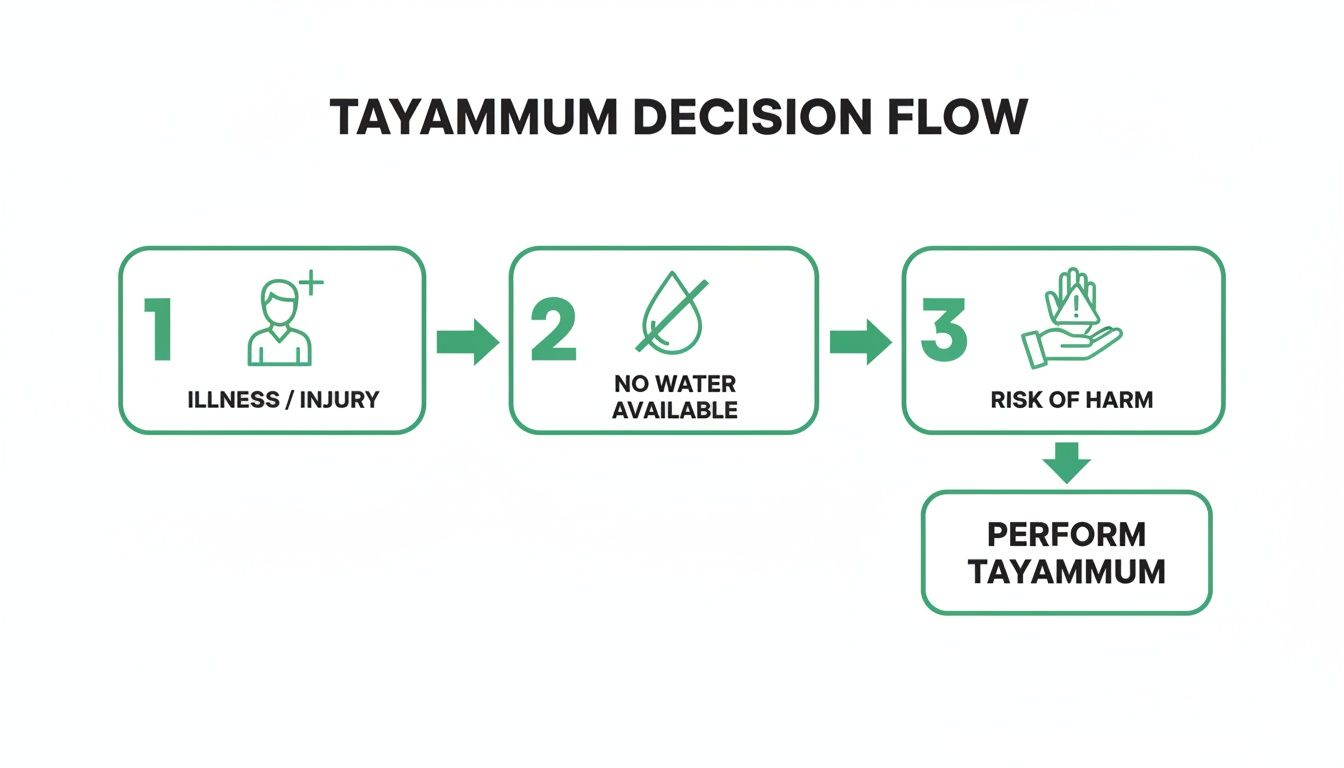
As the flowchart shows, these three conditions are the main reasons we're given this merciful alternative for purification before prayer.
The Heart of the Matter: The Niyyah
Like every act of worship in Islam, tayammum starts with your intention, or Niyyah. This is a silent, internal commitment you make in your heart. You don't need to say a single word out loud.
Just take a moment to focus your mind and silently intend that you are performing tayammum to purify yourself for prayer. This quiet intention is what elevates a simple physical act into a profound act of worship.
Remember, your Niyyah is a private conversation between you and Allah. It’s about clarifying your purpose: "I am doing this to make myself pure to stand before You in prayer."
The Four Simple Actions
Once your intention is set, the physical steps are incredibly quick and straightforward. Here’s how it works.
Begin with 'Bismillah': Start by saying "Bismillah" (In the name of Allah). This beautiful phrase sanctifies the act and immediately brings a sense of mindfulness.
The First Strike and Wiping the Face: Gently place the palms of both hands on your chosen clean surface. A light touch is all you need—no need to press hard. After lifting your hands, you can lightly tap them together or blow on them to shake off any excess dust. Then, use both palms to wipe your entire face once, from your hairline down to your chin and from ear to ear, making sure to cover the whole area.
The Second Strike and Wiping the Arms: Place your palms on the clean surface again, just like before. This time, you'll wipe your arms. Use the palm of your left hand to wipe your right arm, starting at the fingertips and moving all the way up to and including the elbow. Then, switch hands. Use the palm of your right hand to do the same for your left arm, from the fingertips up to the elbow. A good tip is to interlace your fingers as you wipe to ensure the spaces between them are also covered.
And that’s it! You're now in a state of purity and ready for Salah. The whole process feels incredibly natural and easy once you’ve done it a few times.
Teaching this beautiful ritual can also be a wonderful bonding moment with your kids. For families trying to simplify faith concepts, you can model the steps: set your Niyyah, say Bismillah, strike your palms on a clean stone (a dust volume of about 5-10g is sufficient according to Hanafi fiqh), wipe your face, then wipe your arms. This completely water-free ritual builds resilience and is perfect for diaspora parents—whether you're in the arid U.S. Southwest where 15% of the land is dry and 3.5 million Muslims live, or in an urban apartment without a dedicated wudu space. It fosters early prayer habits without any fuss. You can discover more insights about how faith practices adapt to modern life.
The beauty of tayammum truly lies in its simplicity. It removes barriers, ensuring that the call to prayer can always be answered, no matter what challenges your day throws at you. It’s a powerful reminder that Allah’s mercy is vast and ever-present, especially in the life of a busy parent.
A Look at Different Scholarly Views
As you learn how to perform tayammum, don't be surprised if you see a friend, an in-law, or someone at the local masjid doing it a little differently than you were taught. This is perfectly normal! In fact, it's a beautiful reflection of the diversity within our global ummah.
These slight variations come from the different interpretations held by the major schools of Islamic thought, known as madhahib. They're not a source of confusion but a mercy, showing the incredible depth of scholarly work that has gone into understanding our deen. Knowing about them helps us appreciate our rich tradition and feel confident in the way we were taught.
The goal here is to feel secure in your own practice while respecting that others have valid approaches, too.
How Many Times Should You Strike the Earth?
One of the first differences you might notice is whether you should strike the clean earth once or twice. Both ways are based on strong evidence and valid scholarly reasoning. It really just comes down to following the school of thought you're most comfortable with.
- Striking Once: The Shafi'i and Hanbali schools generally hold that one strike is enough to wipe both your face and hands. This view is based on narrations where the Prophet (peace be upon him) demonstrated the act with a single touch to the earth.
- Striking Twice: The Hanafi and Maliki schools, on the other hand, typically teach that you need two separate strikes. You'd perform one before wiping your face, and then a second one before wiping your arms. This is also derived from different, equally valid, narrations and scholarly analysis.
This small difference doesn’t change the core purpose of tayammum at all. It’s simply a variation in the details, and both are accepted and correct ways to perform this important purification.
How Far Up the Arms Should You Wipe?
Another common point of variation is how far up the arms you need to wipe. Is it just to the wrists, or all the way up to the elbows? Once again, the answer depends on the scholarly interpretation you follow.
Everyone agrees that wiping the face is an essential part of tayammum. But when it to comes to the arms, you'll see some differences. By 2025, an estimated 2.2 billion Muslims will navigate these practices. Hanafis and Malikis—who represent about 60% of Muslims—mandate a wipe up to and including the elbows.
Meanwhile, Shafi'is and Hanbalis, who make up a significant portion of the remaining believers, often consider wiping just to the wrists as sufficient. This dry ablution was a source of incredible morale for the early Muslims, like the 70 Muhajirun who journeyed from Makkah to Madinah in 622 CE without reliable water, yet maintained their ritual purity. It's a powerful reminder of how Islamic practices provide resilience in challenging circumstances.
Here’s a simple table to help you see the differences at a glance.
A Gentle Look at Tayammum in Different Madhahib
It's helpful to see these small differences side-by-side. Remember, these are all valid and accepted methods taught by brilliant scholars.
| Action | Hanafi & Maliki View | Shafi'i & Hanbali View |
|---|---|---|
| Striking the Earth | Two separate strikes are typically performed. | One strike is generally considered sufficient. |
| Wiping the Arms | The wipe includes the entire arm up to and including the elbows. | The wipe is usually performed up to the wrists. |
Ultimately, this diversity is a reflection of the intellectual breadth within Islam. It’s a reminder that our faith is accommodating and has room for different, well-reasoned perspectives.
The most important thing to remember is that all of these methods are valid. Following the guidance of the school of thought your family adheres to is perfectly correct. There's no need to feel uncertain if you see someone else doing it differently.
As a parent, you can confidently teach your children the method you know best. At the same time, you can instill in them a beautiful respect for the different ways Muslims all around the world connect with Allah.
Teaching Tayammum to Your Toddler Through Play
So, how do you explain the beautiful ritual of tayammum to a curious two-year-old? The answer is simple: you don't. You play!
For our little ones, faith isn't learned through lectures. It's absorbed through warm, gentle, and playful experiences. When we introduce tayammum this way, we're building a beautiful, positive association with worship long before they're ever required to perform it.
The goal here isn't about getting the steps technically perfect. It’s all about exposure, connection, and making the rituals of our deen feel like a natural part of your family’s loving rhythm. By turning the steps into a game, you are planting the very first seeds of love for salah in their tiny hearts.
Making It Fun and Memorable
Toddlers are sponges for sensory learning and repetition. That’s our cue to transform the actions of tayammum into a delightful little game that engages them physically and emotionally.
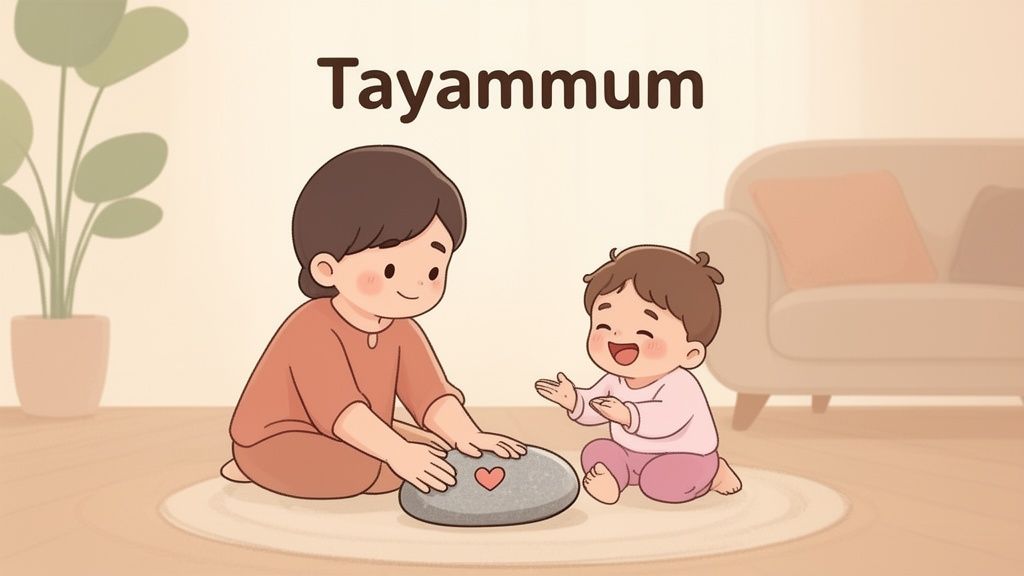
Start by finding a "special" tayammum stone. It could be a smooth, flat one you find together on a walk or even a clean, unglazed ceramic tile you keep just for this purpose. Giving it a name or a special spot makes it an exciting object.
When it's time to play, try saying, "Let's get our prayer hands ready!" and guide them through a simple rhyme:
- "Pat, pat the special stone," (Gently pat the stone together)
- "Wipe our face so clean," (Giggle as you gently wipe their face and yours)
- "Pat, pat the stone again," (Another gentle pat)
- "And wipe our arms all green!" (Using a silly word makes them laugh as you wipe their arms)
This lighthearted approach completely removes any pressure and connects the physical movements with joy and your loving attention.
Modeling Is the Best Teacher
More than any game, your own actions are your child’s most powerful lesson. Toddlers are masterful imitators. When they see you performing tayammum calmly and mindfully before your own prayers, they absorb its importance and peace without a single word.
Let them be near you. They might try to copy, patting the floor or the wall with their tiny hands. Welcome this with a warm smile. This is their way of connecting with you and what you hold dear.
Your toddler doesn't need to understand the fiqh of purification. They just need to see that this is something Mama or Baba does to talk to Allah, and that it's a peaceful, good thing. Your consistency is their curriculum.
This gentle modeling is a core principle in early faith development. For more ideas on weaving these practices into your daily life, you might find some inspiration in our guide on how to teach Islam to toddlers through everyday interactions.
Focus on Connection, Not Correction
This is the golden rule of teaching toddlers about faith: always prioritize connection over correction. If your little one pats the stone too hard, wipes their nose instead of their whole face, or runs off halfway through, that's perfectly okay.
The purpose at this age is purely to build a positive foundation. Every giggle while wiping your faces and every shared moment patting a stone together is a victory. You are weaving the love for prayer into the very fabric of their earliest, happiest memories.
A few tips to keep in mind:
* Keep it short and sweet. A toddler's attention span is a fleeting thing! A minute or two of "tayammum play" is more than enough.
* Follow their lead. If they're suddenly more interested in stacking blocks, let it go. You can always try again later when they are more receptive.
* Use praise and affection. A hug and a "Masha'Allah, what wonderful prayer hands!" will have a much greater impact than any correction ever could.
By using these playful, gentle techniques, you are doing something profound. You are showing your child that our deen is not a set of rigid rules, but a source of connection, warmth, and love—a lesson that will, insha'Allah, stay with them for a lifetime.
Common Questions About Tayammum (and Straightforward Answers)
It's one thing to read the steps, but it's another to apply them in the middle of a hectic day. Questions always pop up, especially when you're trying to weave this beautiful Islamic ritual into the beautiful chaos of family life.
Let's walk through some of the most common queries we hear from parents who are juggling prayer times with playtime, travel, and everything in between.
What if I'm Indoors and Can't Find Any Soil?
This is easily the most frequent question in our modern world. And the good news is, you don't need a pot of soil in your living room. Scholars clarify that tayammum can be done on any clean, natural surface from the earth (sa'id tayyib).
This opens up a surprising number of possibilities right inside your home:
* A marble or granite countertop.
* An unglazed ceramic or terracotta tile.
* A clean brick or stone wall.
* Even the fine layer of dust that has settled on a bookshelf.
The key isn't the visible amount of dust, but the material's origin. Your sincere intention, combined with the physical act of touching a qualifying surface, is what validates the purification. It’s a perfect example of how Islam is designed to be practical for our lives.
How Long Does One Tayammum Last?
Think of tayammum as a temporary key that unlocks the door to your prayer. Generally, a single tayammum is valid for one obligatory (fardh) prayer. You can also pray as many voluntary (nafl) prayers as you like with that same tayammum before the next fardh prayer time begins.
It’s nullified by the same things that break wudu—like using the bathroom or falling into a deep sleep. Crucially, it also becomes invalid the very moment you have access to water and can use it without hardship. Once water is available again, the concession of dry ablution ends, and wudu is required.
Can I Use Tayammum for Ghusl, Too?
Yes, absolutely. Tayammum is a complete substitute for both wudu (minor purification) and ghusl (major purification) when the valid reasons for it are met. This is a profound mercy, especially for new mothers during postpartum recovery or for anyone dealing with a prolonged illness.
If you're in a state requiring ghusl but can't use water for a legitimate reason, you perform tayammum with the specific intention (niyyah) of purifying yourself from major impurity. The physical steps are identical to performing tayammum for wudu; only the intention in your heart is different.
This provision is a powerful reminder that no one is ever cut off from their connection with Allah. It beautifully underscores a core principle of our faith: "Allah does not burden a soul beyond that it can bear" (Quran 2:286).
My Toddler Touched My Tayammum Stone. Can I Still Use It?
A classic real-life parenting question! The main condition for the surface is that it must be pure (tayyib). If your little one touched your tayammum stone or tile with clean hands, it’s perfectly fine to use. No problem at all.
However, if their hands were soiled with something impure (najasah), like a food spill or a leaky nappy, you’ll need to find another clean spot on the stone or just use a different pure surface. For peace of mind, a lot of parents find it helpful to keep a designated stone on a high shelf where it stays clean and ready when needed.
At Babymode, we get it. Raising little Muslims is about weaving faith into every loving, playful, and sometimes messy moment. Our platform is designed to support you with beautiful, halal screen time that nurtures your child's innate goodness (fitra).
Discover a world of ad-free nasheeds, Quranic stories, and lessons on good manners, all created to align with your family's values. Join the Babymode waitlist today and be the first to access a safer, more meaningful screen time experience for your child.