Bringing Islam into your toddler's world isn't about formal lessons or flashcards. It’s about weaving small, loving moments into your day. It’s about creating a warm, positive feeling—a natural connection to faith through simple, heartfelt interactions, like whispering a dua before they drift off to sleep or saying 'Bismillah' before they take their first bite of a snack.
Your Gentle Start to Nurturing a Toddler's Faith
It can feel like a huge responsibility to introduce your little one to their faith, but honestly, it all begins with love. The goal at this tender age isn't to explain complex ideas. It's about building a foundation of safety, comfort, and positive feelings around Islam. It’s about letting your child feel the warmth of your faith long before they can understand all the words.

Think of this journey as creating an atmosphere, not delivering a curriculum. Your home is their first madrasah—a place where faith is felt in your gentle touch, heard in the soft recitation of Qur'an, and seen when you stand for your daily prayers.
The most powerful tool you have is your own example. When your toddler sees you find peace in Salah or hears the calm in your voice when you say 'Alhamdulillah,' they are learning what Islam feels like.
Setting a Loving Foundation
Before you can teach, you have to connect. The real secret is making Islamic practices feel like a natural part of your family’s rhythm, not some separate, formal activity we have to do. This approach truly respects where they are developmentally, leaning into sensory and emotional experiences they can actually understand.
A few principles I always come back to for this age group:
* Keep it simple and pressure-free. A smile and a cheerful "Bismillah" before they eat is a perfect first step. That’s it.
* Focus on positive association. Link Islam with moments of joy, comfort, and love—like a special nasheed you sing during playtime or a big hug right after you finish your prayers.
* Use repetition and routine. Toddlers absolutely thrive on predictability. Consistently saying "Assalamu 'Alaikum" when you walk into a room helps these beautiful phrases become a natural part of their world.
Why This Gentle Approach Matters
The first few years are absolutely critical for shaping a child's language and core values. This is exactly why a gentle, immersive approach to teaching Islam is so effective for toddlers. It’s a unique window of opportunity to build a subconscious, positive connection to their deen that can truly last a lifetime.
Globally, the capacity for early childhood Islamic education is growing. Research shows that as educational attainment has risen in Muslim communities, so has the opportunity for more structured early learning. In the Middle East and North Africa, for instance, the share of Muslims with no formal schooling plummeted from 67% to just 26% between the oldest and youngest generations. This massive shift is paving the way for more thoughtful, age-appropriate resources for families everywhere. You can dive deeper into these Muslim educational trends and their findings on Pew Research Center.
Weaving Islam into Your Everyday Routines
Toddlers absolutely thrive on routine. Their world makes sense through small, repeated rituals—the same song at naptime, the same blue bowl for their cereal, the same way you splash in the tub. This deep-seated love for predictability makes your daily schedule the perfect, most natural place to introduce the rhythms of Islam.
It’s not about adding another "to-do" to your already full plate. Instead, it’s about infusing the things you already do with tiny, meaningful moments of faith.

When you consistently say "Bismillah" before a meal or "Alhamdulillah" after a sneeze, these words become part of the background music of their childhood. They learn that Islam isn't just for the masjid or for special occasions; it's woven right into the warm, comforting fabric of home. This approach makes faith feel like a hug: familiar, reassuring, and always there.
Morning Moments and Daily Transitions
The way you start and move through your day offers countless opportunities for gentle learning. Your toddler is a little sponge, watching and absorbing everything, turning your actions into their first understanding of the world.
Think about what happens when they first wake up. A cheerful "Assalamu 'Alaikum" and a big cuddle, followed by saying "Alhamdulillah for a new day!" as you open the curtains, instantly links waking up with gratitude to Allah. These aren't formal lessons; they're just loving habits.
Simple ways to embed Islam into daily transitions include:
- Leaving the House: Saying "Bismillah, tawakkaltu 'ala Allah" (In the name of Allah, I trust in Allah) as you walk out the door for a nursery run or a trip to the park. Even a simple "Bismillah!" creates a powerful habit.
- Getting Dressed: As you put on their tiny shoes, you could say, "We say 'Bismillah' to start everything, even putting on our shoes!"
- Meal and Snack Times: This is probably the easiest and most effective routine to start with. Consistently saying "Bismillah" before eating and "Alhamdulillah" after teaches both good manners and faith in one simple go.
Remember, at this age, your toddler won't grasp the deep theological meaning behind these phrases. What they will internalize is the feeling of peace, routine, and connection that comes with them. That is a powerful foundation to build on.
Salah as a Family Anchor
I know one of the biggest worries for parents is how to manage Salah with a clingy or energetic toddler. The key is to reframe your thinking: their presence during your prayer isn't a distraction; it's their very first lesson.
When they see you stop everything to pray, they learn that Salah is important. Don't worry if they climb on your back during sujood or try to copy you imperfectly. This is beautiful, active learning in action!
Give them their own small prayer mat right next to yours so they feel included. Their wobbly attempts at ruku' are a sign that your modeling is working. You are teaching them that prayer is a peaceful, normal part of family life—a moment to connect with Allah, even amidst the joyful chaos of raising little ones.
Simple Phrases for Everyday Scenarios
Sprinkling simple Islamic words into your daily chatter is a wonderful way to build their spiritual vocabulary naturally. You don't need to be fluent in Arabic; a few key phrases used consistently will become a normal part of their world.
Here’s a look at how easily you can weave these moments into your day.
Sample Daily Islamic Moments for Toddlers
Simple, age-appropriate Islamic phrases and actions to integrate into your toddler's daily schedule.
| Daily Routine | Simple Islamic Action | What to Say (in English & Arabic) |
|---|---|---|
| Waking Up | Greet them with a smile and a gentle touch. | "Good morning! Alhamdulillah for a new day!" (Praise be to Allah) |
| Mealtimes | Before the first bite of food or sip of milk. | "Let's say Bismillah." (In the name of Allah) |
| After Finishing Food | As you clear their plate or they finish their bottle. | "All done! Alhamdulillah." (Praise be to Allah) |
| Leaving Home | As you step out the door for a walk or nursery run. | "Off we go! Bismillah." (In the name of Allah) |
| Seeing Something Nice | Pointing out a flower, a bird, or the moon. | "Look! Subhan'Allah." (Glory be to Allah) |
| When They Sneeze | A quick, gentle response. | "Alhamdulillah." Your toddler may eventually say it back! |
| Before Bedtime | While tucking them in for the night. | Recite the 3 Quls softly or simply say, "Time for sleep, insha'Allah." |
By attaching these small acts of remembrance to things you're already doing, you’re not just showing them what Muslims do; you’re showing them who we are. It communicates that our faith is a source of gratitude and peace that touches every single part of our lives.
Joyful Learning Through Play and Exploration
For a toddler, the world isn't just a place to live—it's a giant playground. Their most important work is play. This is actually a huge advantage for us as parents, because it means we can introduce the most beautiful concepts of our deen not through dry lessons, but through joy, curiosity, and hands-on fun.
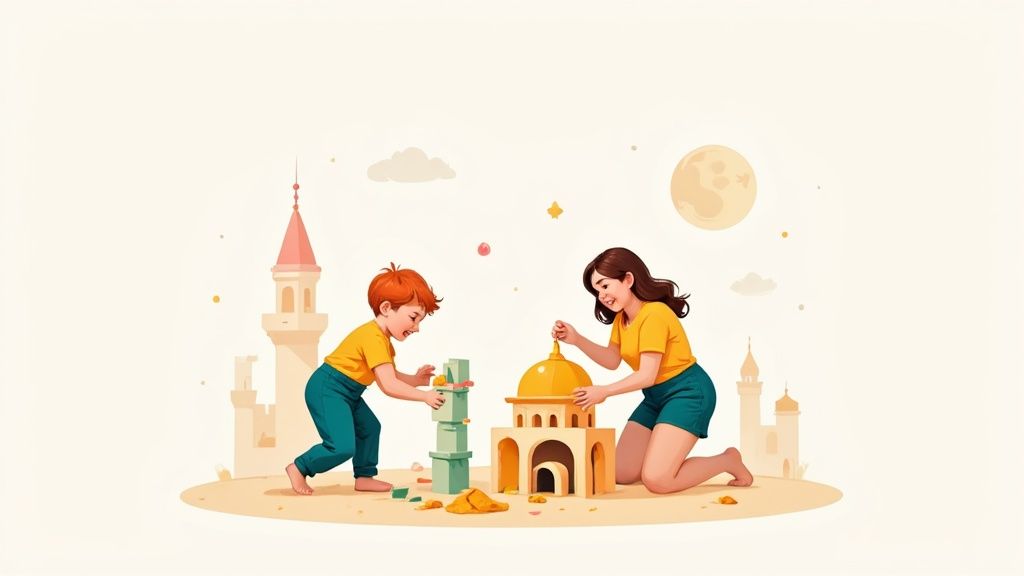
Forget flashcards and formal instruction. At this age, it’s all about connecting faith to their senses. It's about feeling the cool water during wudu, smelling the spices in an Eid cookie, or seeing the beauty of a masjid you just built together from colorful blocks. This way, Islam becomes an experience, something they feel in their hearts, not just a fact they're told to remember.
Engaging the Senses with Islamic Concepts
Toddlers learn by doing. They touch, build, taste, and explore. We can lean into this natural instinct to introduce core Islamic ideas in a way that truly sticks. When they are physically engaged, their little brains are firing on all cylinders, making powerful connections.
Take a concept like Ramadan. Instead of just talking about it, you can bring it to life:
- Get out the playdough and roll out crescent moon and star shapes. As you play, you can say something simple like, "We're making the Ramadan moon! It's a special, happy time for our family."
- Build a block mosque together. It doesn’t need to be an architectural marvel! The simple act of creating a minaret and a dome with their own hands makes the idea of a special place for prayer real and tangible.
- Start a "Good Deeds Jar." Grab a jar and some colorful pom-poms. Every time they share a toy or help put something away, let them add one to the jar. This visually connects kindness and good character with a positive, physical action.
This kind of play-based learning is incredibly effective because it meets toddlers right where they are developmentally. It also helps build a rich, positive emotional landscape around their faith. Many of these hands-on activities are inspired by child-led philosophies, and you can explore more ideas on how to integrate these principles in a Muslim home in our guide on Montessori practices.
The goal isn't to create a masterpiece; it's to create a memory. The feeling they get while squishing playdough into a crescent moon is far more important than how the shape turns out.
Finding Allah in Nature
One of the most profound ways to introduce the concept of Tawhid (the Oneness of Allah) is to simply step outside. Nature is a living, breathing storybook of Allah's magnificent creation, and toddlers are innately curious about every leaf, bug, and puddle.
Try going on a "gratitude walk" around your garden or a local park. It’s a simple but wonderful activity where you actively point out things to be thankful for.
- "Look at that beautiful red flower! Alhamdulillah, Allah made it."
- "Feel the rain on your hand? Subhan'Allah, Allah sends us water."
- "Watch that tiny ant carrying a leaf! Allah is so strong, isn't He?"
This practice gently connects the abstract idea of God to the concrete things your child can see, touch, and experience. You're nurturing a sense of wonder and awe, which is the very foundation of a strong iman. You’re teaching them to see Allah as Al-Khaliq (The Creator) through His handiwork.
Integrating Faith with Modern Learning
Modern educational frameworks increasingly recognize the power of play and integrated learning, which aligns perfectly with how we can approach Islamic education for our little ones.
Experts in early childhood education are blending Islamic values with established learning systems like STEAM (Science, Technology, Engineering, Arts, Mathematics). Studies show that the most successful Islamic kindergartens use a tarbiyah (holistic, nurturing education) approach to foster curiosity while building a strong moral compass from day one. You can read more about how Islamic principles are being applied in STEAM education to see how this works in a classroom setting.
This means when you build that block mosque, you're not just teaching about Islam; you're also developing engineering skills and spatial awareness. That nature walk? It's an early science lesson. This holistic approach ensures their Islamic learning isn't separate from the rest of their development—it enriches their minds and souls all at the same time.
Choosing the Right Books, Media, and Toys
Let's be honest: finding high-quality, halal-aligned resources for your toddler can feel like searching for a needle in a haystack. Many parents are tired of sifting through overstimulating, ad-filled, and sometimes inappropriate content just to find something gentle that reflects our values.
Making confident choices is really about knowing what you’re looking for. The right books and toys become beautiful tools that reinforce the Islamic foundation you're building at home. The wrong ones can be confusing or even work against your efforts. Your goal is to fill your child’s world with things that nurture their fitrah (their pure, natural disposition) and protect their precious innocence.
What to Look for in Toddler Books and Toys
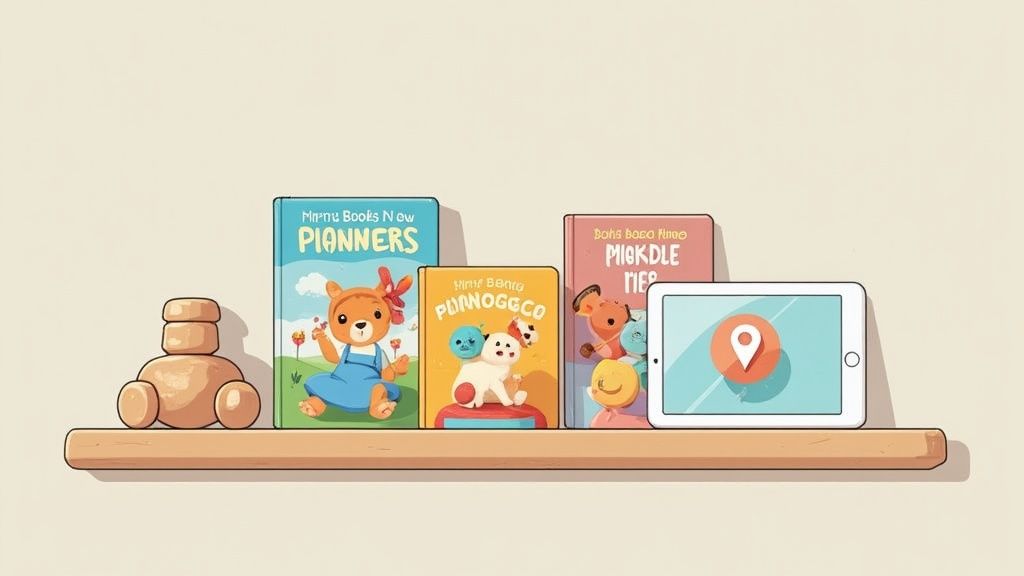
When you’re browsing online or in a bookshop, it helps to have a mental checklist. A good Islamic resource for a toddler should feel warm, authentic, and simple. Our children deserve books that act as mirrors—where they can see their own lives and values reflected right back at them.
Before you click "buy" or head to the checkout, take a moment to ask yourself a few questions:
- Is the message gentle and positive? For little ones, the focus should always be on Allah’s love, mercy, and the incredible beauty of His creation. This isn’t the time for complex fiqh or discussions of fear.
- Are the illustrations appropriate? Look for soft, simple artwork that isn't jarring or overly stimulating. Many parents prefer books with faceless or minimally detailed illustrations to align with Islamic principles.
- Does it represent diverse Muslims? It’s so important for our kids to see that the ummah is a beautiful mix of people from all over the world—South Asian, Arab, African, European, and more.
- Is it durable and safe? This is non-negotiable for the 0–3 crowd. Thick, sturdy board books and well-made wooden toys are always a worthwhile investment.
Focus on board books that introduce just one simple concept at a time. Think of titles about the beautiful names of Allah, basic manners like "Saying Bismillah," or the stories of the Prophets told in a way that a two-year-old can grasp.
Navigating Screen Time with Confidence
Screen time is one of the biggest challenges for modern Muslim parents. We all have those moments when we just need five minutes to get dinner on the table before Maghrib or to finish a work email while the baby naps. But handing over a phone or tablet can feel like a gamble. Mainstream platforms have algorithms that can quickly spiral from a cute animal video to noisy, commercialized, or inappropriate content.
This is where curated, faith-aligned platforms become a game-changer. They provide a safe, walled garden where you can breathe easy, knowing that everything your child sees has been carefully vetted by people who share your values.
Choosing a halal-aligned media platform isn't just about avoiding haram content; it's about proactively providing beneficial, soul-nurturing content that supports their Islamic upbringing.
Platforms designed by Muslims for Muslim children understand our needs. They get rid of the ads, the unpredictable "up next" videos, and the general chaos. Instead, they offer a calm, focused library of content centered on Quranic stories, Arabic letters, and gentle nasheeds. For parents looking for a reliable solution, our guide to the best Islamic apps for kids is a great place to start your search.
Building a Halal-Aligned Media Library
Creating this thoughtful collection of media and toys doesn't have to happen overnight. It’s about making small, intentional choices over time that, together, build a positive and nurturing Islamic environment for your toddler.
Here’s a simple plan to get you started:
- Start with Board Books: Aim to build a small library of 5-10 high-quality Islamic board books. Read them together at bedtime or during quiet moments to create a warm, loving association with these stories.
- Choose Open-Ended Toys: Things like wooden blocks, animal figures, and colorful play silks are amazing for sparking imagination. You can use them to build a "masjid," act out stories about being kind, or explore the beauty of Allah's creation.
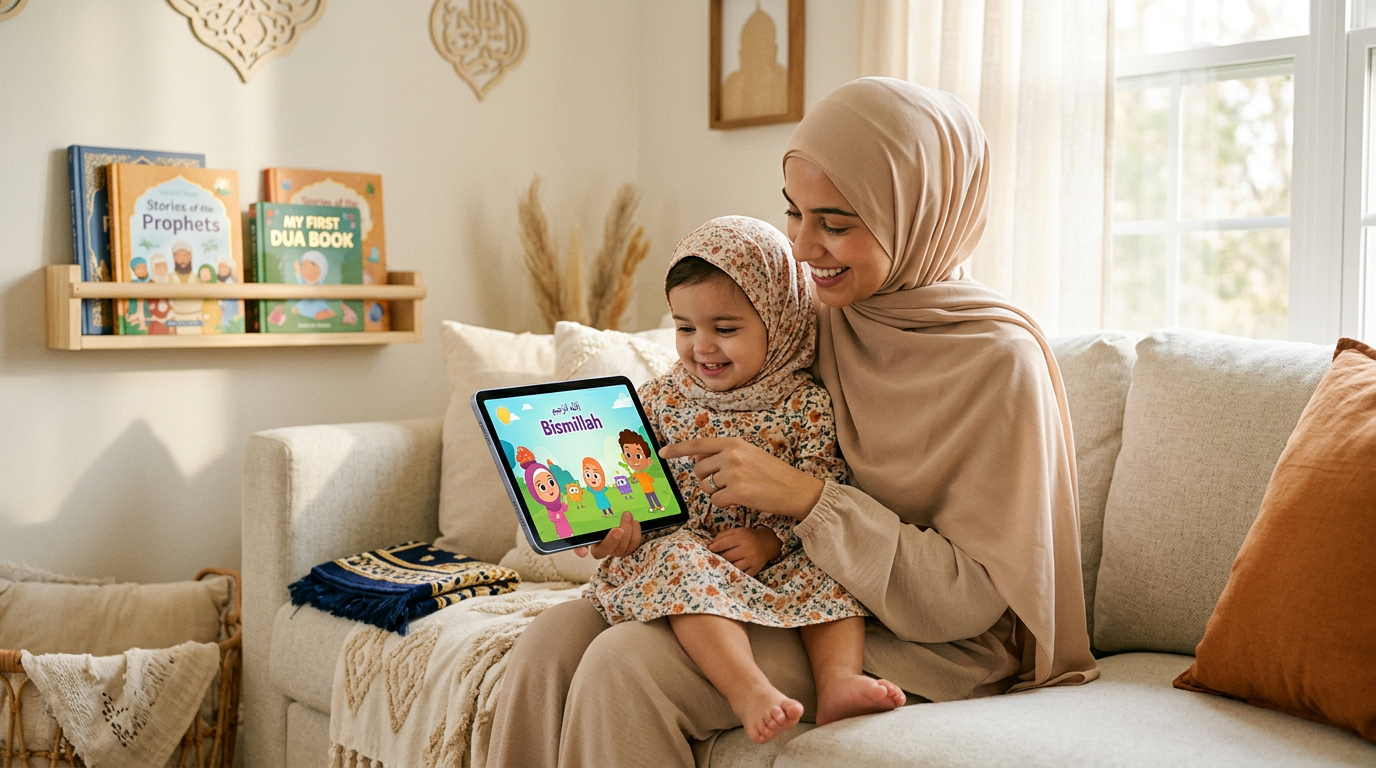
- Select a Safe Screen Time Solution: If you decide to introduce screens, go for a dedicated, ad-free service. Platforms like Babymode are designed specifically for the 0–3 age group, ensuring every video is not only safe but also aligns with Islamic educational goals.
By carefully curating the books, media, and toys in your home, you're doing so much more than just "teaching" Islam. You are creating a world where their faith can blossom naturally, surrounded by beauty, love, and a deep sense of belonging.
For Families in the West: Building a Strong Muslim Identity
Raising a Muslim toddler in a country where Islam isn't the majority faith comes with its own unique challenges—and, subhan'Allah, its own beautiful opportunities. As parents in the UK, USA, Canada, or Australia, one of our deepest prayers is that our children grow up feeling confident and secure in their Muslim identity. This beautiful work starts right now, in these precious early years.
It’s all about creating a sense of belonging so strong that it becomes a natural part of who they are. This isn't about shielding them from the world, but about giving them a firm, loving foundation so they can navigate it with conviction. You are their first and most important role model in showing them the pure joy of being a Muslim.
Weaving in Language and Culture
Language is one of the most powerful threads connecting us to our heritage and our deen. Introducing Arabic to your toddler doesn’t have to feel like a formal lesson; it can be as joyful and simple as singing a song.
Play catchy nasheeds about the Arabic alphabet during car rides or while they're busy with their toys. Even if they're just babbling along, their little ears are tuning into the beautiful sounds of the Qur'an's language. Simple songs about saying "Bismillah" or "Alhamdulillah" create effortless, positive associations that will last a lifetime.
Making Eid an Unforgettable Experience
For our children growing up in the West, Eid needs to feel just as magical as any other major holiday they see around them. As toddlers, they won’t remember the grand feasts, but they will remember the feeling of joy, family, and celebration.
Start building your own family traditions now, no matter how small they seem.
- Decorate the house together. Let them help you stick a crescent moon decal on the window or hang up some fairy lights.
- Bake special Eid cookies. Let them stir the batter or add some sprinkles (even if it gets messy!).
- Plan a special Eid morning breakfast. Something as simple as pancakes with a smiley face can mark the day as special.
These small, repeated rituals build happy memories and a deep-seated love for our beautiful celebrations. You can find more guidance on this in our dedicated article about raising Muslim children in the West.
The Power of Representation and Community
It is so important for our children to see themselves and their families reflected in the world around them. When they see characters in books and toys who look like them—whether they are South Asian, Arab, Black, or converts—it sends a powerful message: You belong. Your story matters.
This is a key reason why authentic representation in children's media is so vital. It validates their identity and shows them the beautiful diversity of our global ummah. Our children deserve books that act as mirrors, reflecting their own lives and values right back at them.
Finding your "village" is also a crucial part of this journey. Connecting with other Muslim families, whether at a local playgroup, the masjid, or a community event, creates an invaluable support system for both you and your child.
This community becomes their extended family—a space where their identity is the norm, not the exception. Yet, finding formal programs that align with our values can be tough. Despite the critical need for early education that nurtures a Muslim identity, there's a real shortage of suitable options.
In the U.S., for instance, while Spanish immersion preschools have grown tenfold to over 3,000 programs, the availability of Arabic or Islamic-rooted early childhood centers remains incredibly scarce. This gap makes our efforts at home and in our community networks even more essential.
Navigating Nurseries and Daycares
If your toddler attends a non-Muslim nursery or daycare, clear and gentle communication is your best friend. Most caregivers are happy to accommodate your family's needs if they understand them.
Schedule a brief, friendly chat with their key teacher. You can explain simple things, like how you're teaching your child to say "Bismillah" before eating, or that you prefer they are offered halal snack options. Providing these small details helps create a consistent and supportive environment for your toddler, ensuring the values you nurture at home are respected when they're in someone else's care.
Answering Your Most Common Questions
As you start weaving Islamic teachings into your toddler’s life, it’s only natural for questions to pop up. Am I starting too early? Am I doing this right? These are questions every caring parent asks. Let's walk through some of the most common ones we hear from families.
Remember, this isn't about a rigid curriculum; it’s about creating a warm, loving atmosphere where your child feels the comfort and beauty of their faith from the very beginning.
Frequently Asked Questions
| Question | Answer |
|---|---|
| At what age should I start teaching my toddler about Islam? | You can begin from day one by creating a loving Islamic atmosphere. For babies (0-12 months), this means hearing the Qur'an or your dhikr. For toddlers (1-3 years), you can introduce simple words like 'Allah' and 'Bismillah' into daily life. It's about gentle, positive exposure, not formal lessons. The goal is for them to feel Islam's comfort long before understanding complex ideas. |
| My toddler is restless during Salah. What should I do? | This is completely normal and a beautiful part of their learning! Let them see you pray consistently. Give them their own small prayer mat to copy you. If they climb on you, gently continue. This teaches them that Salah is a non-negotiable part of family life. At this age, the goal is positive association, not perfect performance. Their presence is a blessing. |
| How can I explain Allah to a two-year-old? | Keep it simple, loving, and focused on gratitude. Use phrases like, 'Allah made the beautiful flowers,' or 'Allah gave us this yummy food.' Connect Allah to all the good and wonderful things in their life. Focus on Allah as the source of love, nature, and family. Avoid abstract concepts; at this age, Allah is best understood through the blessings they can see, touch, and feel. |
| Which Surahs are best for toddlers? | The shortest Surahs are perfect. Surah Al-Ikhlas, Al-Falaq, and An-Nas are wonderful to recite at bedtime because they are rhythmic and offer a sense of peace and protection. Playing recordings of these Surahs softly during playtime or before naps can also create a comforting atmosphere. The goal is familiarity with the sounds of the Qur'an, not memorization. |
Hopefully, these answers bring some clarity and reassurance. The most important thing you can give your child is a home filled with love for Allah and His Messenger ﷺ, and you’re already doing that just by being here.
Are you looking for a safe, halal, and ad-free screen time solution that supports your toddler's Islamic learning? Discover Babymode, the first platform built by Muslims, for Muslim toddlers aged 0–3. Join the waitlist for early access and special launch pricing.