Raising a little Muslim is a beautiful, blessed journey. When you're parenting a toddler, you're doing so much more than just managing nap times and navigating picky eating—you're laying the very first, most important bricks of their spiritual foundation.
The heart of Islamic parenting for toddlers isn't about formal lessons or strict rules. It's about creating a warm, loving home where the beauty of our deen is woven into the simple, everyday moments you're already sharing. It's about nurturing their fitrah, their innate and pure connection to Allah.
This guide is for parents who want practical, gentle ways to do just that. We'll focus on small, consistent actions that, over time, build a mountain of faith.
- Whispering 'Bismillah' before they take a bite of their favourite fruit.
- Saying 'Alhamdulillah' when you see them giggle with joy.
- Pointing to the moon on your evening walk and mentioning Allah as the Creator.
- Playing soft Quran recitation in the background during quiet playtime.
These tiny acts stitch faith into the very fabric of your daily life, making it feel as natural and comforting as a hug. This approach isn't just intuitive; it aligns with what we know about child development.
In fact, research shows that blending timeless Islamic principles with modern parenting insights creates stronger, more resilient families. One study found that approximately 73% of Muslim parents see immense value in this integrated approach. You can learn more about these findings on Islamic parenting strategies and their benefits.
It Starts With Your Loving Presence
Let go of the pressure to be the "perfect" parent or to have all the answers. Your most powerful tool is simply your loving, consistent presence. Your toddler learns about mercy (rahmah), forgiveness, and unconditional love by watching you.
When you respond with patience to a spilled cup of milk or offer a warm cuddle after a fall, you are living the compassion that is so central to our faith. This is the essence of prophetic parenting—embodying gentleness and mercy in your every action.
Your calm, steady response during a tantrum teaches your child more about Islamic character than any lecture ever could. It shows them that love and mercy are our first instincts, even when things get tough.
Before diving into specific daily routines, let's look at the core principles that underpin this approach. These are the foundational ideas that will guide your actions and intentions as you raise your little one.
Core Principles for Islamic Toddler Parenting
Here’s a quick summary of the foundational concepts for bringing faith into your toddler's daily life in a way that feels natural and joyful.
| Principle | Simple Daily Action | Long-Term Goal |
|---|---|---|
| Nurturing Fitrah | Pointing out Allah's creations (sun, trees, animals) on a walk. | To reinforce their innate belief in a loving Creator. |
| Modelling Mercy | Responding to mistakes and accidents with patience and a hug. | To teach them that compassion is the default response. |
| Gentle Consistency | Saying Bismillah before every meal and snack, every single day. | To make Islamic phrases a natural part of their vocabulary and life. |
| Joyful Association | Singing Islamic nasheeds or telling fun stories about the prophets. | To help them associate Islam with happiness, love, and security. |
| Leading by Example | Letting them see you make salah or read Quran, even for a few minutes. | To instil a love for acts of worship through observation. |
By focusing on these small, faith-inspired habits, you're building a foundation of comfort, joy, and security. You can find more ideas to get started in our article on Muslim parenting tips for babies.
This gentle, consistent approach helps make Islam a beloved and inseparable part of your toddler’s world, insha'Allah.
Weaving Faith into Your Toddler's Daily Rhythm
Little ones thrive on predictability. It's their anchor in a big, busy world. Giving your toddler a consistent daily routine is one of the kindest things you can do—it makes them feel safe, secure, and loved. And the wonderful thing about Islamic parenting for toddlers is that our faith gives us a beautiful, natural framework to build that routine around.
This isn't about creating a rigid, minute-by-minute schedule that just adds more stress to your life. Think of it more as a gentle, flowing rhythm that moves with your family's real life, whether you’re navigating nursery runs, working from home, or getting dinner ready before Maghrib. The idea is to create small, consistent touchpoints of faith that become a natural part of their day.
The Five Pillars of Your Day: Anchoring with Prayer Times
The five daily prayers are more than just obligations; they are perfect, gentle markers to structure your toddler's day. Instead of interruptions, they can become moments of shared calm and connection that your child learns to anticipate.
- Fajr: Even if they sleep right through it, your own quiet start to the day sets a peaceful tone for everyone.
- Dhuhr: This is a great signal for a transition. It might mean we're shifting from morning play to lunchtime, followed by a much-needed nap. Let your toddler see you make wudu and pray; their little minds are like sponges, soaking it all in.
- Asr: This is the perfect marker for the afternoon wind-down. For us, it means "after Asr, we have our snack" or "after Baba prays, we'll read a book together."
- Maghrib: As the sun sets, Maghrib beautifully signifies the shift to evening, heralding family time and dinner.
- Isha: This is the final, gentle signal that the day is closing. It’s a time for quiet cuddles, soft Quran recitation, and preparing for bed.
This simple flow shows how these small daily acts build upon each other, creating a home where faith feels like a warm, joyful, and ever-present hug.
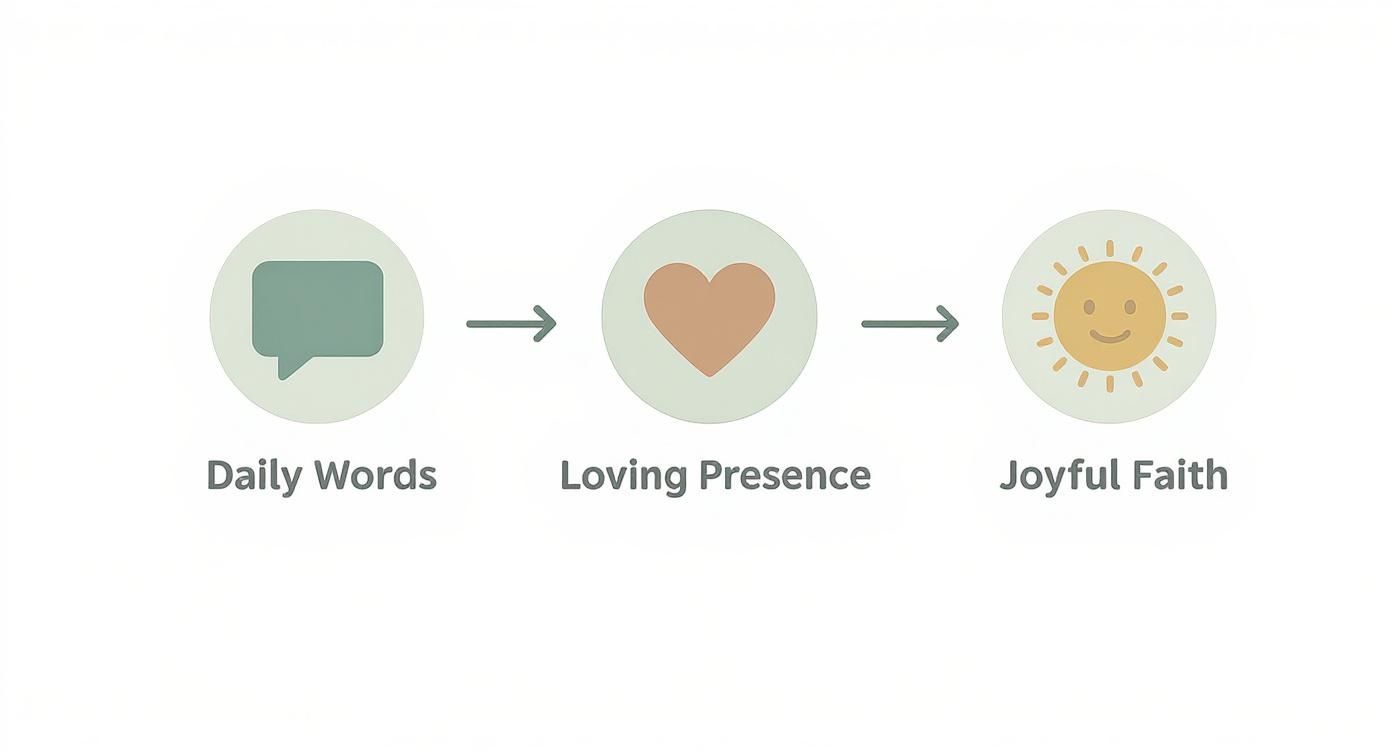
When your child sees you praying, they start building positive, warm feelings about it long before they understand the words. You're laying the groundwork.
Finding Allah in the Little Moments
Beyond prayer, you can sprinkle small acts of remembrance into the things you’re already doing. The real magic is in the consistency—that’s how an action becomes a cherished family habit.
Mealtimes are a perfect place to start. A simple "Bismillah" before every single snack and meal is an incredibly powerful and easy habit to build. You'll be amazed how quickly your toddler starts mimicking you, often before they can even say the word clearly.
The same goes for "Alhamdulillah." Let them hear you say it after a yummy bite of food, after a fun giggle-filled moment, or when you spot something beautiful out the window. You're teaching them that gratitude isn't just for big things; it's a way of life.
A simple "Masha'Allah" when your toddler proudly shows you their block tower or a gentle "Subhan'Allah" when a colourful bird lands in the garden connects their world directly to Allah in the most loving, natural way.
Making Transitions Calm and Connected
Let's be honest, transitions can be tough for toddlers. Waking up, leaving the house, and especially bedtime can be flashpoints for meltdowns. A faith-centered routine brings a sense of calm and purpose to these tricky moments.
A Sample Gentle Rhythm
- Morning Wake-Up: Instead of a rushed start, greet your toddler with a gentle "Assalamu 'alaikum" and a simple morning dua. Keeping the atmosphere calm and screen-free can change the entire tone of the morning.
- Bedtime Wind-Down: About an hour before bedtime, start the transition. Dim the lights, turn off all screens, and play some soft, instrumental-free nasheeds or a quiet Quran recitation. This creates a peaceful cocoon that signals to their body and mind that it's time to rest.
- Leaving the House: This is one of my favourites. Before you walk out the door, make it a habit to say the dua for leaving home together. It takes just a few seconds, but it establishes a powerful ritual of seeking Allah's protection.
By building these small, consistent rituals, you’re creating a predictable world where faith is a source of comfort, not pressure. For more practical ideas, check out our complete guide to building a Muslim toddler routine. The goal is a day that flows with intention and calm, insha'Allah.
Nurturing Good Manners and a Gentle Heart
Teaching adab (good manners) is one of the most beautiful parts of Islamic parenting, especially during these tender toddler years. It’s about so much more than just saying "please" and "thank you." We're trying to cultivate a gentle, compassionate heart that mirrors the character of our beloved Prophet Muhammad (ﷺ), who showed the utmost mercy towards children.
With our little ones, this process doesn't start with lectures or stern corrections. It begins with tiny, lived experiences, guided by your loving example.
This is the age of exploration. Toddlers are naturally curious and test boundaries, which can definitely lead to some challenging moments. Your two-year-old might snatch a toy from their cousin at a family dinner or push a friend at the park. These aren't signs of a "naughty" child. They are simply a little person learning about big emotions without having the words to express them yet. Our role is to guide them with warmth and patience.

Instead of reacting with frustration, we can use these moments to plant the seeds of empathy. For instance, when a toddler grabs a toy, our first instinct might be to say, "No! Give that back!" But a more effective, heart-centered approach focuses on connection first, then redirection.
Gentle Discipline Rooted in Connection
Gentle discipline isn't about being permissive; it's about being effective in a way that protects your child's dignity and strengthens your bond. We shift the focus from punishment to teaching. The goal is to raise a child who chooses kindness because they understand its value, not because they fear the consequences of misbehaving.
This means we can move away from traditional methods like time-outs, which can feel incredibly isolating for a small child who is already overwhelmed. Instead, we can create moments of "time-in." This simply means sitting with your child, offering a calm cuddle, and helping them regulate those big, scary feelings.
When your child is overwhelmed, they don't need to be sent away; they need to be brought closer. A "time-in" with a parent teaches them that your love is a safe place to return to, even when they're struggling. This is mercy in action.
Let's walk through what this might look like in a real-life scenario.
A Practical Example at the Playdate
Imagine you're at a friend's house. Your two-year-old snatches a toy car from their friend, who immediately starts to cry.
Stay Calm and Connect First. Before you do anything else, get down to your child's level. Place a gentle hand on their back and say calmly, "I see you really wanted that car. It looks like a fun one." This simple step validates their desire without condoning the snatching.
Narrate the Other Child's Feelings. Gently point to their friend and say, "Look, Ali is feeling sad. He was playing with the car, and now he is crying." You're building the very first blocks of empathy by helping them connect their action to someone else's feelings.
Offer a Shared Solution. Instead of forcing them to return the toy, which often leads to a power struggle, try offering a solution. "Let's find another car for Ali to play with while you have a turn." Or, "How about you have one more minute with the car, and then it will be Ali's turn?" This teaches sharing and turn-taking in a positive way.
Redirect with Love. If your toddler is still upset, it might be a sign they are overstimulated or tired. This is a perfect moment for a "time-in." You could say, "Let's go have a cuddle and read a book together for a little while." This removes them from the conflict while offering comfort instead of punishment.
Weaving Manners into Daily Life
Teaching adab isn't a separate lesson; it's woven into the fabric of your everyday interactions. You're modelling the behaviour you want to see, all day long.
- Saying "Bismillah" before eating and "Alhamdulillah" after: You're teaching gratitude to Allah.
- Greeting others with "Assalamu 'alaikum": You're teaching them to offer peace to others.
- Speaking softly and respectfully to elders: You're teaching them ihtiram (respect).
- Sharing a piece of your fruit with them: You're teaching them generosity.
Your toddler is always watching you. When they see you handle a dropped glass with a calm "oops" instead of a frustrated shout, they learn patience. When they see you share your snack with their older sibling, they learn generosity. Through these small, consistent acts of mercy and patience, you are nurturing a child who is not only well-behaved but also deeply kind, respectful, and compassionate from the heart.
Introducing Allah and the Quran in a Loving Way
How do you explain the Creator to a curious two-year-old? This is one of the most beautiful questions in Islamic parenting for toddlers, and the answer is so much simpler and more natural than we often think. It’s not about deep theology; it's about making gentle, joyful connections in the world they see and touch every day.
To a toddler, Allah isn't an abstract concept. He is the one who made that big, beautiful moon they see from their bedroom window. He sends the rain they love to splash in and makes the sweet strawberries they gobble up for a snack. Your job, as their loving guide, is simply to point out these everyday miracles.

This approach of weaving faith into the fabric of daily life is incredibly powerful. With a global Muslim population of about 1.8 billion, countless toddlers are being raised with this gentle, faith-based foundation. In fact, research into group counseling strategies based on Islamic values has shown just how effective these principles are in enhancing parenting skills and fostering positive family dynamics.
Seeing Allah’s Gifts Everywhere
Your daily routine is already brimming with teachable moments. It’s just about shifting your own perspective to see—and say out loud—the blessings that are already right in front of you.
- On a walk in the park: "Subhan'Allah, look at that beautiful red flower! Allah made it so colourful."
- Spotting an animal: "Masha'Allah, that cat is so fluffy. Allah created all the animals."
- Eating a piece of fruit: "Mmm, this banana is so sweet. Alhamdulillah for the yummy food Allah gives us."
These little mentions are like planting seeds. You're not looking for your toddler to grasp the full meaning right away. You're simply building a loving association: beautiful, good things come from a loving Creator.
Teaching Duas with Little Lips
Introducing duas at this age is all about participation and routine, not memorization. Toddlers are fantastic mimics, and a short, simple dua can easily become a cherished part of their day. The secret is consistency and keeping it joyful.
Stick to super short phrases that are easy for them to attempt.
- Before Eating: A simple "Bismillah."
- After Eating: A happy "Alhamdulillah!"
- Before Sleeping: A soft "Bismillah."
- When Sneezing: A quick "Alhamdulillah."
- When Waking Up: A cheerful "Alhamdulillah."
When you make it a consistent part of the routine—just like singing a nursery rhyme—they will pick it up naturally. They might just mumble or make a sound at first, and that’s wonderful! It’s the habit and the turning towards Allah that you’re nurturing.
Don’t get hung up on perfect pronunciation. The goal here is to make turning to Allah a natural reflex. When they hear these words during moments of comfort and everyday life, they learn that Islam is a source of peace and blessing.
A Gentle First Connection with the Quran
Your toddler’s first experience with the Quran should be wrapped in warmth, comfort, and love. The aim is simply familiarity and creating a positive feeling, not formal learning. Think of it as introducing them to a beautiful, peaceful sound that fills your home.
You can do this in a few simple ways.
1. Gentle Recitation
Try playing a soft, beautiful Quran recitation in the background during quiet playtime, before naps, or on car rides. The sound itself is incredibly soothing and introduces the rhythm of the Quran to their hearts. Pick a Qari with a calm, melodic voice.
2. Colourful Quranic Storybooks
Board books with bright, simple pictures of stories like Prophet Nuh’s (AS) ark or the story of the elephant are fantastic. They bring the Quran to life in a way a toddler can connect with, focusing on Allah's amazing creation and the good character of the prophets.
3. Joyful Nasheeds
Singing nasheeds (without instruments) about Allah, the prophets, or simple Islamic concepts is a brilliant teaching tool. Toddlers learn so much through music and repetition, and a happy song about saying "Bismillah" makes the whole idea fun and easy to remember. And for your own spiritual growth, you might find inspiration in our guide on the powerful dua 'Allahumma inni as'aluka' for a deeper connection.
By weaving these simple practices into your life, you ensure your child’s first encounters with their faith are filled with love, making it a source of comfort they will turn to for years to come, insha'Allah.
Navigating Modern Challenges with Islamic Values
Let's be honest. Raising a toddler today means you’re not just parenting your child; you’re also parenting their environment. It can feel like a constant balancing act, trying to shield their innocence while still preparing them for the world around them.
The goal of Islamic parenting for toddlers isn’t to build a bubble. It's about giving them a strong, faith-filled filter to see the world through.
Managing Screen Time with Purpose
There will be moments when you desperately need five minutes of peace to get dinner on the table before Maghrib. Or maybe you need to soothe a crying baby without your toddler feeling left out. In those real-life situations, a screen can feel like a lifesaver.
The key isn't to demonize screens or ban them entirely. It's about being intentional. Instead of letting screen time be the default activity, think of it as a specific tool you pull out for a specific purpose.
When you do use it, the focus has to be on quality, not just quantity. We want to find content that isn't just harmless, but actively good for them—something that aligns with the values we're trying to build in our homes. This means stepping away from those endless-scroll, algorithm-driven platforms where you never know what's coming up next.
The best way to handle screen time isn't about feeling guilty or setting impossible rules. It's about making conscious choices before you need it. When you're prepared, you can offer something that nurtures their heart and mind, not just something that distracts them.
Finding Trusted, Halal-Aligned Content
The good news is that the world of Muslim children's media is growing. It's so much easier now to find high-quality, halal-aligned content than it was even a few years ago. You want to look for resources that are calm, engaging, and gently reinforce the lessons you’re already teaching at home.
Here's what to look for:
- Purpose-Built Platforms: Some services are designed from the ground up to be safe spaces for Muslim kids. For instance, Babymode provides a completely ad-free experience just for Muslim toddlers. Every cartoon, nasheed, and story is pre-screened, which gives you incredible peace of mind.
- Curated YouTube Channels: The main site can be a digital jungle, but there are some wonderful channels dedicated to gentle Islamic content. Look for creators who use slow-paced animation, soft, instrument-free nasheeds, and simple stories about good manners or the beauty of Allah's creation.
- Interactive Islamic Apps: A handful of high-quality apps can teach the Arabic alphabet or simple duas through fun, interactive games. This can be a fantastic alternative to just passively watching videos.
With this curated approach, you're back in the driver's seat. You aren’t just handing over a device and hoping for the best; you are actively choosing content that supports your parenting.
Halal-Aligned Screen Time Resources for Toddlers
Finding the right digital tools can feel overwhelming. To make it easier, here is a curated list of trusted, age-appropriate resources that align with Islamic values, helping you make intentional choices for your little one.
| Resource Type | Recommended Examples | Key Features |
|---|---|---|
| Streaming Platforms | Babymode | Ad-free, 100% pre-screened content, focuses on Quran, nasheeds, and Islamic values. |
| YouTube Channels | Omar & Hana, Zaky | Instrument-free nasheeds, stories about prophets, and lessons on Islamic manners (adab). |
| Interactive Apps | Ali and Sumaya, Miraj Stories | Teaches Arabic alphabet, duas, and Quranic stories through playful, interactive games. |
This table is just a starting point. The goal is to build your own small, trusted library of digital resources you can turn to confidently when you need them.
Navigating Social Situations with Confidence
As your toddler gets a bit older, their world will expand. They'll start interacting more at the park, in playgroups, or with neighbors. This is often when tricky social questions come up, like how to handle invitations to birthday parties or other events that might not align with your family's practices.
There’s no single "right" answer here—it really depends on your family, your community, and what you're comfortable with. The most important thing is to be gracious and confident in your choices.
For example, if you're invited to a party you'd rather not attend, you could politely decline but then suggest a special one-on-one playdate to celebrate the child instead. It's a warm, personal alternative.
When your child is playing with non-Muslim friends, you can focus on the beautiful, universal values we all share: being kind, sharing toys, and playing gently. These are the principles that build bridges. You're teaching your child how to be a confident Muslim who can engage respectfully with everyone, truly embodying the beautiful adab of our faith.
Your Questions on Islamic Toddler Parenting Answered
As you walk this beautiful, and let's be honest, sometimes overwhelming path of raising a little Muslim, questions are completely normal. This journey is full of heart-melting moments and times you’ll find yourself wondering, "Am I doing this right?"
We get it. We've been there. So, we've gathered some of the most common questions we hear from parents like you, offering gentle, practical, and faith-centered answers to bring you some peace of mind.
How Do I Handle Tantrums During Prayer Time?
This is a classic. The very moment you say "Allahu Akbar," your toddler suddenly decides it's the most urgent time to climb on your back or demand a snack. Before anything else, take a deep breath. This is completely normal toddler behaviour, not a sign of disrespect. Their world revolves around you, and when you're suddenly unavailable, it can be confusing for them.
Here are a few gentle strategies that can make a real difference:
- Give them their own "Salah Spot." Lay out a small prayer mat or even just a special blanket right next to yours. You could give them a child-safe tasbih or a soft toy to hold. This little invitation makes them feel included and helps build a positive connection to prayer.
- Try to pray during their downtime. This isn't always possible, especially once naps are a thing of the past, but aligning your prayers with their quiet play or nap time can sometimes give you a few precious, uninterrupted minutes.
- It’s okay to keep it short and sweet. If you're praying your sunnah prayers and a full-blown meltdown is happening, it is perfectly fine to keep them brief. The Prophet (ﷺ) himself shortened his prayer when he heard a child crying. This is an act of mercy, not a spiritual shortcoming.
The real key here is to stay as calm and consistent as you can. Over time, they’ll absorb the rhythm of prayer and understand it’s a peaceful, non-negotiable part of your family’s day.
Am I Doing Enough to Teach Them About Islam?
This question almost always comes from a place of deep love. The pressure we put on ourselves to "do enough" can feel immense, but for a toddler, the most powerful lessons aren't formal at all. You are almost certainly doing far more than you give yourself credit for.
If you fill your home with the sounds of the Quran, say "Bismillah" before you eat, and respond to their tumbles with a patient hug, you are teaching them Islam. You are showing them what mercy (rahmah), gratitude (shukr), and trust in Allah (tawakkul) look like in real life.
Islamic parenting for toddlers isn't about ticking off a checklist. It's about the atmosphere you cultivate in your home—one of warmth, love, and gentle reminders of Allah's presence in every little thing. Trust your efforts, and trust in Allah's guidance.
How Can I Teach My Toddler Arabic When We Don't Speak It at Home?
Introducing Arabic early is a wonderful goal, but it doesn't mean you need to be a fluent speaker. At this age, the goal isn't fluency; it's about creating a positive and familiar feeling around the language.
- Start with key Islamic phrases. Weave words like Bismillah, Alhamdulillah, Masha'Allah, and Insha'Allah into your everyday chats. These will naturally become some of their very first Arabic words.
- Lean on nasheeds and stories. Play instrument-free nasheeds about the Arabic alphabet or simple Islamic ideas. Find colourful, sturdy board books that introduce Arabic letters and words. It’s the sound and rhythm that matter most right now.
- Find quality, age-appropriate media. Look for shows or simple apps designed to gently introduce Arabic to young children in a playful way.
By making Arabic a fun and regular part of their world of sounds, you’re laying an incredible foundation for more structured learning down the road, insha'Allah.
Is It Okay for My Toddler to See Me Cry or Get Upset?
Yes, absolutely. Showing your emotions in a healthy way is one of the best things you can do to teach your child emotional intelligence from an Islamic perspective. Our deen recognizes the full range of human emotions—even our beloved Prophet (ﷺ) wept from grief and compassion.
When you're feeling overwhelmed and your toddler sees you take a deep breath and say, "Mama is feeling a little frustrated, I just need a quiet moment," you are modelling a critical life skill. You’re showing them how to identify and manage big feelings without yelling or losing control.
This teaches them that having these feelings is normal and that there are healthy ways to handle them. It's a real, authentic display of what it means to be human and to strive for patience, even when it’s hard.
Parenting a toddler is a marathon, not a sprint. By focusing on connection, mercy, and small, consistent acts of faith, you are giving your child the most beautiful start.
For parents looking for a truly safe, ad-free, and faith-aligned screen time solution, Babymode offers a curated world of content designed for Muslim toddlers. Every cartoon, nasheed, and story is pre-screened to ensure it nurtures your child's fitrah with positive values and gentle learning. Give yourself peace of mind and join the waitlist for a calmer, more intentional screen time experience at https://babymode.ai.