As Muslim parents, we want every learning moment for our little ones to be safe, joyful, and aligned with our values. Teaching numbers is a foundational milestone, but finding counting songs for preschoolers that are engaging without being overstimulating, educational without contradicting Islamic principles, and free from ads or distracting content can be a real challenge. It often feels like a constant search for material that respects our family's boundaries and supports a calm, faith-centred home.
This guide is designed to help. We've carefully curated a list of 10 classic and modern counting songs, providing practical ways to adapt them into beautiful, faith-inspired learning tools. You'll discover how to transform simple rhymes into meaningful lessons, from counting our blessings to Allah to naming the Five Pillars of Islam. This resource offers actionable ideas for making numeracy a natural and purposeful part of your child’s day, whether you're singing during nappy changes, looking for a calm screen-time option, or simply enjoying a playful moment together.
In this list, you will find:
* Actionable Activity Suggestions: Simple ways to bring each song to life with movement and play.
* Faith-Aligned Adaptations: Ideas for integrating Islamic concepts and values into traditional rhymes.
* Bilingual Integration: Tips for introducing Arabic or Urdu numbers alongside English.
* Practical Screen-Time Guidance: Notes on finding safe, ad-free versions for those moments when you need a trusted digital resource.
Insha'Allah, this collection will help you build a strong foundation in both numbers and faith, making early learning a source of connection and barakah in your home.
1. One, Two, Three, Four, Five (Traditional Counting Rhyme)
This classic English nursery rhyme is one of the most foundational counting songs for preschoolers. Its simple, repetitive structure and narrative about catching a little fish make it incredibly effective for teaching the numbers one through five in sequence. The steady rhythm and rhyming pattern help little ones memorise the numbers and the story, building early numeracy and language skills simultaneously.
Because of its simplicity and wide recognition, this song is an excellent starting point for faith-aligned adaptations. It provides a familiar tune that can be repurposed with Islamic themes, making learning feel both comfortable and meaningful for young Muslim children.
How to Implement and Adapt
The strength of this song lies in its adaptability. While the original lyrics are harmless, creating versions that reflect Islamic values can deepen a child's connection to their faith from an early age.
- Create Islamic-Themed Lyrics: Swap the fish narrative for themes that resonate with a Muslim household. For example, count the five daily prayers, the pillars of Islam, or family members. > Babymode Adaptation: “One, two, three, four, five, time for Zuhr to arrive. Six, seven, eight, nine, ten, let’s make wudu and pray then.”
- Introduce Bilingual Counting: Use the melody to teach Arabic numerals. Sing a line in English and repeat it with Arabic numbers: "One, two, three..." followed by "Wahid, ithnan, thalatha..." This gently introduces a new language in a familiar context.
- Pair with Visuals and Gestures: Create flashcards with both English and Arabic numerals (١, ٢, ٣). As you sing each number, show the corresponding card and use your fingers to count along. Consistent hand gestures are crucial for little ones who learn through movement.
Why It’s Effective for Muslim Families
This song is particularly valuable because it serves as a gentle introduction to numeracy that can be seamlessly integrated into a child's daily Islamic life. Using a familiar tune to count duas, blessings, or items related to faith helps normalise and embed Islamic concepts into their playtime and learning.
For parents looking for more ways to integrate faith into early learning, our guide on preschool learning songs offers additional ideas and resources. By adapting traditional rhymes, you create a rich, values-based educational experience that feels both fun and spiritually nurturing.
2. Number Song (Super Simple Songs - Counting 1-10)
This modern, upbeat song from Super Simple Learning has become a global favourite in preschool education. Its strength lies in a clear, repetitive structure that introduces numbers one through ten with corresponding hand gestures. The cheerful melody and simple, direct lyrics make it one of the most effective counting songs for preschoolers, especially for toddlers and young children just beginning their numeracy journey.
The song's modern appeal and built-in kinesthetic learning component make it a fantastic base for faith-aligned adaptations. Its straightforward "number-plus-action" format can be easily repurposed to teach foundational Islamic concepts, transforming a simple counting exercise into a meaningful learning experience for young Muslim children.
How to Implement and Adapt
The song's call-and-response style is perfect for interactive learning. Parents can adapt it to instill Islamic values and introduce new languages in a playful way.
- Integrate Islamic Concepts: Modify the lyrics to connect each number to a core Islamic principle. This helps children associate numbers with meaningful concepts from an early age. > Babymode Adaptation: “Number one, number one, what is one? One is for Allah, only One. Number two, number two, what is two? Two is for my parents, I love you.”
- Introduce Bilingual Counting: Use the catchy tune to teach counting in another language, like Urdu or Arabic. Sing the number in English, then repeat it in the second language while showing the numeral. "One... Wahid... Two... Ithnan..."
- Incorporate an Instrument-Free Version: For families who prefer vocal-only nasheeds, the song works beautifully without instruments. A simple, a cappella version maintains the rhythm and focus on learning, aligning with specific preferences.
- Pair with High-Contrast Visuals: Use clear, simple visuals like flashcards or digital animations showing the hand gesture, the English numeral, and the Arabic (١, ٢, ٣) or Urdu (۱، ۲، ۳) numeral. This multi-sensory approach reinforces number recognition.
Why It’s Effective for Muslim Families
This song is highly effective because it combines auditory learning with physical movement, a method proven to enhance memory and engagement in young children. By adapting it, parents can introduce core Islamic ideas, such as the Oneness of Allah (Tawhid) or the importance of parents, in a way that feels natural and fun.
Its simple, clean format is ideal for creating the kind of safe, purposeful content that many Muslim families seek. For more guidance on choosing high-quality educational media, explore our resources on safe learning preschool videos. Adapting songs like this allows you to build a foundation of both academic and spiritual knowledge.
3. Five Little Monkeys (Subtraction & Counting Song)
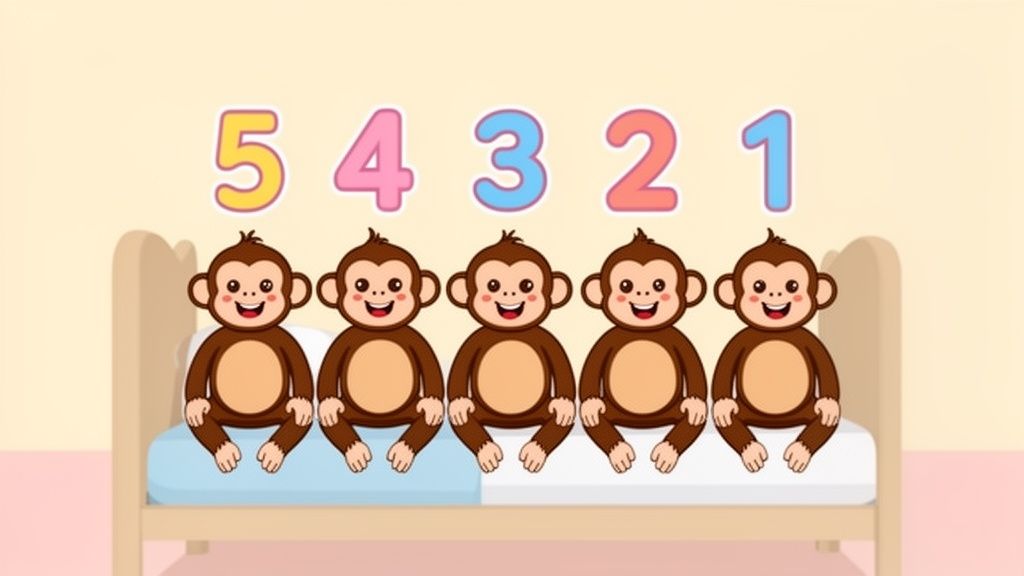
"Five Little Monkeys" is one of the most dynamic counting songs for preschoolers because it introduces the concept of subtraction. The narrative of monkeys jumping on a bed and falling off one by one helps children visualise numbers decreasing, which is a foundational maths skill. Each verse counts down from five, reinforcing number recognition in reverse order in a playful, memorable story.
The theme of monkeys bumping their heads might be a bit much for sensitive toddlers. Fortunately, its structure is perfect for faith-aligned adaptations that replace the slightly concerning narrative with positive, values-based scenarios, making it a powerful tool for teaching both numbers and good character.
How to Implement and Adapt
The repetitive countdown makes this song easy to customise. By changing the characters and actions, you can create versions that reflect Islamic values and teach important lessons in a gentle, reassuring way.
- Reframe the Narrative with Positive Actions: Shift the focus from misbehaviour to positive activities. Instead of monkeys falling off, you could have children performing good deeds or participating in family life. > Babymode Adaptation: “Five little siblings sitting so neat, one went to help Mamma, oh what a treat! Mamma was so happy and Papa said with glee, ‘JazakAllah khair for helping our family!’”
- Use Sunnah-Inspired Themes: Connect counting to beneficial Islamic practices. A song about eating dates, for example, can teach both numbers and the Sunnah in a fun context.
- Incorporate Bilingual Counting: Reinforce Arabic or Urdu numbers within the song. Sing "Four little monkeys..." and then, "Arba'a little monkeys..." to build bilingual vocabulary naturally.
- Use Finger Puppets: Create simple puppets representing the characters in your adapted song. Using your fingers to show the number decreasing provides a strong visual and kinesthetic aid for learning subtraction.
Why It’s Effective for Muslim Families
This song is highly effective because it transforms a lesson in subtraction into a lesson in Islamic manners (adab). By adapting the lyrics to model obedience, helpfulness, and other positive behaviours, parents can use a popular tune to instill foundational values.
Creating versions like “Five Little Children Reciting Qur'an” or “Five Little Siblings Sharing Toys” turns a simple counting exercise into a meaningful opportunity for character development. It allows children to learn early maths concepts within a framework that aligns with a calm, faith-centred home environment.
4. Two Little Blackbirds (Counting Pairs & Left-Right Coordination)
This traditional finger-play song is a fantastic tool for introducing the concept of pairs and opposites. Its simple narrative of two birds flying away and returning, represented by the pointer fingers, helps children count to two while developing crucial fine motor skills, hand-eye coordination, and an early understanding of concepts like left and right. The song's interactive nature makes it a joyful learning experience.
Because it focuses on storytelling through movement, this rhyme offers a wonderful opportunity for faith-aligned adaptations. The simple structure can be used to convey Islamic concepts of partnership, good deeds, and cooperation in a way that is gentle and easy for toddlers to grasp.
How to Implement and Adapt
The core of this song is the finger play, making it highly adaptable for storytelling that reinforces Islamic values. The focus on "two" can be linked to many positive concepts within a Muslim household.
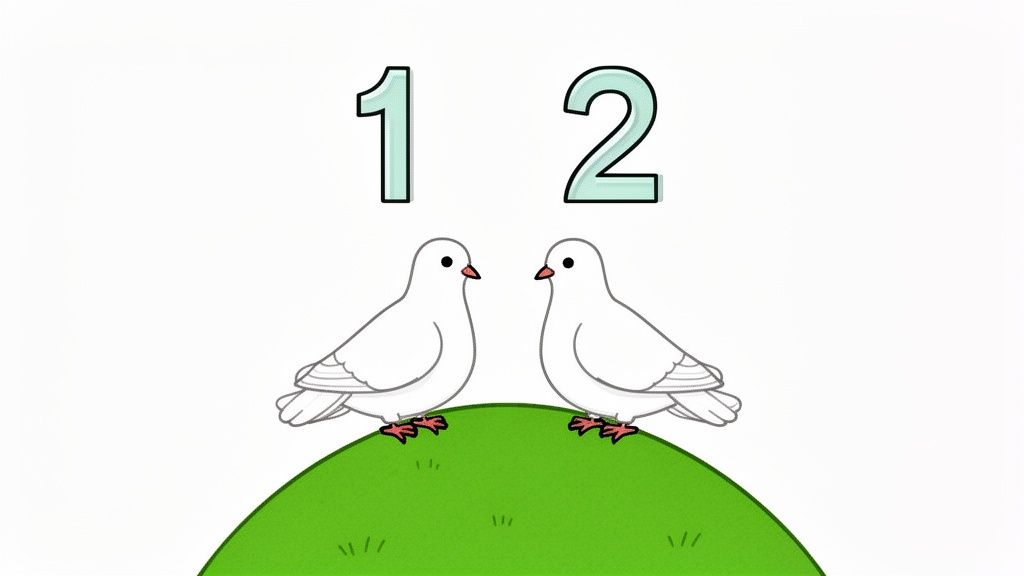
- Create Islamic-Themed Lyrics: Replace the "blackbirds" with symbols that carry positive Islamic connotations, such as doves, which are mentioned in the Qur'an. You can also adapt it to teach about cooperation between siblings. > Babymode Adaptation: “Two little doves sitting on a hill, one named Sabr and one named Jamil. Fly away, Sabr, fly away, Jamil! Come back, Sabr, come back, Jamil!”
- Teach Good Deeds: Frame the two birds as good deeds (Hasanat). When they "fly away," they are being done, and when they "come back," they are being rewarded. This introduces the concept of cause and effect in a gentle, abstract way.
- Use Puppets or Visual Aids: For younger children, simple finger puppets or felt board cutouts of doves or children can make the song more engaging. Clear, close-up demonstrations of the hand actions are essential for little ones to follow along.
Why It’s Effective for Muslim Families
"Two Little Blackbirds" is more than just a counting song; it’s a tool for teaching foundational concepts like pairs, opposites, and coordination. By adapting it with Islamic themes, parents can transform a simple finger-play game into a meaningful lesson about patience (Sabr), beauty (Jamil), or the value of good actions.
This rhyme is perfect for one-on-one bonding time, helping to build a secure attachment between parent and child. Its calming rhythm also makes it suitable for quiet moments before a nap. By incorporating it into daily routines, you can seamlessly weave faith-based learning into your child's playtime.
5. Ten Green Bottles (Reverse Counting & Language Development)
"Ten Green Bottles" is a classic cumulative song that introduces preschoolers to the concept of subtraction and reverse counting. The song’s narrative, which involves bottles accidentally falling one by one, teaches numbers from ten down to zero. Its predictable and repetitive structure helps children anticipate the next line, reinforcing number sequence and strengthening memory and language skills.
This song is particularly useful for its ability to be adapted to stories and themes that align with Islamic values. By replacing the falling bottles with more positive or neutral actions, it can be transformed into a valuable tool for teaching concepts of kindness, tidying up, or even religious practices in a playful, memorable way.
How to Implement and Adapt
The core strength of this song is its narrative structure, which can be easily modified to suit a Muslim family’s values. Instead of focusing on items falling or breaking, the story can be about completing positive actions or organising items.
- Create Positive Islamic Narratives: Change the theme to one that encourages good deeds or reflects daily Muslim life. For example, counting down good deeds done for the day or Surahs memorised. > Babymode Adaptation: “Ten kind deeds we did today, ten kind deeds we did today. And if one kind deed is for Allah’s sake, there’ll be nine kind deeds to still make.”
- Focus on Tidying and Order: A wonderful adaptation is to use the song for cleanup time. Count down toys as they are put away in a box, transforming a chore into a fun counting game.
- Use Visual and Physical Aids: Line up ten toys, blocks, or even cushions. As you sing each verse, physically remove one item. This kinesthetic approach helps children grasp the concept of "one less" and makes the abstract idea of subtraction tangible. For younger toddlers, start with just five items to keep it simple.
Why It’s Effective for Muslim Families
This song offers a fantastic opportunity to teach reverse counting, a foundational maths skill, within a positive and values-driven context. Adapting it to themes like completing good deeds or tidying up helps instill concepts of responsibility, order, and seeking Allah’s pleasure through small, everyday actions.
By turning a traditional counting song for preschoolers into a lesson on positive behaviour, parents can seamlessly blend early numeracy education with Islamic tarbiyah (upbringing). This makes learning feel purposeful and integrated into the fabric of a Muslim home.
6. One, Two, Buckle My Shoe (Sequential Counting with Rhyming)
This well-loved nursery rhyme is a powerhouse among counting songs for preschoolers, cleverly pairing numbers with simple, rhyming actions. The song typically counts from one to ten, with each pair of numbers forming a couplet that tells a small story, like "One, two, buckle my shoe" or "Three, four, shut the door." This structure simultaneously reinforces number sequencing, phonemic awareness, and vocabulary.
The predictable rhythm and strong rhyming pattern make the sequence easy for young children to memorise. This makes it a fantastic tool for faith-based adaptations, as the familiar cadence can be used to introduce Islamic concepts and phrases in a way that feels natural and playful.
How to Implement and Adapt
The action-oriented nature of this song makes it highly engaging, and its structure is perfect for customisation. Swapping the original actions for ones that reflect a Muslim family's daily life can make learning numbers a spiritually enriching activity.
- Create Islamic Rhyming Couplets: Develop new lyrics that connect numbers to Islamic values and routines. The key is to maintain the simple, predictable rhythm. > Babymode Adaptation: "One, two, say Bismillah too. Three, four, knock on the door. Five, six, no naughty tricks. Seven, eight, a clean, full plate."
- Pair Numbers with Prayer Actions: Link the counting sequence to the steps of salah. For instance, "One, two, our hands we raise. Three, four, on the floor." This kinesthetic approach helps children associate numbers with meaningful movements.
- Use Hand Gestures and Props: Act out each line. Pretend to buckle a shoe, knock on a door, or pick up sticks. Using simple props or creating story cards for each couplet can make the song even more interactive and memorable for visual learners.
Why It’s Effective for Muslim Families
"One, Two, Buckle My Shoe" is effective because it embeds numerical learning within the context of actions and daily routines. By adapting the lyrics, parents and educators can transform it into a tool for teaching both numbers and Islamic manners (adab). This approach helps children see that their faith is a natural and joyful part of everyday activities, from saying Bismillah before eating to being kind to others.
7. This Old Man (Skip Counting & Rhythmic Pattern Recognition)
This traditional British nursery rhyme is a fantastic tool for introducing more than just simple counting. Its strong, predictable rhythm and engaging narrative about an old man playing "knick-knack" teach rhythmic pattern recognition and lay the groundwork for understanding more complex mathematical sequences. The repetitive structure helps children anticipate what comes next, building cognitive skills and memory.
While the original lyrics are harmless, the song’s powerful melodic and rhythmic framework makes it an excellent candidate for faith-aligned adaptations. The tune can be repurposed to count blessings, good deeds, or elements of Allah's creation, transforming a simple counting song into a meaningful lesson in gratitude and faith.
How to Implement and Adapt
The core value of "This Old Man" is its pattern-based learning, which can be easily customised with Islamic themes. By replacing the original narrative, you can create a fun, educational experience that reinforces a child’s Muslim identity.
- Create Faith-Centred Lyrics: Change the "old man" to a "good person" or focus on counting blessings from Allah. Replace the phrase "knick-knack paddywhack" with something positive and faith-affirming. > Babymode Adaptation: “This good person, he counts one, he counts his blessings one by one. With a Subhanallah, Alhamdulillah, let's thank Allah alone. This good person is never on his own.”
- Teach Skip Counting with Good Deeds: Adapt the song to count by twos, fives, or tens using the concept of good deeds. For example, "He counts by twos, to help is what he’ll choose," helping children see numbers in groups.
- Use Rhythmic Hand Motions: The traditional "rolling hands" gesture is perfect for demonstrating counting patterns visually. Use this motion to count along, making the abstract concept of numbers more concrete. Pair this with flashcards showing both English and Arabic numerals (١, ٢, ٣).
Why It’s Effective for Muslim Families
This song’s rhythmic nature makes it especially effective for teaching foundational maths concepts in a way that feels like play. When adapted with Islamic lyrics, it becomes a powerful tool for embedding core values. Using phrases like "Subhanallah" and "Alhamdulillah" within the song normalises praising Allah in everyday activities.
By transforming this classic rhyme, parents can introduce concepts like gratitude and good deeds alongside numeracy. This integrated approach helps children connect their learning directly to their faith, creating an educational experience that is both intellectually stimulating and spiritually enriching.
8. Count and Clap Song (Auditory-Kinesthetic Integration)
This contemporary educational song merges vocal counting with synchronised clapping, tapping, or stomping, creating a powerful multi-sensory learning experience. This method engages a child's visual, auditory, and kinesthetic (movement-based) pathways simultaneously, making it one of the most effective types of counting songs for preschoolers. It teaches number sequences while building essential skills like rhythm, coordination, and motor planning.
The active nature of this song is perfect for toddlers who need to move their bodies. For Muslim families, this format provides an exciting opportunity to connect physical actions with Islamic concepts, turning a simple counting game into a meaningful act of remembrance and learning.
How to Implement and Adapt
The core idea is to pair a number with a physical action, which can be easily adapted to include Islamic values and language. This approach is excellent for helping little ones embody what they are learning.
- Incorporate Islamic Phrases: Link each number to a short, rhythmic Islamic phrase. This connects counting with positive spiritual affirmations, building a natural association between numbers and faith. > Babymode Adaptation: “One, say Subhanallah [clap], Two, say Alhamdulillah [clap], Three, say Allahu Akbar [clap]...”
- Vary the Kinesthetic Actions: Keep your child engaged by changing the movements. Start with simple claps, then introduce knee pats, foot stomps, or gentle pats on the chest. This variation helps develop different motor skills.
- Create Bilingual Versions: Use the count-and-clap rhythm to introduce Arabic or Urdu numbers. Sing "One [clap], Two [clap]," then follow up with "Wahid [clap], Ithnan [clap]." The physical action acts as a bridge between the two languages.
Why It’s Effective for Muslim Families
The Count and Clap song is highly effective because it channels a toddler's natural energy into constructive, faith-centred learning. By associating numbers with physical praise like saying "Alhamdulillah," children learn that remembrance of Allah can be a joyful and active part of their day. This method is fantastic for teaching foundational Islamic concepts, like the five pillars or the names of daily prayers, in a way that is memorable and physically engaging.
9. Counting Food/Fruits (Practical Numeracy & Vocabulary Combination)
This category of counting songs for preschoolers uses familiar food items like apples, dates, or berries to teach numbers in a tangible way. By grounding abstract number concepts in concrete objects from a toddler's daily life, these songs make learning to count more intuitive and relatable. This approach powerfully combines mathematical and linguistic development, building a child's food vocabulary and even nutritional awareness at the same time.
For Muslim families, this method offers a beautiful opportunity to connect counting with foods that have cultural or religious significance. It transforms a simple numeracy exercise into a moment of gratitude and learning about halal and sunnah practices, making everyday meals a learning opportunity.
How to Implement and Adapt
The key is to use foods that are not only familiar but also hold special meaning within an Islamic context. This enriches the learning experience, making it both educational and spiritually nurturing.
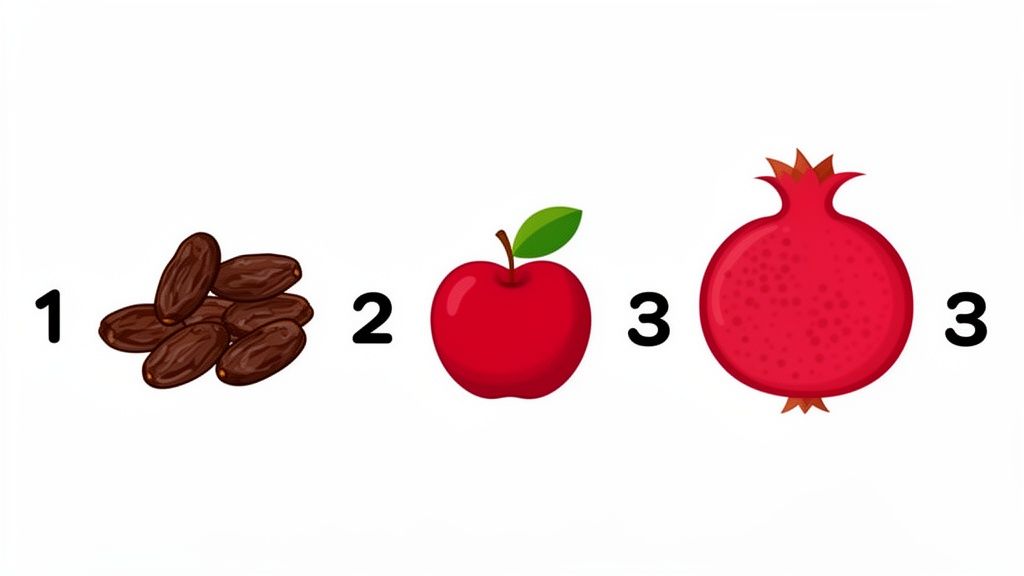
- Focus on Sunnah and Qur'anic Foods: Create simple songs that count foods mentioned in Islamic tradition, such as dates, pomegranates, olives, or figs. This connects counting to faith in a gentle, natural way. > Babymode Adaptation: “One little date, sweet and brown. Two little dates, we gobble them down. Three little dates, a sunnah food for me, Alhamdulillah for dates, one, two, three!”
- Create Bilingual Food Vocabulary: Use a simple melody to count foods in English and then in another language like Arabic or Urdu. For example, "One apple, wahid tuffah; Two bananas, ithnan mawz." This builds language skills during snack time.
- Incorporate Gratitude: End each song with "Alhamdulillah" to teach gratitude for Allah's blessings. This simple addition embeds an important Islamic value into the counting practice.
Why It’s Effective for Muslim Families
Songs that count food items are incredibly effective because they link learning directly to a child's lived experience. Mealtimes and snack times become opportunities for playful education. By focusing on halal and sunnah foods, parents can reinforce both dietary guidelines and beneficial Islamic practices from the earliest age. This approach helps children appreciate the blessings of food and see their faith reflected in the simple, everyday routine of eating.
Integrating counting with tangible items also complements other forms of hands-on learning, like playing with educational toys. For more ideas on how tactile play can support development, explore our guide to shape toys for toddlers.
10. Body Parts Counting (Anatomical Awareness & Motor Development)
Counting songs that focus on body parts are a fantastic tool for toddlers, teaching numbers while also fostering body awareness and gross motor skills. These songs encourage children to identify and count their fingers, toes, eyes, and ears, helping them develop a sense of self and an understanding of their own bodies. This kinesthetic approach, where movement is linked to learning, creates strong neural connections for both numeracy and anatomy.
For Muslim families, this type of song provides a beautiful opportunity to frame the body as a blessing from Allah. It shifts the focus from simple identification to one of gratitude and appreciation for the gifts of sight, hearing, and movement, making it a powerful and spiritually grounding activity.
How to Implement and Adapt
The key is to connect counting with a sense of gratitude and wonder. These songs should be gentle, interactive, and filled with positive reinforcement about the amazing way we are created.
- Infuse Islamic Gratitude: Frame the counting activity as an act of thankfulness. Instead of just counting two eyes, you can sing about being thankful for the two eyes that Allah gave you to see the world. > Babymode Adaptation: “One little nose to smell the flowers, Alhamdulillah for this gift of ours. Two little ears to hear the adhan, Alhamdulillah for Allah’s great plan.”
- Create Bilingual Vocabulary Songs: Use a simple melody to teach the names of body parts in both English and Arabic or Urdu. Sing "I have two eyes, I have aynain," while pointing to your eyes. This introduces new vocabulary in a fun, repetitive way.
- Focus on Tactile Interaction: Gently guide your child to touch their own nose, ears, or count their fingers as you sing. This hands-on interaction is crucial for toddlers and helps them internalise the concepts much faster than passive watching.
Why It’s Effective for Muslim Families
These counting songs for preschoolers are incredibly effective because they align perfectly with the Islamic concept of shukr (gratitude). They teach children that their bodies are a precious trust (amanah) from Allah and that each part has a purpose and is a blessing. This foundational understanding helps nurture a positive self-image rooted in faith.
By linking counting to gratitude for their own bodies, you are teaching more than just numbers; you are instilling an early sense of awe and appreciation for Allah's creation. This makes learning a holistic experience that nurtures both the mind and the soul.
Preschool Counting Songs — 10-Item Comparison
| Song / Activity | Implementation 🔄 | Resources ⚡ | Expected Outcomes ⭐📊 | Ideal Use Cases 💡 | Key Advantages ⭐ |
|---|---|---|---|---|---|
| One, Two, Three, Four, Five (Traditional Counting Rhyme) | 🔄 Low — simple melody and repeatable structure, easy lyric swaps | ⚡ Minimal — voice-only or simple visuals | ⭐📊 Foundational 1–5 numeracy, strong memorization | 💡 Intro to numbers for 1–3 year-olds, short attention spans | ⭐ Highly memorable, very adaptable to Islamic themes |
| Number Song (Super Simple Songs - Counting 1-10) | 🔄 Low–Medium — requires synchronized gestures and clear pacing | ⚡ Low–Moderate — quality audio/video; possible licensing | ⭐📊 Comprehensive 1–10 counting, kinesthetic reinforcement | 💡 Group lessons or videos for 0–3 age band; bilingual adaptation | ⭐ Covers 1–10, proven classroom effectiveness, kinesthetic aid |
| Five Little Monkeys (Subtraction & Counting Song) | 🔄 Medium — narrative sequencing & safety reframing needed | ⚡ Moderate — animation/sound effects and careful scripting | ⭐📊 Teaches subtraction (counting down), narrative comprehension | 💡 2–3 year-olds learning subtraction and cause–effect | ⭐ Engaging story-based subtraction; high replay value |
| Two Little Blackbirds (Counting Pairs & Left-Right Coordination) | 🔄 Low–Medium — finger-play choreography and clear demonstration | ⚡ Minimal — hands/puppets or simple props | ⭐📊 Fine motor development, concept of pairs, left–right awareness | 💡 Fine-motor practice and parent-child bonding (12–36 mo) | ⭐ Strong fine-motor and grouping benefits, calming activity |
| Ten Green Bottles (Reverse Counting & Language Development) | 🔄 Medium — long/cumulative structure; may need condensation | ⚡ Moderate — multiple verse visuals/animation for 10→0 | ⭐📊 Reverse counting to 0, expanded number range, vocabulary growth | 💡 Vocabulary and countdown practice for 2–3 year-olds | ⭐ Teaches countdown concept and larger number range |
| One, Two, Buckle My Shoe (Sequential Counting with Rhyming) | 🔄 Low–Medium — rhymed couplets with action cues | ⚡ Low — visuals/actions; optional simple audio | ⭐📊 Sequencing, phonemic awareness, action-based learning | 💡 Phonics + counting sessions; active participation for toddlers | ⭐ Combines rhyme and action to boost memory and engagement |
| This Old Man (Skip Counting & Rhythmic Pattern Recognition) | 🔄 Medium — pattern variations and cultural rewording required | ⚡ Low–Moderate — rhythm focus, clear gesture examples | ⭐📊 Introduces skip counting and rhythmic pattern recognition | 💡 Preparing children for patterned counting (2–3 yrs) | ⭐ Flexible format for multiple counting patterns and call-response |
| Count and Clap Song (Auditory-Kinesthetic Integration) | 🔄 Medium — needs tight synchronization of audio and movement | ⚡ Low–Moderate — high-quality video showing movements clearly | ⭐📊 Improves coordination, rhythm, and multi-sensory number recall | 💡 Motor-development sessions and parent-led home activities | ⭐ Multi-sensory, scalable difficulty, excellent for coordination |
| Counting Food/Fruits (Practical Numeracy & Vocabulary Combination) | 🔄 Low — object-based counting; easy to script culturally | ⚡ Low–Moderate — good food visuals/animation, cultural vetting | ⭐📊 Concrete numeracy, food vocabulary, cultural/halal learning | 💡 Mealtime learning, nutrition education, cultural lessons | ⭐ Concrete, relatable examples; opportunity to teach halal/Sunnah |
| Body Parts Counting (Anatomical Awareness & Motor Development) | 🔄 Low — direct pointing/touch prompts; script sensitivity needed | ⚡ Minimal — on-screen model or parent demonstration | ⭐📊 Body awareness, proprioception, counting + anatomy vocabulary | 💡 Parent-child activities, occupational therapy goals, early body literacy | ⭐ No props needed, highly engaging and self-directed learning |
Making Every Number Count: Your Next Steps
We’ve journeyed through ten delightful counting songs, from the classic charm of "One, Two, Three, Four, Five" to the dynamic actions of the "Count and Clap Song." Each tune offers more than just a way to learn numbers; they are gateways to bonding, developing motor skills, and building foundational knowledge in a way that feels like pure, joyful play. The real magic happens not just in the singing, but in how you weave these simple melodies into the fabric of your daily Muslim family life.
The key takeaway is that learning is an act of worship when done with the right intention. These counting songs for preschoolers are not just educational tools; they are opportunities to nurture your child’s curiosity and intellect, gifts entrusted to us by Allah (SWT). By adapting lyrics to include halal foods, Islamic concepts, or even phrases in Arabic or Urdu, you are creating a learning environment that is both stimulating and spiritually affirming. You are showing your child that their faith is a natural, beautiful part of every single activity, even something as simple as counting fingers and toes.
Weaving Numbers into Your Daily Rhythm
The true power of these songs is unlocked when they become part of your routine. Moving forward, think about integrating them into your day-to-day moments.
- During Snack Time: Sing a song about counting dates, olives, or berries. This transforms a simple snack into a hands-on maths lesson.
- While Getting Dressed: Use "One, Two, Buckle My Shoe" as you put on socks and shoes, making the morning routine smoother and more playful.
- At Playtime: Use "Five Little Monkeys" with stuffed animals or finger puppets to introduce the concept of subtraction in a gentle, narrative-driven way.
- Before Salah: Count the rak’ahs for the upcoming prayer or count your child’s fingers as you sit together on the prayer mat.
This consistent, gentle repetition is what helps a young child’s brain form strong neural connections. It builds a sense of security and predictability while making learning effortless.
Nurturing a Love for Learning, Rooted in Faith
As you continue this journey, remember that your role is not just to teach numbers but to cultivate a love for discovery. When you sing, clap, and move with your child, you are communicating that learning is exciting and something you can do together. This positive association with education is a priceless gift that will serve them for the rest of their lives, Insha'Allah.
Remember, the goal isn't just to teach one, two, three. It's to build a foundation of joyful learning, where every new concept is discovered within the safety and warmth of your family's values. You are nurturing a future learner who is confident, curious, and connected to their deen.
As your child masters these counting songs, you might want to explore further how to help your preschooler grasp math concepts early on, laying a solid foundation for future learning. The principles of making learning tangible and fun are universal. By starting with these songs, you are already giving your child a powerful head start, embedding numeracy into their world in a way that feels natural and deeply connected to their home life.
Ultimately, every number counted, every rhyme sung, and every shared smile is a building block. You are not just teaching mathematics; you are building memories, strengthening bonds, and raising a child who sees beauty, order, and purpose in the world around them, all through the beautiful lens of our faith.
Tired of endlessly searching for safe, halal, and ad-free content? Babymode offers a curated world of purposeful screen time, including gentle counting songs and nasheeds designed for Muslim children aged 0-3. Join the waitlist to create a calm and faith-aligned media experience for your little one.