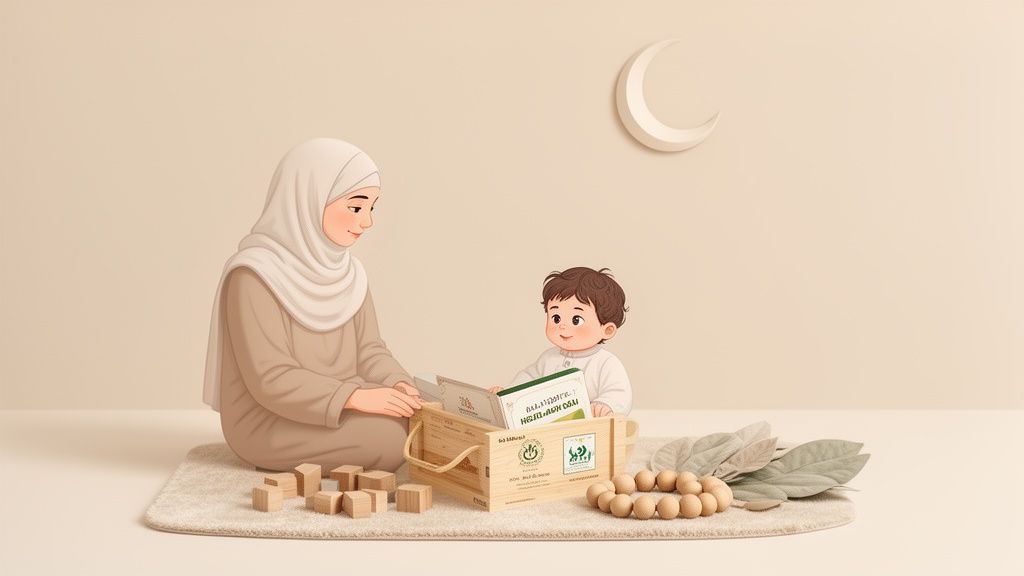
A learning box preschool is really just a simple, powerful system you create at home. You put together themed boxes filled with hands-on activities for your little one, and you rotate them regularly to keep things feeling new and exciting. It's a fantastic screen-free approach that offers a calm, focused alternative to the digital world for children aged 0-3.
Why a Learning Box Preschool Just Works for Modern Muslim Families
In a world buzzing with distractions, so many of us Muslim parents are searching for gentle, intentional ways to raise our children. We want to protect their innocence and start building a strong foundation of faith and good character right from the start. The whole idea of a learning box preschool aligns so beautifully with that vision.
This isn't about pushing academics or sticking to a rigid schedule. Not at all. It's about creating small, precious moments of connection and discovery that fit into the natural rhythm of a Muslim home. Think of it as a way to have enriching, hands-on activities ready to go—perfect for the quiet moments between prayers, before naptime, or even while you’re busy in the kitchen preparing for Iftar.
A Calm Alternative to Overstimulation
Let's be honest, one of the biggest struggles for parents today is managing screen time and shielding our kids from content that just doesn't sit right with our values. A learning box is such a positive, powerful answer to that challenge. Because you're the one curating every single item, you have complete peace of mind that everything is halal-friendly, safe, and right for their developmental stage.
This hands-on approach is wonderful for nurturing your child’s fitra—their pure, natural disposition. It encourages them to focus, solve little problems, and develop a genuine love for learning without the frantic pace of screens. And we’re not alone in feeling this way; it’s a global shift. The market for kids' activity boxes has grown significantly as more families see the value in hands-on play, with North America making up nearly 40% of this demand.
By simply offering a curated box of items, you’re creating a calm, predictable activity that invites your child to explore at their own pace. This is how we build independence and deep concentration—skills that will serve them for a lifetime, insha'Allah.
Integrating Faith and Play Seamlessly
The real magic of a learning box system for a Muslim family is how effortlessly you can weave in our faith and values. It goes way beyond just learning colours and shapes; it becomes about connecting those concepts back to Allah's beautiful creation.
Imagine the possibilities. A learning box can help you:
* Foster Good Akhlaq: Activities can be designed around sharing, taking turns, and being gentle.
* Introduce Islamic Concepts: You could create a box themed around the moon for Ramadan, use different fabrics and spices for a sensory box exploring items mentioned in the Qur'an, or use simple blocks to build a mini masjid.
* Connect with Daily Life: These activities are self-contained and easy to pull out for just a few minutes of focused play while waiting for Maghrib or during a quiet afternoon.
Ultimately, this method helps you cultivate a peaceful, intentional learning atmosphere right in your own home. If you appreciate structured, faith-aligned educational philosophies, you might also enjoy our guide on exploring the Montessori method from a Muslim perspective.
Getting Started with Your First Halal-Friendly Learning Box

The whole idea of a learning box preschool system can seem like a lot of work, but getting your first one ready is surprisingly simple. You really don't need a cart full of expensive, specialized toys. Honestly, you probably have a treasure trove of perfect items already tucked away in your kitchen drawers and closets.
The secret is to look for simple, open-ended objects that spark a child's natural curiosity. We're aiming for a small, manageable collection that your little one can safely explore. This isn’t about creating a picture-perfect setup for social media; it's about carving out a moment of focused, peaceful play that actually fits into the beautiful chaos of your day.
Start with a Simple Container
Before you even think about what goes inside, find the right container. It doesn’t need to be anything fancy. A shoebox, a woven basket, or a clear plastic bin works wonderfully. The container itself becomes a cue, signaling to your child that it’s time for a special, focused activity.
If possible, pick something your toddler can eventually learn to open themselves. This little step is a great way to build their sense of independence and accomplishment. When you're labeling your boxes for rotation, consider using things like dissolvable labels for hands-on learning—they make it easy to switch themes without any sticky residue or waste.
Gathering Your Halal-Friendly Materials
Now for the fun part: the treasure hunt! The goal is to collect a handful of items that are safe, engaging, and aligned with your values—meaning no inappropriate images or sounds. Think about different textures, shapes, and things that can be stacked, sorted, or just explored by curious little hands.
Here are a few ideas to get you started, using everyday objects you likely have right now:
- For Sensory Exploration: A soft scrap of prayer mat fabric, a clean dish brush with gentle bristles, a smooth wooden spoon, or a few large, uncooked pasta shells in a little bowl.
- For Fine Motor Skills: A few colourful bottle caps (big enough not to be a choking hazard!), a handful of chunky wooden beads and a shoelace for threading practice, or a small container filled with cotton balls to pull out and stuff back in.
- From the Real World: An empty (and thoroughly cleaned) spice jar with a screw-on lid, a set of measuring spoons on their ring, or a few different-sized lids from various food containers.
Safety First, Always: For children in the 0–3 age group, preventing choking is the top priority. My go-to rule of thumb is this: if an object can fit through a toilet paper tube, it’s too small for unsupervised play. Always stay close and supervise your child when they're using their learning box.
Putting It All Together
Once you have about 5–7 interesting items, just place them inside your chosen box. That’s it! The beauty of this system is its sheer simplicity. You can realistically pull one of these together in ten minutes during naptime using only things you find in a single kitchen drawer.
Try not to overfill the box. A smaller, thoughtfully chosen selection is far less overwhelming for a young child and encourages them to focus more deeply on each item. As your little one grows, you can start introducing more complex things like simple puzzles or sorting trays. If you're looking for more toy ideas down the line, you can find great tips on what to look for in alphabet learning toys in our helpful guide.
Faith-Inspired Activities for Ages 0 to 3
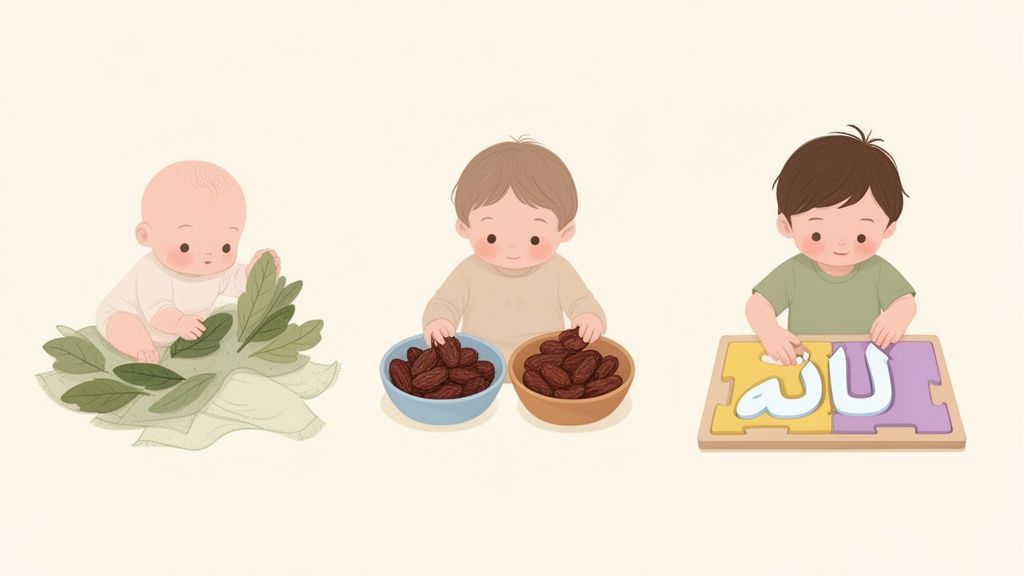
This is where the magic really happens—filling your learning box preschool system with activities that not only nurture your little one's development but also gently connect them to their faith. The secret is to match everything to their specific stage of discovery. We want to keep it simple, sensory-rich, and rooted in the wonders of Allah's creation.
Remember, every stage opens a new door. For a baby, the world is all about touch and sound. For a toddler, that world starts to have patterns to sort and objects to move with real purpose.
Activities for Babies 0 to 12 Months
At this precious age, learning is almost entirely sensory. Your goal is simply to provide safe, interesting items that stimulate their sense of touch, sight, and hearing. It’s all about introducing them to the beautiful variety in the world around them.
Think about interesting textures and gentle sounds that they can safely explore with their hands and, inevitably, their mouths. The focus here is pure discovery, not achieving a specific outcome.
- A "Textures of Creation" Basket: I love this one. Just gather a few items with distinct feelings. You could include a smooth, cool stone from the garden, a soft feather (large enough not to be a choking hazard!), a rough piece of bark, and a soft square of wool.
- Sounds of the Home: An empty, clean spice bottle filled with a few grains of rice or lentils makes a lovely, gentle shaker. A set of wooden measuring spoons is also fantastic—they create such a satisfying clacking sound when tapped together.
The purpose here is simple observation and connection. As your baby explores a leaf, you can just whisper, "SubhanAllah, look at the beautiful green leaf Allah made." You're planting the very first seeds of connection between the world and the Creator.
Activities for Young Toddlers 1 to 2 Years
Young toddlers are driven by a deep need for order and an intense desire to use their hands with more skill. They absolutely love sorting, stacking, pouring, and fitting things together. This is the perfect time to introduce activities that build those crucial fine motor skills and their ability to concentrate.
These simple tasks satisfy their innate desire to categorise and make sense of their environment. I find it’s also a wonderful time to have a calm nasheed playing in the background while they work.
- Sorting Dates: Place a few large Medjool dates and some smaller Deglet Noor dates in a bowl. Then, provide two smaller bowls and show your toddler how to sort them by size—one for the big dates, one for the small ones.
- Threading Large Beads: Use chunky wooden beads (far too big to be a choking hazard) and a thick shoelace with a knot at one end. This simple action is fantastic for developing hand-eye coordination and a little bit of patience.
- Pouring and Scooping: A tray with two small, non-breakable pitchers—one filled with dry chickpeas or large lentils—is a recipe for a very happy toddler. They can practice pouring back and forth, which is so satisfying for them.
Activities for Older Toddlers 2 to 3 Years
By this age, toddlers are ready for more complex challenges. They can start exploring early concepts like letters and numbers, and you can introduce simple ideas that reflect Islamic values in a tangible way. Their attention spans are growing, which opens the door for activities with a few more steps.
Now, the focus starts to shift toward recognizing patterns, basic counting, and connecting their actions to meaningful concepts.
- Arabic Letter Puzzles: A simple wooden puzzle with the first few Arabic letters is a wonderful introduction. As they place the "Alif" piece, you can say the letter's name. It's a gentle, play-based start.
- A Sadaqa Box: Decorate a small box together and call it your "Sadaqa Box." Add a few large, play coins to the learning box. Show your toddler how to post the coins through a slot in the box while talking simply about the joy of giving to others.
- Counting Tasbih Beads: Use a large-beaded tasbih (or even make one with giant craft beads) to practice counting to three. You can guide their tiny finger as they touch each bead and say, "one, two, three."
To make it even easier to see how these activities align with your child's growth, here is a quick-reference table. Think of it as a cheat sheet for matching a fun activity to a specific developmental goal.
Sample Learning Box Activities by Age and Developmental Goal
| Age Group | Developmental Focus | Halal-Aligned Activity Idea | Materials Needed |
|---|---|---|---|
| 0–12 Months | Sensory Exploration | Textures of Creation Basket: Exploring items from nature. | A small basket, a smooth stone, a large feather, a piece of bark, a wool scrap. |
| 0–12 Months | Auditory Stimulation | Homemade Shakers: Creating gentle sounds. | Empty spice jars, rice or lentils, wooden spoons. |
| 1–2 Years | Fine Motor Skills & Sorting | Date Sorting: Categorizing by size. | A large bowl, two small bowls, a mix of large and small dates. |
| 1–2 Years | Hand-Eye Coordination | Threading Tasbih Beads: Practicing precision. | Large wooden beads, a thick shoelace with a knot. |
| 2–3 Years | Early Literacy | Arabic Letter Puzzles: Letter recognition through play. | A simple wooden puzzle with large Arabic letter pieces. |
| 2–3 Years | Early Numeracy & Values | Counting on a Tasbih: One-to-one correspondence. | A large-beaded, child-safe tasbih. |
| 2–3 Years | Understanding Values | The Sadaqa Box: Practicing the concept of giving. | A small decorated box with a slot, large play coins. |
Hopefully, this table gives you a clear snapshot of how simple, everyday items can become powerful tools for both learning and spiritual connection in your child's earliest years.
Weaving Learning Boxes into Your Daily Rhythm
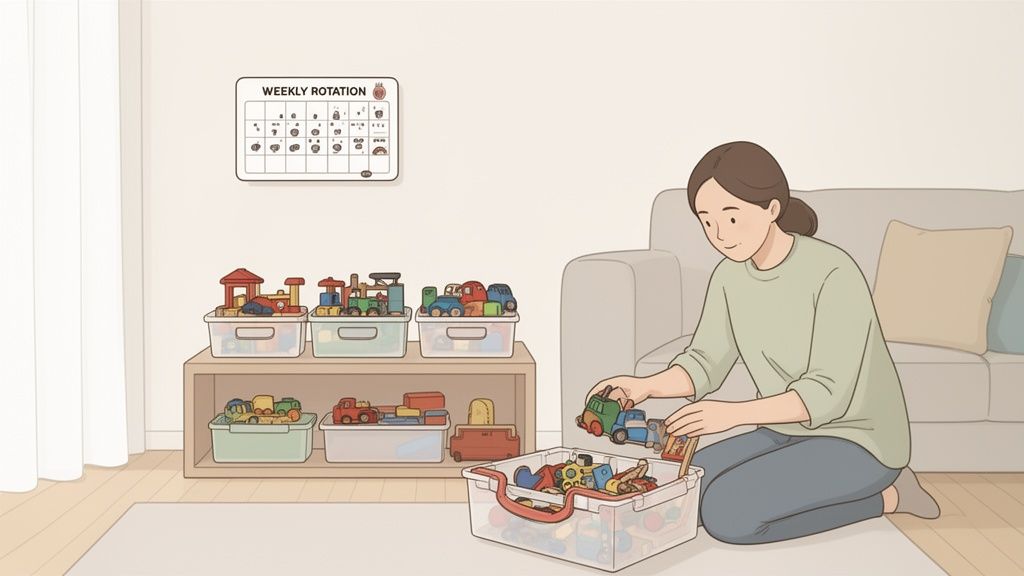
Having a fantastic collection of activities is a great start, but the real magic of a learning box preschool system happens when you weave it into the natural flow of your day. It’s not about adding another stressful "to-do" to your list. Instead, it’s about creating a predictable, peaceful moment for connection that little ones truly need to thrive.
Look for the quiet pockets in your day. Could that calm 15 minutes after the Dhuhr prayer become your special "box time"? During Ramadan, this can be a true lifesaver—a focused, quiet activity for your toddler while you prepare Iftar.
When you link the learning box to something that already happens every day, you create a beautiful anchor. Your child will quickly learn to anticipate this special time with excitement.
The Secret to Keeping Things Fresh: Toy Rotation
One of my favorite strategies for keeping kids genuinely interested is toy rotation. The idea is simple: you only have a few learning boxes out at any given time, while the others are stored away.
When you swap them out, the "old" toys suddenly feel brand new again. This simple trick is incredible for preventing the overstimulation that comes from having too much stuff out at once. It keeps your child deeply engaged with the materials right in front of them.
You don't need a complicated schedule. A simple weekly swap is often all it takes.
- Pick a swap day: Many families I know love using Friday. It links the excitement of a "new" box with the special feeling of Jummah.
- Watch for cues: If you notice your child is losing interest after just a few days, try rotating a box twice a week. The goal is to follow their natural rhythm.
- Keep it manageable: You might have four boxes in total rotation, but only bring out one or two for your child to access at a time.
This gentle rotation does more than just combat boredom. It teaches children to value and appreciate their belongings, encouraging them to explore each item more deeply rather than flitting from one thing to the next in a room full of clutter.
Smart Storage for a Tidy, Peaceful Home
Let's be honest—most of us don't have a giant, dedicated playroom. The thought of adding more "stuff" to our living space can feel completely overwhelming. The key is finding storage solutions that work for you, even if you're in a small apartment or a busy home.
A tall, narrow shelving unit tucked away in a closet can be a game-changer for storing the out-of-rotation boxes. I highly recommend clear, stackable bins so you can see what's inside at a glance. This makes the weekly swap quick and painless.
Keeping the stored boxes out of your child's sight is also crucial—it preserves that wonderful element of surprise and excitement when a "new" box appears.
Of course, a calm daily rhythm isn't just about play; it's also about nourishment. To round out your routine with healthy habits, check out this excellent parent's guide to the best snacks for preschoolers. When both playtime and snack time are predictable, you help create a secure and happy environment where your child can flourish.
Balancing Hands-On Play with Mindful Screen Time
Let's be honest with ourselves. In most of our homes, screens are a part of the daily rhythm. The idea of completely banning them can feel overwhelming and, frankly, unrealistic when you’re trying to manage prayer times or just get dinner on the table.
So, instead of focusing on guilt, let's shift our perspective. The real goal is to make screen time intentional, mindful, and aligned with our family’s values.
This is where the beauty of a learning box preschool really shines. It doesn't have to be at war with digital tools. When used thoughtfully, screen time can become a powerful supplement to hands-on play, not a replacement for it. Think of it as building a bridge—connecting a digital idea to a real, tangible experience.
From Screen to Hands-On Learning
Let me paint a picture for you. Imagine you and your toddler snuggled up together, watching a short, sweet Babymode video about the Arabic letter 'Alif'. The video is calm, focused, and completely free of jarring ads or those distracting "up next" suggestions. It’s a shared, purposeful moment.
The video ends after just a couple of minutes. The screen goes off, and you turn to your learning box. Inside, you pull out a large wooden puzzle piece of the letter 'Alif'. Now, your child’s hands are on it. They can trace its shape, feel its texture, and connect the abstract sound and image from the screen to something solid and real.
See the difference? This simple routine transforms passive viewing into active, engaged learning. It frames screen time not as an endless digital babysitter, but as a specific tool with a clear start and a clear finish, used for a very specific purpose. This approach gives you the confidence to use modern tools without compromising on your commitment to hands-on development or your family's core values.
Choosing Your Tools Wisely
The secret here is using platforms that actually respect your values and your child's developmental needs. Unlike mainstream video sites built on algorithms designed to keep eyes glued to the screen for as long as possible, a closed, curated system puts you back in the driver's seat.
You have total control, ensuring every single piece of content aligns with Islamic principles and is appropriate for your little one’s sensitive mind.
This move toward curated, educational content is a significant trend. The subscription-based model for kids' activity boxes has grown into a major market, with North America alone holding 39.7% of the global share. It shows that parents are actively looking for convenient, trustworthy, and age-appropriate content—and this applies to both their physical and digital resources. You can explore more about this growing market for kids' subscription boxes.
By being selective about what our children watch, we create a safe space for them to explore concepts that matter to us—from the stories in the Quran to the foundations of good character. It allows us to bring technology into our homes in a way that feels supportive, not intrusive.
For a deeper dive into this topic, be sure to read our guide on approaching screen time for ages 0-3 from an Islamic perspective.
Your Learning Box Questions, Answered
Starting a new routine like a learning box preschool system naturally brings up a few questions. It’s completely normal to wonder about the practical side of things, especially when you're juggling the needs of little ones. Let's walk through some of the most common questions I hear from parents.
How Do I Manage This with Both a Baby and a Toddler?
This is the reality in so many homes! The secret isn't to find one-size-fits-all activities, but to create separate, age-appropriate boxes.
For your baby, think "sensory box." Fill it with larger, safe-to-mouth items like a crinkly fabric square or a smooth wooden ring. Meanwhile, your toddler's box can focus on developing fine motor skills with activities like threading chunky beads or stacking blocks.
You can set aside a special, supervised time for each child with their box. Maybe your toddler gets their box while the baby is napping, and vice versa. Another lovely idea is a shared "family box" with items everyone can enjoy together, like soft puppets for telling stories or simple board books.
My Child Gets Bored Easily—How Often Should I Rotate the Boxes?
Every child is different, so the key is to watch your little one and adjust. A once-a-week rotation is a great starting point—maybe you can make "New Box Friday" a fun tradition!
But if you notice your toddler losing interest after just a few days, don't feel locked into a schedule. Feel free to switch to a twice-weekly rotation.
The goal is to reignite curiosity, not stick to a rigid schedule. Honestly, sometimes just swapping out two or three items is enough to make an entire box feel completely new and exciting again.
What If I’m Just Not Creative Enough to Come Up With New Ideas?
Don’t worry about being a Pinterest-perfect parent! You absolutely do not need to be an expert. The best ideas will come from your child’s own budding interests and the rhythm of your daily life.
Is your toddler fascinated by the moon and stars? Create a box with some silver craft paper and star shapes. Are you cooking with lentils? Let them scoop and pour some dry ones on a tray (with close supervision, of course).
Simple is almost always best for this age. A box with nothing more than a few different-sized containers and lids to match can provide a surprising amount of focused, developmental play. You’ve got this.
Ready to create a calm, faith-aligned environment for your little one? Babymode offers a safe, ad-free digital space to complement your hands-on activities with gentle, value-driven screen time.