Helping our toddlers navigate their big feelings is one of the most important jobs we have as parents. In Muslim families, this means guiding them with gentleness, patience, and a deep connection to our faith. Creating a feelings theme preschool environment at home is not about complex lesson plans; it’s about weaving emotional awareness into daily routines, from playtime to bedtime duas.
This guide is for busy Muslim parents seeking practical, faith-aligned activities for children aged 0-3. We understand the unique rhythm of a Muslim household, where learning happens between prayer times and family gatherings. That's why we've compiled a list of resources to help your little one build a healthy emotional vocabulary rooted in Islamic values. You will find actionable ideas for sensory play, art, and storytime, all tailored to protect your child's innocence and nurture their fitra (natural disposition).
Inside, you will discover 10 specific, easy-to-implement activities that foster emotional intelligence while respecting your family’s values. From Dua-Based Feelings Journals to Feelings Puppet Theaters, each suggestion is designed to be screen-free and enriching. This list provides the tools to help your child understand that all feelings are okay, that they can manage them in healthy ways, and that Allah is always near, offering comfort and guidance. Let's explore how to nurture these little hearts with wisdom and love.
1. Emotion Face Recognition Cards with Islamic Values
A cornerstone of any effective feelings theme preschool plan is helping children identify and name their emotions. Emotion face recognition cards are a powerful, tangible tool for this. By integrating Islamic values directly onto the cards, you can transform a simple matching game into a foundational lesson in faith-based emotional regulation.
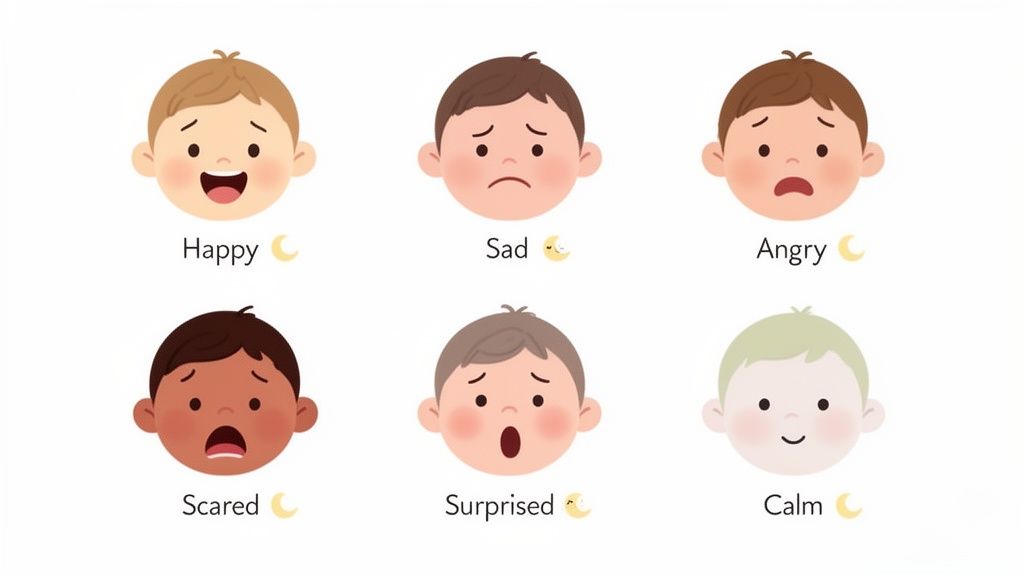
These cards feature diverse faces expressing core feelings like happiness, sadness, anger, fear, surprise, and calmness. The key difference is the addition of a simple, corresponding Islamic phrase or dua. For example, a card showing a happy face might include the phrase "Alhamdulillah" (All praise is for Allah), while a card for a scared face could have "Hasbunallahu Wa Ni'mal Wakeel" (Allah is sufficient for us, and He is the best Disposer of affairs).
This approach connects emotional literacy directly with a child’s growing understanding of their faith. It teaches them that their feelings are valid and that Islam provides beautiful, constructive ways to respond to them. It's a method successfully used by Islamic preschools and homeschooling families who want to build a strong Muslim identity from the earliest years. If you're new to this concept, you can explore how flash cards support early learning here.
Actionable Tips for Implementation
- Laminate for Durability: Little hands will be using these cards often. Laminating them ensures they withstand frequent use, spills, and exploration.
- Create a "Feelings Basket": Designate a special basket or box in your home. Encourage your child to choose a card that matches how they feel, creating a gentle, non-verbal way to communicate their emotions.
- Pair with Storytime: Use the cards during storytime. When a character in a book feels sad, pause and ask your child to find the "sad" card. This helps them connect feelings to actions and consequences in a narrative context.
2. Dua-Based Feelings Journal with Picture Prompts
Moving beyond simple identification, a feelings journal helps children process and express their emotions in a personal, reflective way. A dua-based feelings journal uses drawings, stickers, and pictures to bridge emotional expression with spiritual comfort, making it a powerful tool for your feelings theme preschool activities at home. This interactive journal becomes a safe space where a child's feelings are validated and connected to the reassuring presence of Allah.
The concept is simple: your child uses non-verbal means to show how they feel on a page. They can draw a scribble, choose a sticker, or you can paste a picture. You then act as their scribe, writing down their words about why they feel that way. Beside it, you write a relevant Islamic dua or a short, calming phrase. For instance, next to a drawing about feeling worried, you might write, "Allah is always with you."
This practice is being adopted by Muslim families across North America and the UK. It not only documents emotional growth but creates a precious keepsake that frames a child’s inner world within an Islamic framework. It teaches them that for every feeling, there is a path back to peace through faith, turning a simple activity into a profound act of early spiritual development.
Actionable Tips for Implementation
- Create "Our Feelings Box": Keep the journal, stickers, and crayons in a special, decorated box that is easily accessible. This makes journaling an inviting and regular part of your child's routine.
- Journal During Calm Moments: The best time for journaling is not during a tantrum, but afterwards during a quiet moment. This could be after Maghrib prayers or before bedtime stories.
- Review and Reflect Together: Once a month, sit down and look through the journal with your child. Talk about the different feelings they had. This helps them see that emotions are temporary and provides an opportunity to notice patterns and celebrate their emotional growth.
3. Feelings Puppet Theater with Islamic Characters
Dramatic play is a powerful vehicle for emotional exploration in early childhood, and a puppet theater provides a safe, engaging stage for this discovery. By creating a feelings theme preschool activity centered on familiar characters, you can guide children through social scenarios in a way that is both playful and spiritually grounding. This approach allows little ones to project their feelings onto the puppets, acting out solutions and expressing emotions without direct pressure.
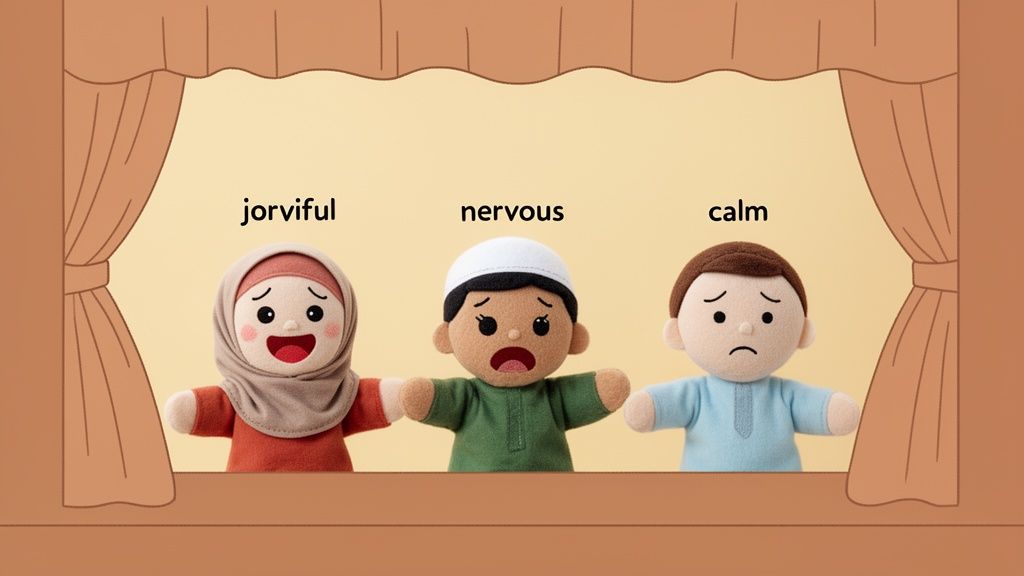
The concept is simple: use hand puppets or felt board figures representing diverse Muslim children to enact short stories about feelings. For instance, a puppet named Omar might feel sad because his friend took his toy. Another puppet, Fatima, can then model a gentle, Islamic response, perhaps suggesting they say "Bismillah" and find a way to share. This method is used effectively in Islamic preschools from Toronto to Singapore to teach emotional regulation aligned with good manners (adab).
This technique builds empathy, problem-solving skills, and emotional vocabulary. It connects the abstract concept of feelings to tangible actions and faith-based language, showing children how to navigate their inner world with kindness. You can discover the developmental benefits of hand puppets for infants to see how this tool supports early learning.
Actionable Tips for Implementation
- Use Simple, Safe Puppets: Choose soft puppets that are easy for toddlers to manipulate. The focus should be on the emotional expression, not on complex puppet mechanics.
- Keep Scenarios Brief: Toddler attention spans are short. Aim for scenarios that last only one to two minutes, focusing on a single emotion and a simple, positive resolution.
- Integrate Islamic Phrases: Weave gentle Islamic reminders into the puppet dialogue. Phrases like "SubhanAllah" for surprise, "Alhamdulillah" for happiness, or "Insha'Allah we can solve this" normalise turning to faith in all situations.
- Let Your Child Lead: Sometimes, just give your toddler the puppets and see what stories they create. Their play can reveal feelings they may not have the words for yet.
4. Color-Emotion Matching Activities with Islamic Themes
Connecting abstract feelings to concrete visuals is a powerful learning strategy for young children. Color-emotion matching is a classic component of a feelings theme preschool framework that uses colors as anchors for different emotions, like blue for calm, yellow for happy, or red for angry. By integrating Islamic concepts, this simple sorting activity becomes a multi-layered lesson in emotional literacy and cognitive development.
This method helps children categorize and articulate their internal states using a simple visual language. When a child learns to associate the color red with feeling angry, they gain a tangible way to identify and communicate that big emotion before they have the full vocabulary to describe it. For example, a card showing an angry face can be paired with a red block, and a dua for managing anger can be introduced alongside it.
This approach is used effectively in early childhood programs across the Muslim world, from preschools in Malaysia to nurseries in the UAE, because it builds cognitive sorting skills while grounding emotional understanding in a familiar, faith-based context. Muslim families in the UK and Canada also use this method with common household items like colored Duplo blocks or clothing to discuss feelings in a playful, everyday manner.
Actionable Tips for Implementation
- Connect to Allah's Creation: Use natural materials like colored leaves, stones, or dried flowers for sorting. This beautifully links the activity to the Islamic theme of appreciating Allah's creation.
- Create a Reference Chart: Design a permanent color-emotion chart for your play space. When a feeling arises during the day, you can gently point to the chart and ask, "It looks like you might be feeling a bit red right now. Is that right?"
- Introduce Arabic Vocabulary: Label the color swatches with their Arabic names (e.g., أحمر for red, أصفر for yellow). This seamlessly integrates language development into your emotional learning activities.
- Build a Collage: Use scraps of colored paper, magazines, and fabric for your child to create a collage based on one feeling. A "happy yellow" collage could be a fun, focused art project.
5. Feelings Music and Nasheeds Activity
Music and movement are natural languages for young children, making them perfect vehicles for a feelings theme preschool curriculum. By using curated nasheeds, which are Islamic vocal songs, you can create a rich, faith-aligned auditory experience that helps toddlers connect with and express their emotions. This activity pairs the spiritual calm of nasheeds with physical movement, building emotional literacy and gross motor skills simultaneously.
The concept is to select nasheeds that evoke different feelings. A joyful, upbeat nasheed about saying "Alhamdulillah" can inspire happy spinning and jumping. A slow, gentle nasheed about Allah's mercy can encourage calm, soothing swaying. During and after the nasheed, you can talk with your child about how the sounds made them feel, helping them build a vocabulary to describe their internal world.
This method is beautifully integrated into the daily routines of Islamic preschools and is used by Muslim families during calming-down time or for active play. It honours Islamic tradition by using halal audio while tapping into the universal power of music to teach. For those wanting to expand their collection of appropriate songs, there are resources that explain how to create nursery rhyme videos for kids with a faith-sensitive approach.
Actionable Tips for Implementation
- Use Expressive Props: Introduce lightweight scarves, ribbons, or streamers. Encourage your child to move them in ways that match the nasheed: fast and high for excitement, or slow and low for sadness or calm.
- Create a "Feelings Playlist": Compile a playlist of nasheeds that cover a range of emotions. You can label them "Happy Nasheeds," "Calm Nasheeds," and "Thoughtful Nasheeds" to easily select one that matches or helps shift the current mood in your home.
- Teach Simple Hand Movements: Pair well-known nasheeds with simple, repetitive hand gestures. This creates muscle memory and strengthens the connection between the song's emotional message and physical expression.
- Integrate with Daily Life: Play nasheeds during car rides or while cooking dinner. This normalises using sound to create a calm and happy atmosphere at home. You can discover more about using nasheeds for children to reinforce these lessons.
6. Feelings Story Basket with Bilingual Storybooks
Reading together is a powerful way to bond with your child and explore complex topics, making a story basket an essential tool for your feelings theme preschool activities. A Feelings Story Basket is a curated collection of picture books and board books that specifically address emotions through relatable characters and gentle narratives. By including bilingual options, you also build a beautiful bridge between emotional literacy, language skills, and your child’s cultural and religious identity.
This approach involves creating an accessible, inviting basket of books that children can explore independently or during shared reading time. The stories serve as a launchpad for conversations about how characters feel and how their responses align with Islamic values like patience (sabr) and gratitude (shukr). This method is used effectively in settings from UK Islamic libraries to Muslim homeschooling co-ops in Toronto.
A bilingual story basket normalises discussions about feelings while reinforcing heritage languages like Arabic or Urdu. It teaches children that stories, emotions, and faith are all interconnected parts of their world. As they see a character feel nervous but then say "Bismillah" before trying something new, they learn a practical, faith-based coping strategy in a context they can understand.
Actionable Tips for Implementation
- Curate with Purpose: Look for books from publishers like Kube Publishing that focus on character and emotions from a faith-sensitive perspective. Choose stories that label feelings clearly and show constructive ways to manage them.
- Rotate the Collection: Keep the basket fresh and engaging by rotating 5–7 books monthly. This prevents "book blindness" where familiar books are overlooked and encourages excitement for new stories.
- Use Sticky-Note Prompts: Place small sticky notes inside the covers with simple questions to ask your child, such as "How do you think he feels?" or "What can we say when we feel happy like this?" This helps guide meaningful conversations.
- Connect to Real Life: After reading about a character who felt brave, you can say, "You were brave at the doctor's today, too! Mash'Allah." This connects the story directly to their own experiences.
7. Feelings Role-Play Dress-Up Station with Islamic Clothing
Dramatic play is a powerful vehicle for emotional learning, and a dedicated dress-up station transforms this abstract process into a tangible experience. By incorporating Islamic and everyday clothing, this station becomes a key part of your feelings theme preschool activities, allowing children to step into different roles and safely explore complex emotions within a familiar, culturally affirming context.
This isn't just about playing make-believe; it's about emotional rehearsal. A child can put on a small thobe and pretend to be a father going to Jummah prayers, exploring feelings of excitement and peace. They might wear a hijab and a doctor's coat to act out a visit to the clinic, navigating feelings of nervousness or bravery. This approach beautifully merges imaginative play with cultural identity, providing a space where children see their family’s way of life reflected in their learning.
This method is successfully used in many early years settings, from North American Islamic schools incorporating modest wear into their emotional learning curriculum to family centres in Singapore. The goal is to connect feelings to real-life scenarios, reinforcing that their emotions are a natural part of experiences they understand and recognize from their own Muslim family life.
Actionable Tips for Implementation
- Include a Diverse Wardrobe: Stock the station with simple, child-friendly items like small hijabs made of soft cotton, miniature thobes or jubbas, and various professional outfits like a stethoscope or a baker's apron. This shows that people who dress like their family members can have many different roles and feelings.
- Create Guided Scenarios: Introduce simple prompts to kickstart the play. For example, "Let's pretend we are getting ready for Eid! How do we feel? Let's find an outfit that feels happy and special."
- Use a Child-Safe Mirror: Place a shatterproof, full-length mirror near the dress-up station. This allows children to see themselves in character, observe their own facial expressions as they act out emotions, and make a stronger connection between a feeling and how it looks.
8. Feelings Sensory Bins with Islamic Themes
Tactile exploration is a powerful pathway for a young child's emotional development. A sensory bin offers a contained, hands-on environment where preschoolers can physically engage with materials, which naturally helps them process and understand complex concepts like feelings. By incorporating Islamic themes, you can seamlessly connect this sensory experience to faith-based coping strategies and values, making it a cornerstone of your feelings theme preschool activities.
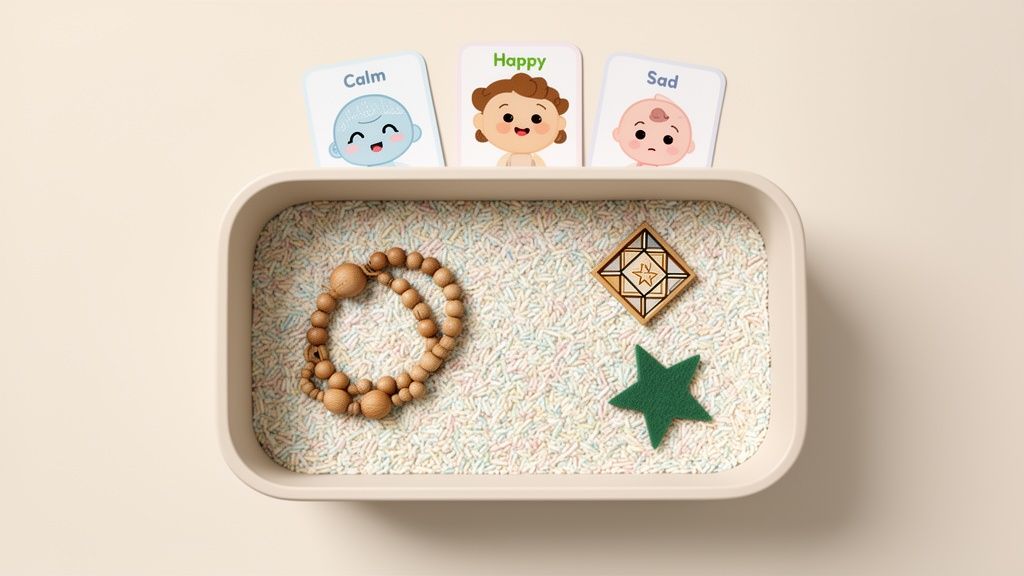
The concept is simple: fill a transparent bin with a base material like coloured rice, sand, or water beads. Then, add objects that prompt discussions about emotions. This could include emotion flashcards, small mirrors for self-reflection, or toys with different expressions. The Islamic integration comes from adding elements like smooth tasbeeh (prayer beads), small wooden Kaaba blocks, or moon and star shapes. As your child scoops, pours, and sorts, you can guide conversations, asking, "This character looks sad. What can we say to Allah to feel better?"
This multisensory approach is highly effective because it engages touch, sight, and hearing, solidifying learning. It’s a technique used by many Muslim nurseries to create designated "calm-down" corners and by Islamic preschools as part of their emotional regulation curriculum. It moves emotional learning from an abstract idea into a tangible, calming, and spiritually grounded activity.
Actionable Tips for Implementation
- Rotate Materials Monthly: Keep the experience fresh and engaging by changing the base material. One month could be kinetic sand representing patience, and the next could be smooth, cool water beads to discuss calmness. This maintains novelty and holds your child's interest.
- Include Permanent 'Calm' Objects: Designate a few special items that always stay in the bin, such as prayer beads or beautiful geometric-shaped blocks. These become familiar, soothing tools your child can reach for when they feel overwhelmed.
- Use as a Transition Tool: A sensory bin is an excellent activity to bridge the gap between different parts of the day, like the busy time before dinner or while you are trying to get a task done.
- Supervise and Choose Safely: Always supervise young children during sensory play. Ensure all materials are age-appropriate and non-toxic, especially for toddlers who may still be mouthing objects.
9. Feelings Mirror Affirmations with Islamic Values
A powerful yet simple activity in your feelings theme preschool toolkit is the use of mirror affirmations. This practice involves guiding your toddler to look at their reflection while repeating positive, faith-based statements. It's a gentle and direct way to connect self-awareness with a strong, positive self-concept rooted in their identity as a Muslim.
This activity helps children see themselves as Allah (SWT) sees them: worthy, capable, and loved. As they gaze at their own face, you can gently say affirmations like, "Alhamdulillah, I am healthy," or "Allah loves me very much." This practice directly nurtures emotional resilience by building a foundation of self-worth and confidence from the earliest age. This can be easily incorporated into daily routines like brushing teeth or getting dressed.
By combining visual self-recognition with loving, faith-filled words, you are teaching your child that their identity is a source of strength. This builds an internal dialogue that can support them through various feelings as they grow. For more ideas on fostering self-esteem and emotional well-being through self-talk, explore the power of empowering positive affirmations for students.
Actionable Tips for Implementation
- Keep it Simple and Repetitive: Use short, easy-to-remember phrases that a toddler can grasp. Repetition is key to helping the message sink in. Phrases like "I am kind" or "Allah made me special" are perfect.
- Practice Consistently: Integrate mirror affirmations into a fixed part of your day, such as your morning routine after waking up or before bedtime. Consistency makes it a comforting and expected ritual.
- Use a Warm, Calm Tone: Your tone of voice is crucial. Speak softly and lovingly to create a positive emotional association with the affirmations and the act of self-reflection.
- Connect to Actions: After you see your child do something kind, stand in front of the mirror with them and say, "You were so kind when you shared your toy. Mash'Allah!"
10. Feelings Movement and Yoga with Islamic Grounding
Connecting physical movement with emotional expression is a powerful tool in a feelings theme preschool setting, helping toddlers understand that feelings live in their bodies. By integrating simple, yoga-inspired movements with Islamic concepts, we can teach children to ground themselves spiritually as they regulate their emotions, bridging the gap between physical awareness and faith.
This approach uses gentle, toddler-friendly poses and actions linked to Islamic practices and emotional states. For example, you can guide a child through “calm breathing” to manage frustration or practice being “strong like a mountain” to feel secure. This method transforms physical activity into a holistic practice of self-awareness, teaching children that their bodies and faith are connected in managing big feelings. It is important to remember this is about gentle movement and not prayer.
This innovative combination is gaining traction globally, from Islamic preschools that integrate movement into their daily lessons to Muslim yoga instructors offering specialized toddler classes. It provides a beautiful, kinesthetic way for children to learn that Islam offers physical pathways to peace and emotional stability.
Actionable Tips for Implementation
- Keep It Short and Simple: A toddler's attention span is brief. Aim for 5-10 minute sessions with very simple, slow movements. Focus on one or two feelings and their corresponding movements per session.
- Use a Soft, Special Space: Practice on a comfortable surface like a prayer mat or a soft rug. This not only ensures safety but also designates the space as special and calm.
- Pair with Calming Sounds: Enhance the multisensory experience by playing gentle, ad-free nasheeds in the background. This helps create a tranquil atmosphere and reinforces the Islamic connection.
- Use as a Transition Tool: Movement is a fantastic way to reset energy. Use these activities as a calming transition before naptime or after a busy outing to help your child balance active play with quiet focus.
Comparison of 10 Islamic-Themed Preschool Feelings Activities
| Activity | 🔄 Complexity | ⚡ Resources | ⭐ Expected outcomes | 📊 Key advantages | 💡 Ideal use cases / Tips |
|---|---|---|---|---|---|
| Emotion Face Recognition Cards with Islamic Values | Low — simple prep, parent-led | Low — print/digital, laminate option | High — emotion ID, bilingual vocab, faith cues | Screen-free, bilingual, faith-integrated | Home/preschool; laminate cards, use in daily chats |
| Dua-Based Feelings Journal with Picture Prompts | Moderate — parent records and prompts | Low–Medium — journal, art supplies | Moderate–High — expression, keepsake, fine motor | Tangible record, privacy-focused, language exposure | Reflection routines, homeschooling; keep it accessible and fun |
| Feelings Puppet Theater with Islamic Characters | Moderate — setup, scripts, facilitation | Medium — puppets, stage or felt board | High — role-play, emotional modelling, language | Imaginative play, multi-sensory engagement, conflict-resolution | Small groups or home; short scenarios, use soft puppets |
| Color-Emotion Matching Activities with Islamic Themes | Low — straightforward setup and sorting | Low — colored objects, collage materials | Moderate — color recognition plus emotion links | Adaptable, concrete learning, fine-motor practice | Circle time or table activity; create permanent color-emotion chart |
| Feelings Music and Nasheeds Activity | Low — playlist + movement plan | Low–Medium — halal audio, safe space | High — emotional regulation, gross motor skills | Calming, culturally aligned music alternative | Calming routines; use scarves/ribbons, curated playlist |
| Feelings Story Basket with Bilingual Storybooks | Low — curation and rotation | Medium — multilingual books, storage | High — literacy, emotional vocabulary, representation | Promotes bilingualism, parent bonding, independent choice | Reading corner or loan program; rotate 5–7 books monthly |
| Feelings Role-Play Dress-Up Station with Islamic Clothing | Moderate — space, organization, maintenance | Medium — clothing, props, storage | High — identity, imaginative play, fine motor | Builds cultural pride, role exploration, dialogue | Play area or transitions; use breathable fabrics, scenario cards |
| Feelings Sensory Bins with Islamic Themes | Moderate — prep, supervision, hygiene | Low–Medium — bin materials, thematic objects | High — calming input, regulation, fine motor | Multisensory calming, flexible, low-cost | Calm-down corner; supervise closely, rotate materials monthly |
| Feelings Mirror Affirmations with Islamic Values | Low — minimal setup, consistent delivery | Low — child-safe mirror, affirmation cards | Moderate–High — self-awareness, positive identity | Simple, routine-friendly, faith-grounded affirmations | Morning routines; use simple bilingual phrases regularly |
| Feelings Movement and Yoga with Islamic Grounding | Moderate — guidance for safe adaptation | Low — mat/space, visual guides or videos | High — body awareness, emotional regulation | Combines physical and spiritual grounding, routine-friendly | Transition activities; keep 5–10 mins, clarify play vs prayer |
Building an Emotionally Healthy Home, Insha'Allah
As we’ve explored, integrating a feelings theme preschool plan into your child's daily life is one of the most powerful gifts you can offer. It moves beyond simple color recognition or counting; it builds the very foundation of a resilient, compassionate, and self-aware Muslim. By intentionally creating space to talk about emotions like happiness, sadness, frustration, and calm, we give our children the vocabulary to understand their inner world and navigate the outer one with confidence and grace.
The activities in this guide, from crafting Dua-Based Feelings Journals to engaging in role-play, are designed to be more than just educational tools. They are stepping stones for connection. They open doors to meaningful conversations that might otherwise never happen, allowing you to understand your toddler's heart and guide them with gentle wisdom. These moments of shared play and learning are where deep bonds are formed and where the seeds of emotional intelligence are sown.
Key Takeaways for Your Family
The journey of teaching emotional literacy is not a one-time lesson but a continuous, beautiful process woven into the fabric of your daily routine. Here are the most crucial takeaways to remember as you implement these ideas:
- Consistency Over Complexity: You don't need elaborate setups. The simple, consistent practice of naming feelings during daily moments, like after a fall ("That must have felt scary") or when sharing a toy ("Sharing makes our hearts feel happy"), is incredibly effective. A few minutes each day can have a profound impact.
- Connect Feelings to Faith: The unique strength of an Islamic approach to emotional health is linking our feelings back to Allah. Gently reminding your child that it’s okay to feel sad and that we can make dua, or that happiness is a blessing for which we say Alhamdulillah, integrates their emotional and spiritual development. This provides a powerful anchor for life.
- Model the Behavior You Want to See: Children are keen observers. They learn how to manage big feelings by watching how we manage ours. When you have a moment of frustration, narrating your own process in simple terms ("Mummy is feeling a little frustrated, so I'm going to take a deep breath to feel calm"), provides a real-time, invaluable lesson. Your example is the most powerful curriculum.
Your Actionable Next Steps
Bringing a feelings theme preschool experience to life can feel like a big task, but you can start small and build from there. Here’s a simple plan to get started this week:
- Choose One Activity: Don't try to do everything at once. Look back through the list and pick just one activity that resonates with you and fits your child's current interests. Is it the Feelings Sensory Bin or the Mirror Affirmations? Start there.
- Gather Your Simple Materials: You likely have most of what you need at home. Prepare your chosen activity so it's ready to go when the moment is right, perhaps during a quiet afternoon or after nap time.
- Introduce the Concept Gently: Use simple, positive language. For example, "Look at these happy and sad faces! Let's see if we can make a happy face too." Let your child’s curiosity lead the way.
- Observe and Adapt: Pay attention to your child's reactions. If they love an activity, expand on it. If they aren't interested, don't force it. You can always try again another day or choose a different approach.
Ultimately, this journey is about nurturing a home environment where every feeling is valid, where emotional expression is safe, and where faith is the ultimate source of comfort and strength. By embracing this feelings theme preschool approach, you are not just preparing your child for school; you are preparing them for life. You are raising a child who, insha'Allah, will be able to navigate their emotions with wisdom, treat others with empathy, and face the world with a heart connected to their Creator.
Ready to expand your toolkit with safe, faith-aligned digital resources? Babymode offers a curated world of ad-free shows, interactive games, and calming nasheeds designed to support your toddler's emotional and cognitive development within a halal framework. Continue your child's learning journey in a trusted environment by exploring Babymode today.