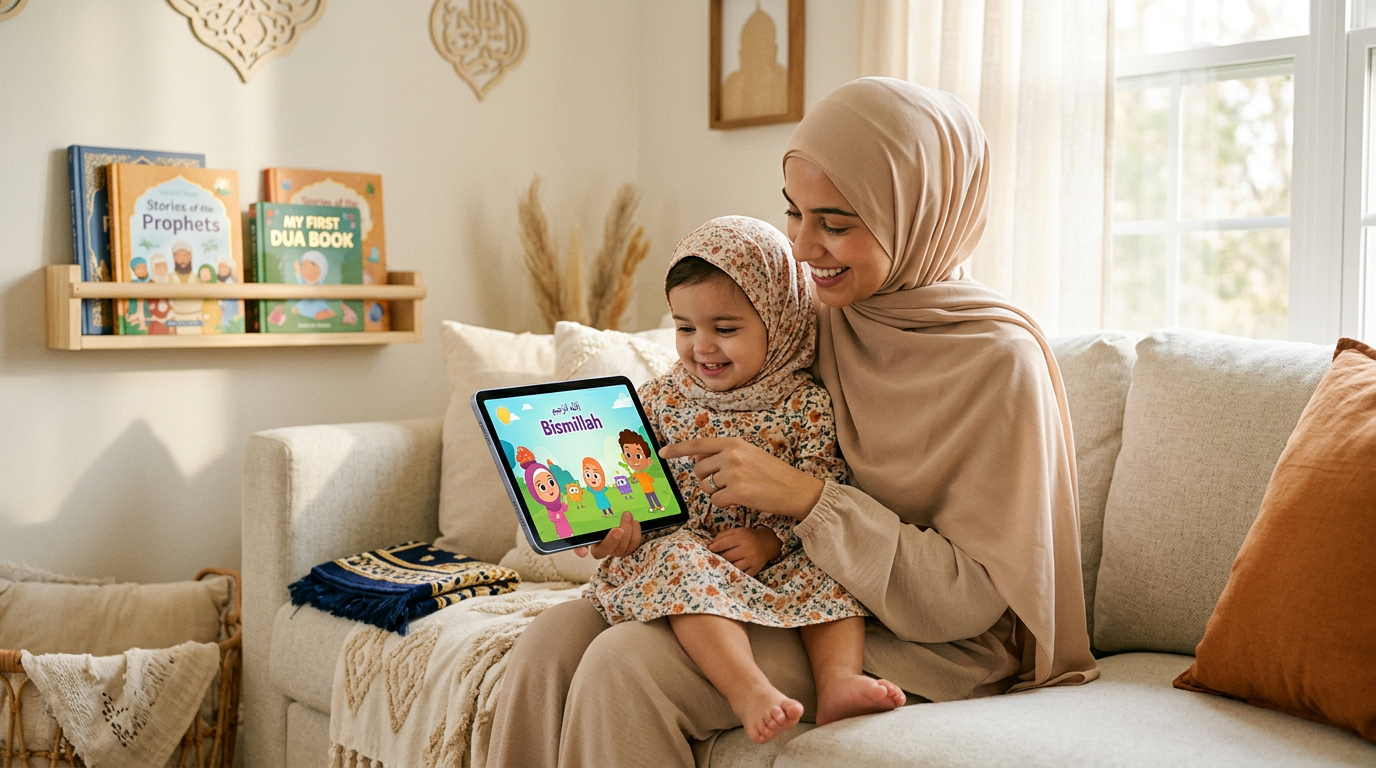
Helping our little ones navigate big feelings like frustration, joy, or sadness is a core part of their tarbiyah (upbringing). As Muslim parents, we want to teach them that all feelings are from Allah and can be managed in healthy, gentle ways. Simple, calming songs about feelings for preschoolers are a wonderful tool to build this emotional foundation, turning abstract ideas into memorable tunes they can understand and remember, especially in the 0-3 age range.
This guide is more than just a list of songs. It’s a practical toolkit for Muslim families looking to nurture emotional intelligence while upholding Islamic values in a way that's suitable for babies and toddlers. You will find eight carefully selected song ideas, each with:
- Simple Activities: Gentle, screen-free ways to bring the lessons to life during playtime or quiet moments.
- Bilingual Vocabulary: Key emotion words in English, Arabic, and Urdu to support early language development.
- Faith-Aligned Ideas: Simple ways to incorporate du'a, Alhamdulillah, and other Islamic concepts into each song.
We’ll explore how to use these melodies to teach your little one to recognize feelings, connect them to gratitude, and find comfort in remembering Allah, all within a safe, halal-friendly framework. Let's begin building these essential skills, one gentle song at a time.
1. In My Heart: A Book of Feelings
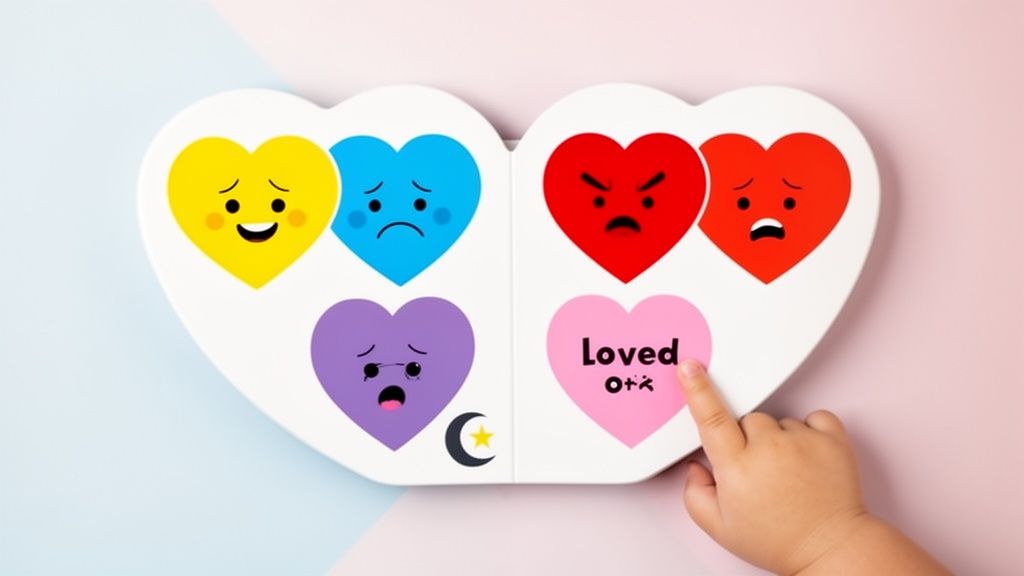
More than just a song, "In My Heart" is a complete social-emotional learning tool based on the beloved book by Jo Wylie. Its strength lies in its simplicity, making it one of the most effective songs about feelings for preschoolers. The gentle melody and straightforward lyrics help children connect words like "happy," "sad," or "brave" to tangible, everyday situations. The accompanying book, with its iconic heart-shaped cutouts, provides a visual and tactile experience that reinforces the lesson, perfect for tiny hands.
This resource is powerful because it gives little ones a basic framework for emotional literacy. It’s not just about naming a feeling; it’s about understanding that feelings come and go, and all of them are a normal part of life. For Muslim families, this foundational concept aligns beautifully with Islamic teachings on navigating life's ups and downs with faith.
Making It Your Own: Islamic & Bilingual Adaptations
The "In My Heart" framework is wonderfully adaptable for a faith-aligned upbringing. Its simple structure makes it easy to layer Islamic concepts and bilingual vocabulary on top, creating a richer learning experience.
- Connect Feelings to Faith: Use the song as a starting point to talk about how we turn to Allah. When the heart feels sad (حزن - huzn), we can make du'a. When it feels happy (فرح - farah), we say "Alhamdulillah."
- Create Dua Flashcards: Make simple cards for each feeling in the book. On the "scared" card, write a simple du'a for protection. On the "angry" (غضب - ghadab) card, include the idea of seeking refuge in Allah from Shaytan.
- Link to Gentle Stories: When discussing patience or sadness, share a very simplified story of a Prophet and their reliance on Allah. This connects abstract feelings to relatable, faith-affirming narratives.
- Expand Learning: Beyond the song itself, exploring various children's books can further develop your child's emotional vocabulary and understanding.
This approach helps normalize discussing emotions within an Islamic context, teaching children from a young age that their feelings are valid and that their faith provides tools for guidance and comfort. You can find more ideas for structuring these conversations in our guide to creating a feelings theme for preschoolers.
2. If You're Happy and You Know It (Gentle Adaptation)
This timeless classic is a wonderful tool for teaching emotional expression through movement. Its call-and-response format and simple melody make it one of the most engaging songs about feelings for preschoolers. While the traditional version focuses on happiness, you can easily adapt it to cover a range of emotions, linking each one to a gentle, faith-based action.
The song's strength lies in its ability to build an immediate physical connection to an abstract feeling. Instead of just saying "I'm sad," a child learns to associate that feeling with the positive action of making du'a. This approach helps Muslim children understand from a very young age that their emotions are valid and that their faith provides practical, comforting actions to navigate them. It transforms a simple song into a foundational lesson in emotional and spiritual regulation.
Making It Your Own: Islamic & Bilingual Adaptations
The tune of "If You're Happy and You Know It" is incredibly versatile, making it easy to create versions that align with Islamic values and incorporate bilingual vocabulary. This turns a fun sing-along into a meaningful part of your daily routine.
- Connect Feelings to Actions: Adapt the lyrics to reflect Islamic responses. For example, "If you're sad and you know it, make du'a" (raising hands), "If you're angry and you know it, take a breath" (inhaling deeply), or "If you're thankful and you know it, say Alhamdulillah."
- Incorporate Arabic/Urdu: Weave in key vocabulary. Try singing, "If you're feeling shukr (شكرا) and you know it, say 'Alhamdulillah'" or "If you're feeling huzn (حزن) and you know it, make du'a." This gently introduces faith-based language in a joyful context.
- Link to Daily Routines: Use the song to prepare for prayer. Sing "If it's time for prayer and you know it, stand up tall" or "If you've done your wudu and you know it, feel so clean." This connects the physical actions of worship with feelings of peace and readiness.
- Use for Emotional Check-ins: At bedtime, use the melody to ask your child how they are feeling. "Are you happy and you know it?" or "Are you tired and you know it?" This creates a safe and predictable space for them to share their feelings before sleep.
This method teaches children that their faith is a resource for all of life's moments, big and small. It builds a beautiful association between their emotions, positive actions, and their connection to Allah.
3. Today I Feel Like (Emotional Variety Song)
This approach moves beyond single-emotion songs to present a narrative journey through a child's day. Instead of focusing on just "happy" or "sad," this type of song models how feelings naturally change from morning to night, making it one of the most realistic songs about feelings for preschoolers. The structure typically follows a daily routine (waking up, playing, mealtime), showing that it's normal to feel excited at one moment and frustrated the next. This validates the entire spectrum of a child's emotional experience.
Its power lies in teaching emotional transition and regulation. For a young child, the idea that a "big feeling" like anger or sadness won't last forever is a profound and comforting lesson. By linking emotions to the familiar rhythm of a day, the song normalizes these shifts and shows that feelings come and go. This is particularly valuable for Muslim families, as it mirrors the daily rhythm of the five prayers and provides a natural structure for embedding faith-based coping mechanisms.
Making It Your Own: Islamic & Bilingual Adaptations
The daily routine format is perfectly suited for integrating Islamic life and bilingual vocabulary. You can create a "My Day with Allah" version that maps emotional moments to the structure of the day.
- Structure Around Salah: Frame the song around prayer times. "Before Fajr, I felt sleepy (نعسان - na’saan). After playing, before Dhuhr, I felt energetic! But then I felt sad (اداس - udaas) when my toy broke."
- Embed Dua at Each Transition: At each emotional change, introduce a simple Islamic phrase. When a lyric mentions feeling worried, you can add, "So I take a deep breath and say Alhamdulillah." When feeling angry, "I remember to say A’udhu billahi minash shaitanir rajeem."
- Create Visual Story Cards: Make simple picture cards that show a child's routine from morning to night. Each card can depict an activity, an emotion, and a corresponding Islamic response, creating a visual storyboard for the song.
- Personalize the Lyrics: The most effective use is to adapt the lyrics to your child’s actual day. "Today you felt frustrated when your blocks fell down, then you felt happy (خوش - khush) when we read a book." This makes the lesson immediate and personal.
4. The Color of My Feelings (Sensory Learning Song)
"The Color of My Feelings" uses a creative, sensory-based approach to make it one of the most unique songs about feelings for preschoolers. It connects abstract emotions to concrete colors. This is especially powerful for toddlers aged 1-3, as their brains are wired to learn through linking what they see (color) with what they feel (emotion).
This technique gives children a visual language for their internal world. For a young child, saying "I feel red" might be easier than finding the word "angry." For Muslim families, this concept can be beautifully layered with the rich color symbolism found in Islamic tradition, transforming a simple song into a lesson infused with faith and cultural meaning. This approach offers a powerful way to expand on the lessons from our emotions worksheets for preschoolers.

Making It Your Own: Islamic & Bilingual Adaptations
The color-emotion framework is highly adaptable for a faith-aligned upbringing. By integrating Islamic symbolism and Arabic vocabulary, you can create a deeper, more meaningful connection for your child.
- Connect Colors to Faith: Introduce colors with gentle Islamic associations. Green (أخضر - akhdar) can represent peaceful feelings, reminding us of the gardens of Jannah. White (أبيض - abyad) can signify purity and calm.
- Create Lyrical Connections: Adapt the song with faith-based lyrics. For example, "When I feel peaceful like green fields Allah made" or "When I feel loved like a golden sunset, it’s a gift from Allah."
- Use Sensory Play: Reinforce the lesson with hands-on activities. Use colored scarves or play silks during the song. When singing about feeling "blue" (أزرق - azraq), you can make a simple du'a for sadness to be lifted. Exploring more fun ways to explore colours for toddlers can further enhance this multi-sensory learning experience.
- Tie Colors to Dua: Associate a simple prayer with each color-emotion. For "green/peaceful," you could say, "Ya Allah, bring me peace like Your green earth." This teaches children to turn to their faith no matter what color their feelings are.
5. Feelings in My Body (Physical Awareness Song)
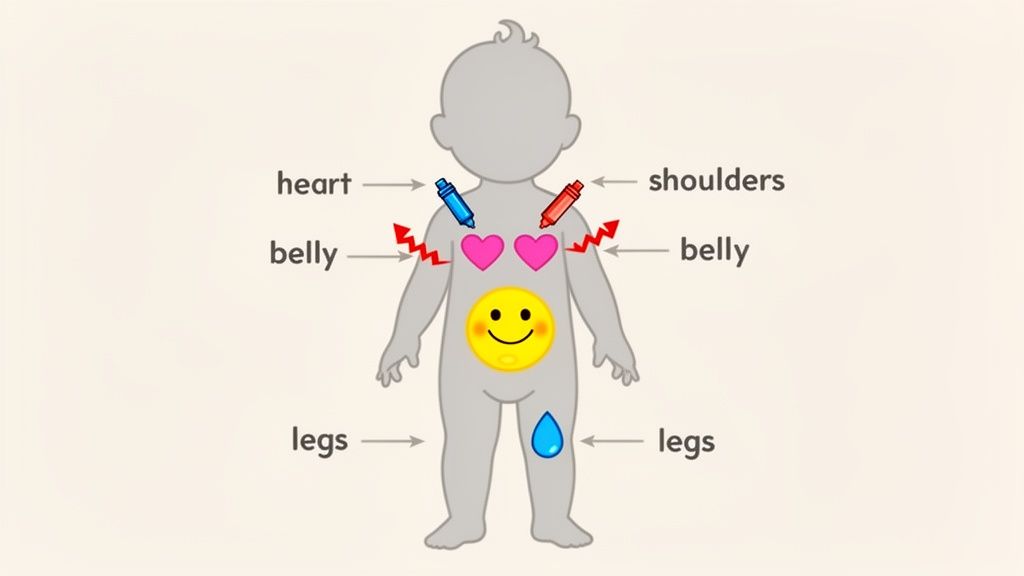
This approach moves beyond just naming emotions and helps children understand where feelings live in their bodies. A song focused on somatic awareness guides little ones to notice physical sensations, like a warm, fluttery tummy for happiness or tight shoulders for worry. This is a foundational skill for emotional regulation, teaching children that feelings are not just abstract ideas but real, physical experiences. This makes this one of the most practical types of songs about feelings for preschoolers.
For Muslim families, this practice of body awareness connects deeply with spiritual rituals that involve the whole body. It bridges the gap between a feeling and a faith-based action, teaching children that their bodies are a tool for both emotional understanding and connecting with Allah. It helps them recognize the physical cues that might prompt them to make du'a or seek comfort in remembrance (dhikr).
Making It Your Own: Islamic & Bilingual Adaptations
A "Feelings in My Body" song is a powerful tool for integrating Islamic concepts of mindfulness and physical-spiritual connection into your child’s daily life. It provides a simple, child-friendly entry point into deeper spiritual practices.
- Connect Feelings to Wudu: Pair the song with the wudu routine. As you wash each part, you can mindfully ask, "How do my hands feel today? Do they feel strong and ready to make du'a?" This links physical cleansing with emotional and spiritual purification.
- Use Gentle Gestures: Create a hand-over-heart gesture for feelings of love (حب - hubb) or peace, explaining, "We feel Allah’s love in our hearts." This is a beautiful physical anchor that aligns with Islamic gestures used during heartfelt du'a.
- Introduce Mindful Breathing: Incorporate simple breathing into the song. When singing about feeling worried (قلق - qalaq), practice taking a deep breath and letting it out slowly. This is a precursor to calming techniques rooted in both science and Islamic tradition.
- Link Body Parts to Dua: Connect specific body parts to actions of worship. You can sing, "My hands feel calm when I make du'a," or "My heart feels happy when I remember Allah." This reinforces the idea that our bodies are instruments for connecting with our Creator.
6. When I Feel [Emotion], I Can Islamic Action
This approach moves beyond simply naming emotions and gives children a practical, faith-based toolkit for managing them. It's a lyrical framework that pairs a feeling with a constructive, Islamic action. This makes it one of the most empowering songs about feelings for preschoolers because it builds self-efficacy and resilience from a very young age. The core idea is simple: "When I feel sad, I can remember Allah loves me," or "When I feel angry, I can say Astaghfirullah."
The power of this method lies in its solution-focused nature. It teaches children that their feelings are valid signals, not overwhelming states, and that they have tools to respond. For Muslim families, this directly connects emotional regulation to their faith, showing that Islam provides practical guidance for every aspect of life. It helps prevent learned helplessness by teaching toddlers that they can take positive steps when big feelings arise.
Making It Your Own: Islamic & Bilingual Adaptations
This solution-focused framework is highly adaptable and can be tailored to your family's specific needs and vocabulary. Its repetitive structure makes it easy for young children to learn and apply, turning abstract Islamic concepts into concrete, memorable actions.
- Create Emotion-Strategy Pairs: Develop simple, consistent pairings. When your child feels sad (حزن - huzn), the action is to make du'a for comfort. When they feel angry (غضب - ghadab), the action is to take three deep breaths and say "Astaghfirullah."
- Model the Behavior: The most effective way to teach this is to model it yourself. Say out loud, "Mama is feeling frustrated, so I'm going to take a deep breath and say Alhamdulillah." This shows your child how to apply the strategy in real-time.
- Use Hand Gestures: Create simple physical cues for each action. A hand on the heart can signify making du'a, while placing a hand on the chest can be the gesture for deep breathing. This helps non-verbal or pre-verbal children communicate their coping strategy.
- Focus on Gratitude: When feelings of jealousy or envy (حسد - hasad) come up, guide your child to the response of gratitude. The song can be, "When I want what they have, I can say Alhamdulillah for what I have."
This approach integrates emotional intelligence directly with Islamic practice, teaching children that their faith is a source of strength, comfort, and practical solutions for navigating their inner world.
7. I Can Tell How You Feel (Empathy Song)
Moving beyond identifying one's own feelings, this song concept teaches a crucial social skill: recognizing emotions in others. It's one of the most powerful songs about feelings for preschoolers because it builds the foundation for empathy. The song guides children to observe facial expressions, body language, and tone of voice, helping them understand what their friends or family members might be feeling. It encourages them to become thoughtful and aware observers of the people around them.
This focus on others is a cornerstone of Islamic teachings on community and compassion (rahmah). The song helps nurture a child's innate ability to care, teaching them not just to see an emotion, but to consider a kind and gentle response. It prepares them to be emotionally intelligent and supportive members of their family and community, embodying the Prophetic example of kindness from a very young age.
Making It Your Own: Islamic & Bilingual Adaptations
This song’s framework is perfect for teaching empathy through the lens of faith. It provides a practical way to connect the Islamic call for compassion with everyday interactions.
- Create Real-Life Scenarios: Instead of abstract examples, use moments from a Muslim family’s day. A sibling looks sad (حزين - hazin) after dropping their toy. Mama looks tired after a long day of fasting. A grandparent looks happy (سعيد - sa'eed) when they arrive for a visit.
- Teach Gentle Responses: Pair each recognized emotion with an appropriate, kind action. "I see Baba is tired. I can sit quietly with him." or "My brother is upset. I can ask if he needs a hug." This connects observation with ihsan (excellence in conduct).
- Link to Prophetic Compassion: Share simple stories of how the Prophet Muhammad (peace be upon him) noticed and responded to the feelings of others, especially children. This makes empathy a sunnah to follow.
- Use Visual Aids: Create or find an emotions chart that shows different facial expressions. You can use our emotions chart printable as a fun matching game to reinforce what children learn from the song.
This approach transforms a simple song into a profound lesson on Islamic manners, teaching children that noticing and caring for the feelings of others is an essential part of being a Muslim.
8. Alhamdulillah for All My Feelings (Gratitude Song)
This concept transforms the conversation around feelings by rooting emotional acceptance in the core Islamic principle of gratitude (shukr). It’s an approach, rather than a single song, that reframes all emotions, even difficult ones, as gifts from Allah. This powerful method is one of the most uniquely faith-aligned ways to teach songs about feelings for preschoolers, moving beyond just naming emotions to understanding their divine purpose. The goal is to teach children to say "Alhamdulillah" for every state of the heart.
Its strength lies in its profound shift away from categorizing feelings as "good" or "bad." Sadness isn't something to be fixed, nor is anger something to be suppressed. Instead, this approach teaches that every feeling is a signpost pointing us back to Allah and teaching us something valuable. This wisdom, found in the stories of the Prophets and Islamic spiritual teachings, helps build deep emotional resilience grounded in faith.
Making It Your Own: Islamic & Bilingual Adaptations
This gratitude-based framework can be woven into your family’s daily life through custom songs, duas, and conversations. It helps your child build a direct, personal relationship with Allah through their own inner world.
- Create Your Own "Alhamdulillah" Song: Develop a simple, slow-paced nasheed. Create verses like, "For my sad tears (دموع - dumoo'), I say Alhamdulillah, they teach my heart to make du'a," or "For my big anger (غضب - ghadab), I say Alhamdulillah, it teaches me to take a deep breath."
- Link Feelings to Quranic Verses: When your child feels worried (قلق - qalaq), gently remind them with the meaning of the verse, "Verily, in the remembrance of Allah do hearts find rest." (Surah Ar-Ra'd 13:28). This connects their feeling directly to Allah's comfort.
- Model Prophetic Emotional Expression: Talk about how the Prophet Muhammad (peace be upon him) expressed sadness, showing that expressing our feelings is human and sunnah. Share how Prophet Yusuf's patience during his sadness was praised by Allah.
- Pause for "Dua Moments": When a strong feeling arises, use it as a trigger. Pause, acknowledge the emotion together, and make a simple du'a for guidance or ease. This teaches children to turn to Allah in every state.
8-Item Comparison: Preschool Feelings Songs
| Item | 🔄 Implementation Complexity | ⚡ Resource Requirements | 📊 Expected Outcomes | 💡 Ideal Use Cases | ⭐ Key Advantages |
|---|---|---|---|---|---|
| In My Heart: A Book of Feelings | Low — simple song + board book | Low — die-cut book, basic audio | Foundational emotion ID & vocabulary | Circle time; 0–3 bilingual settings; tactile learning | Highly visual & tactile; easy Islamic story tie-ins — ⭐⭐⭐⭐ |
| If You're Happy and You Know It (Gentle Adaptation) | Low–Medium — adapt lyrics for Islamic actions | Low — no instruments; video or live modeling helpful | Gross motor + emotional expression; group engagement | Morning gatherings; movement routines; parent-child bonding | Movement-based, inclusive of emotions; great for active learners — ⭐⭐⭐⭐ |
| Today I Feel Like (Emotional Variety Song) | Medium — narrative framing across a day | Medium — audio/video and storyboarding | Teaches emotional fluidity & resilience | Aligning emotions with prayer times; daily routines | Strongly fits Islamic daily rhythm; normalizes changing feelings — ⭐⭐⭐⭐⭐ |
| The Color of My Feelings (Sensory Learning Song) | Medium–High — careful design for color symbolism | High — quality animation/props needed | Accelerated retention via color-emotion pairing | Video-first content; visual learning modules | Multi-sensory retention; ties to Islamic color symbolism — ⭐⭐⭐⭐ |
| Feelings in My Body (Physical Awareness Song) | Medium — sensitive messaging & parent guidance | Medium — guided videos; parent resources | Interoceptive awareness; early regulation skills | Wudu-linked routines; mindfulness moments | Evidence-backed somatic approach; aligns with wudu/prayer — ⭐⭐⭐⭐ |
| When I Feel [Emotion], I Can Islamic Action | Low–Medium — clear if-then structure | Low — simple audio/video; parent modeling | Builds self-efficacy and concrete coping habits | Home practice; calm-down strategies; parent coaching | Highly practical; directly teaches Islamic coping tools — ⭐⭐⭐⭐⭐ |
| I Can Tell How You Feel (Empathy Song) | Medium — needs diverse, non-stereotyped scenarios | Medium — video examples and coaching prompts | Empathy and social awareness; reduces peer conflict | Social skills lessons; family & group settings | Teaches compassion (rahmah) and perspective-taking — ⭐⭐⭐⭐ |
| Alhamdulillah for All My Feelings (Gratitude Song) | Medium — theological grounding + sensitive framing | Low–Medium — reverent nasheed production, parental guide | Acceptance-based resilience; Islamic emotional theology | Spiritual routines; reflective moments with parents | Deeply authentic Islamic framing; promotes acceptance & resilience — ⭐⭐⭐⭐⭐ |
From Songs to Strong Iman: Raising Emotionally Resilient Little Muslims
As we’ve journeyed through these ideas for songs about feelings for preschoolers, it’s clear that simple melodies are more than just entertainment. They are powerful tools for nurturing the very foundations of your child's emotional and spiritual well-being. Each song, from the playful adaptation of "If You're Happy and You Know It" to the profound simplicity of "Alhamdulillah for All My Feelings," serves a crucial purpose in your child’s development. They transform abstract concepts like happiness, sadness, and anger into tangible, manageable ideas that a young mind can grasp.
By integrating these songs into your daily routines, you are not just teaching vocabulary; you are building an emotional toolkit rooted in Islamic values. You are showing your child that feelings are natural, God-given experiences. More importantly, you are guiding them toward healthy, faith-aligned responses. When we sing about saying "SubhanAllah" when we're amazed or making du'a when we're sad, we are embedding the core principles of our deen into their earliest memories. This foundation helps them develop tawakkul (reliance on Allah) and sabr (patience) from a young age.
Key Takeaways for Your Family's Journey
Let’s quickly recap the most important actions you can take starting today:
- Be Consistent: Weave these songs into everyday moments. Sing about feeling happy during playtime, or use a calming nasheed when frustration arises before naptime. Repetition is how preschoolers learn best.
- Connect and Model: Use the songs as a springboard for conversation. When you notice your child is upset, you can gently sing, "When I feel angry, I can take a deep breath," and then model the action for them. Your example is their most powerful lesson.
- Expand the Learning: Don't stop at the song. Use the suggested activities, like drawing feelings or pointing out emotions in storybooks, to reinforce the concepts and make learning interactive and multi-sensory.
- Embrace Bilingualism: Introducing Arabic or Urdu terms like farah (joy) and huzn (sadness) through song enriches your child's vocabulary and strengthens their connection to their cultural and religious heritage.
Ultimately, this journey is about raising children who are not just smart, but emotionally intelligent and spiritually grounded. The goal is to create a home environment where every feeling is acknowledged, validated, and channeled through the beautiful lens of our faith. You are equipping your little one with the confidence to navigate their inner world, knowing that every emotion is an opportunity to connect with themselves, with others, and most importantly, with Allah. This is a profound act of tarbiyah, and every small, consistent step you take is building a legacy of strong iman, insha'Allah.
Tired of endlessly searching for safe, faith-aligned content? Babymode offers a curated world of ad-free, halal screen time, including gentle songs about feelings for preschoolers that support your child’s development and align with your family's values. Discover a calmer, more intentional approach to media by visiting Babymode today.