Diving into the world of Arabic can feel like unlocking a beautiful secret code. But at its heart, the written language is wonderfully simple, built from just three key elements: letters (al-huruf), vowels (harakat), and a few special marks to guide Quranic recitation. Getting to know these basics is the perfect first step to sharing the language of our faith with your little one in a way that feels natural and joyful.
Your Gentle Start to Arabic with Your Toddler
As Muslim parents, we look at the beautiful, flowing script of the Quran and dream of passing that love on to our children right from the start. But let's be real—life with a baby or toddler is hectic, and the thought of teaching a language can feel like one more thing on an already full plate.
This guide isn't about formal lessons or stressful flashcard drills. It's about weaving a gentle, loving connection to Arabic into the everyday moments you already share. We’ll explore the meaning behind Arabic symbols in a way that fits your real life, whether you’re multitasking before Maghrib or stealing a quiet moment during naptime. The goal here is to build a foundation of love for the language, making it a familiar and comforting sound in your child’s world.
Think of this as a friend helping you connect your child to our shared heritage, one small, gentle step at a time, inshaAllah.
This chart gives you a bird's-eye view of how it all fits together, starting with the core letters and layering on the vowels and special marks that bring the language to life.
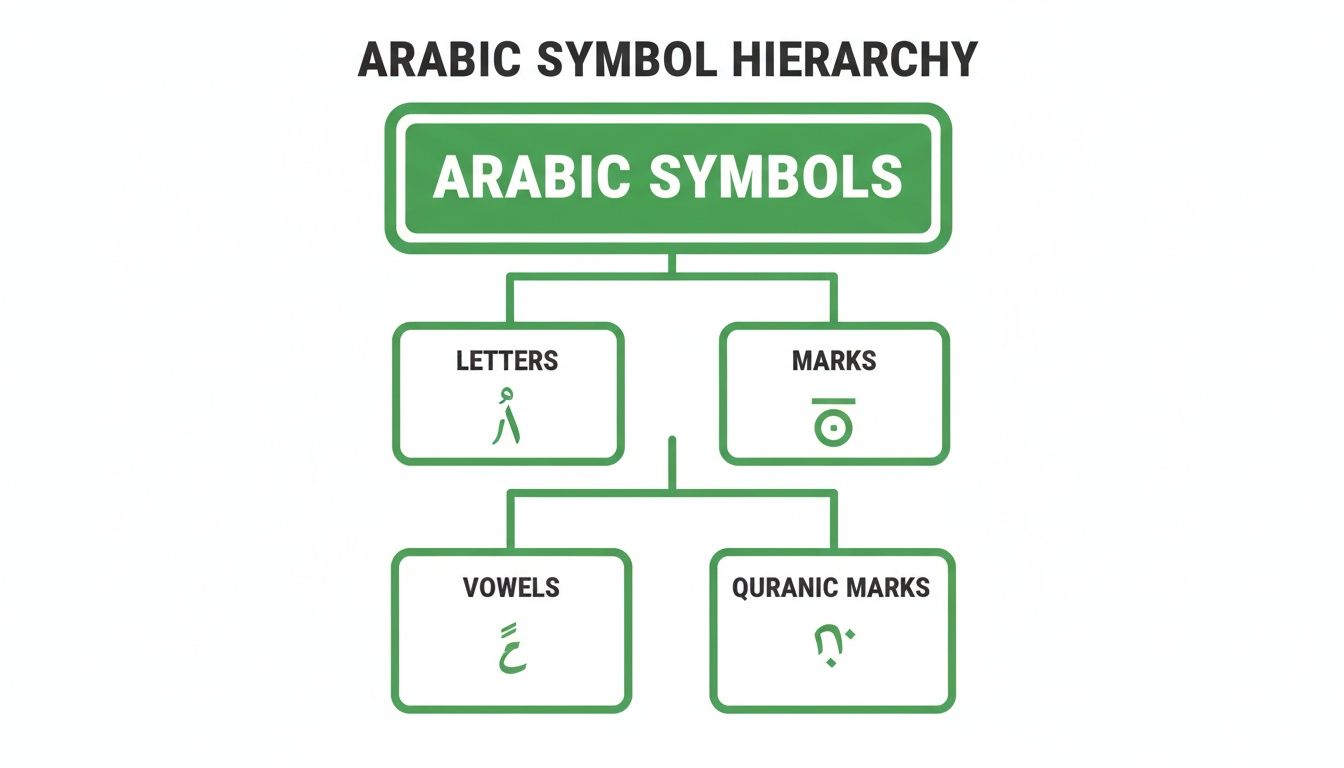
As you can see, everything starts with the letters. The other symbols are just there to add sound, rhythm, and meaning.
What We'll Discover Together
This guide is designed to help you build your confidence as you go, focusing on what’s most useful for you and your child aged 0–3. Here’s a peek at what’s ahead:
- Meet the Arabic Alphabet: We’ll get to know the 28 letters not as a list to be memorized, but as friendly shapes with their own unique sounds and personalities.
- The Magic of Vowels: You'll see how tiny dashes and curls placed above and below the letters are what make the words sing.
- Quran-Specific Symbols: We'll gently demystify those special little marks you see in the Mushaf that guide us in beautiful recitation.
- Art & Calligraphy in Our Homes: We’ll explore the meaning behind sacred words like 'Allah' (الله) that often decorate our walls and lives.
- Playful, Everyday Learning: You’ll get simple, practical tips for making Arabic a fun and natural part of your toddler’s day.
To make this even easier, here's a quick summary of the different types of symbols we'll be covering.
A Quick Look at Arabic Symbols
| Symbol Type | What It Represents | Why It Matters for Your Toddler |
|---|---|---|
| Arabic Letters | The 28 foundational shapes of the alphabet. | These are the building blocks. Recognizing them is the very first step. |
| Harakat (Vowels) | Tiny marks that add vowel sounds (like 'a', 'i', 'u'). | They turn letters into spoken words, helping with early pronunciation. |
| Quranic Marks | Special symbols used only in the Quran. | They guide recitation rhythm and pausing, creating a beautiful sound. |
| Calligraphy/Motifs | Artistic forms of words like "Allah" and "Muhammad". | These connect the written language to beauty, art, and spirituality. |
This table is just a starting point. Now, let’s jump in and get to know the beautiful Arabic alphabet.
Getting to Know the Arabic Alphabet and Its Sounds
Let's start right at the beginning, with the foundational building blocks of Arabic. The best way to introduce these to your little one is through sound and play. The Arabic alphabet, often affectionately called the 'Alif-Ba-Ta,' is made up of 28 distinct letters, each with its own look and sound.
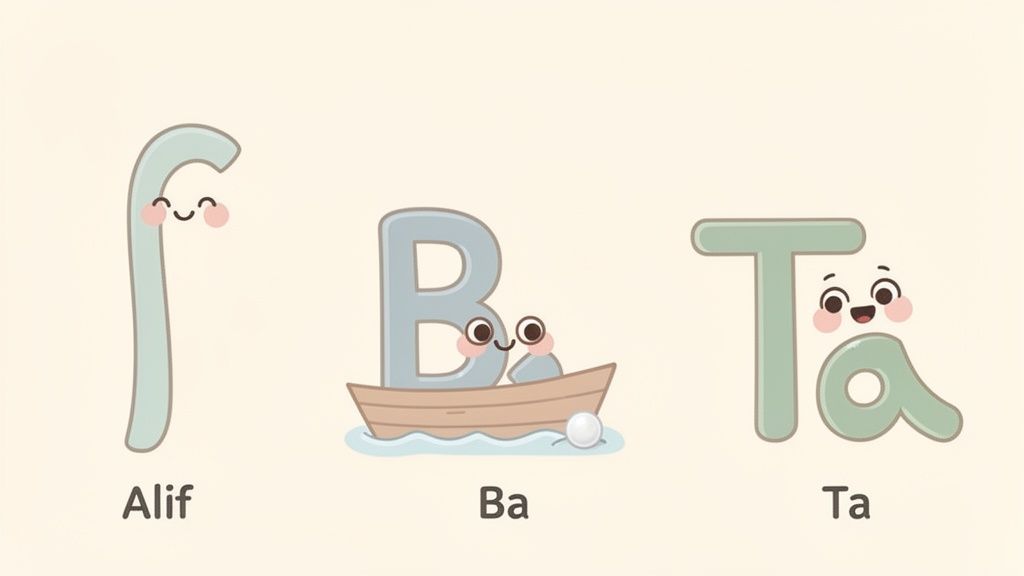
Forget dry memorization or endless flashcard drills. Think of each letter as a new friend with its own personality. For instance, the letter 'Ba' (ب) could be a little boat floating on the water with a single pearl underneath. This kind of simple, visual story is perfect for a toddler's imagination, making the shape stick in their mind in a fun and memorable way.
The Sounds of Our Faith
The main goal here is to get comfortable with the phonetic sounds so you can say them confidently for your child. It’s all about gentle, playful exposure that you can weave into your everyday life. In fact, you're probably already doing this without even realizing it.
When you say, "Alif for Allah" during story time or "Ba for Bismillah" before your baby has their milk, you're creating a positive, pressure-free first introduction to the language of the Quran. It's these small, consistent moments that build a warm and loving connection to Arabic.
The real beauty of this approach is that it's rooted in love and play, not performance. Your child feels your warmth and starts to associate these new sounds and shapes with comfort and security. That’s the most powerful foundation for learning you can possibly build.
The alphabet you're sharing has a rich history that stretches back centuries. This beautiful script connects hundreds of millions of people across many countries, spanning from the Classical Arabic of the Quran to the Modern Standard Arabic we see in books and media.
This chart shows all the letters in their standalone forms.
Seeing them all laid out like this really gives you an appreciation for the unique shapes and elegant forms that make the script so visually stunning.
From Shapes to Familiar Words
As you introduce these letters, the magic really happens when you connect them to words that are already a part of your family's life. This makes the sounds meaningful and helps your child see that these 'symbols' belong in their world.
Here are a few simple examples you can weave right into your daily routine:
- ت is for Tamr (Dates): When you offer your toddler a date, you can gently say the word, putting a little emphasis on the 'Ta' sound. This immediately connects the letter to a sweet taste they love.
- ش is for Shams (Sun): While looking out the window in the morning, you can point and say, "Shams," linking the 'Sheen' sound to the bright, warm sun.
- ق is for Qamar (Moon): During your bedtime routine, look for the moon together and whisper "Qamar." This makes the 'Qaf' sound a soothing part of winding down for the night.
This method isn’t just about teaching letters; it’s about connection. You are linking the sounds of Arabic to the sensory experiences of your child’s life—taste, sight, and the comfort of a familiar routine. In doing so, you're nurturing an organic and joyful familiarity with the language. For those curious about other early language tools, you might find our insights on Alef to Tav learning resources helpful for cross-linguistic inspiration.
Bringing Words to Life with Vowels and Markings
If Arabic letters are the building blocks of a word, think of the little dashes and curls above and below them as the magic that brings them to life. These markings are called harakat (which literally means "movements"), and they're the secret to turning silent consonants into the rich, flowing sounds of spoken Arabic.
For parents, understanding these little symbols is the key to confidently sounding out words for your little one. You don't need to dive deep into complex grammar; just getting a feel for these vowels will empower you to pronounce the familiar, loving words you already use every day in your home.
It’s a simple but powerful concept: the letters are the body, and the harakat are the voice. Without them, the letters are quiet. With them, they can sing.
The Three Main Vowel Sounds
There are three core short vowels in Arabic, and the easiest way to get the hang of them is by connecting them to sounds your child already knows from English. Let’s meet them.
- Fatha ( َ ): This is a small diagonal line placed above a letter. It makes a short 'a' sound, just like the 'a' in 'apple' or 'a' in 'cat'.
- Kasra ( ِ ): You'll find this small diagonal line below a letter. It creates a short 'i' sound, very similar to the 'i' in 'sit' or 'i' in 'pin'.
- Damma ( ُ ): This is a small, curly symbol that looks like a tiny 'w' and sits above a letter. It makes a short 'u' sound, like the 'u' in 'put' or the 'oo' in 'book'.
These three simple marks are the absolute foundation of pronunciation. Just by recognizing where they are, you can start to sound out the words your toddler hears all the time.
For a young child, consistency is everything. When they hear you say the 'a' sound while pointing to a Fatha, their brain makes a natural connection. They link the symbol to the sound, all within the comforting context of your voice.
Think about the word for mother, 'umm' (أُمّ). It starts with an Alif (أ) that has a Damma ( ُ ) on top, giving it that 'u' sound. Or father, 'abb' (أَبّ), which begins with an Alif (أ) carrying a Fatha ( َ ) for the 'a' sound. See? You're already using these vowels constantly!
Two More Important Markings
Beyond the three main vowels, two other symbols add rhythm and emphasis to words. They are essential for understanding how Arabic words are truly spoken.
1. Sukun ( ْ ) The Quiet Mark
The Sukun is a small circle you'll see above a letter. It’s like a 'pause' button for the vowel sound. It simply means the letter has no vowel attached to it, so you just pronounce the letter's own sound and stop.
For instance, in the word 'bint' (بِنْت), meaning 'girl,' the final letter 'ta' (ت) has a Sukun on it. You say 'bin-' and then add the crisp 't' sound at the end, without tacking on an 'a', 'i', or 'u'. The Sukun is what creates those sharp, clear endings to syllables and words.
2. Shadda ( ّ ) The Doubling Mark
The Shadda looks a bit like a tiny 'w' and also sits above a letter. This one is the 'emphasis' marker. When you spot a Shadda, you double the sound of that letter, holding onto it for just an extra beat.
Let's go back to our examples of mother, 'umm' (أُمّ), and father, 'abb' (أَبّ). Both have a Shadda on the second letter. This is precisely why we say 'um-m' and 'ab-b' with a slight stress in the middle, rather than a single, quick sound. It adds a loving emphasis that our children can actually feel in the rhythm of the words.
By getting comfortable with these five simple markings—Fatha, Kasra, Damma, Sukun, and Shadda—you unlock the ability to read and pronounce countless Arabic words. It’s a wonderful skill to build, allowing you to share the sounds of our faith with your child with genuine warmth and confidence.
Understanding Special Symbols in the Quran
When you sit down with the Mushaf, your little one is probably drawn to the flowing curves of the main Arabic script. But as their eyes wander across the page, they'll notice a whole world of smaller, unique symbols scattered throughout. These aren't letters or vowels; think of them as gentle guides for recitation—little road signs that help the reader's voice flow beautifully.
This section is a parent-friendly introduction to these important Quranic markings. We'll skip the complex Tajweed terminology and focus on the practical meaning behind the symbols you'll encounter most often. The goal is to build your own confidence so you feel comfortable with what you’re seeing.
When your child watches you read, you can point to these marks, helping them build a visual connection to the Holy Book. It's a simple, natural way to normalise the beautiful and detailed script of the Quran in your child’s world right from the start.
Gentle Signposts for Pausing
Just like punctuation in English tells us when to pause or stop, these symbols in the Quran guide the rhythm of recitation. They are crucial for preserving the meaning of the verses and ensuring the sound is melodious.
Here are the most common pausing marks you'll come across:
- The Small Meem (م): When you see this tiny 'meem' floating above a word, it signals a mandatory stop. It’s the equivalent of a full stop at the end of a sentence. You must pause here before continuing.
- The Laa (لا): This symbol looks like the Arabic word for 'no,' and it means just that: do not stop here. If you were to pause, it could accidentally change the meaning of the verse. It’s best to keep reading until you find a more suitable place to take a breath.
- The Three Dots (.
. ..): Spotting a pair of these three-dot symbols in a verse means you have a choice. You can stop at one of them, but not both. Think of it as an 'either/or' option for taking a breath.
These symbols are a beautiful mercy, designed to make recitation clear and accessible for everyone. They were developed to protect the precise meaning and sound of the Quran as it was revealed, ensuring its message remains unchanged across generations.
This careful effort to preserve the Quran's integrity actually spurred the standardisation of the entire Arabic script. These special marks were a key part of that, helping the Quran spread as Islam expanded.
Symbols for Sound Changes
Other symbols aren't about pausing but about how to connect or change sounds between words. One of the most common you'll see is the small noon (ن).
The Small Noon (ن)
This tiny 'noon' sometimes appears above a noon sakinah (a noon with a sukun) or a tanween (the double vowel endings) right before the letter 'ba' (ب). It’s a little instruction to change the 'n' sound into a soft 'm' sound.
This might sound technical, but it’s a natural softening of pronunciation that makes recitation feel smoother and more fluid. It’s one of the many subtleties that make listening to the Quran so peaceful. By recognising these special symbols, you are not just reading words; you are engaging with a sacred tradition of recitation. This foundational knowledge is a wonderful starting point, and for more ideas on creating a spiritually nurturing environment, check out our guide on how to teach Islam to toddlers.
Islamic Art and Calligraphy: A Visual Language of Faith
Arabic is so much more than a spoken language; it’s an art form that brings incredible beauty and meaning into our homes and mosques. For many children, their very first connection to the aesthetics of our faith comes from seeing these beautiful visual symbols—the elegant calligraphy on the wall or the gentle curve of a crescent moon in a picture book.
This section is all about exploring some of the most common and beloved symbols you and your child will encounter. When you understand what they mean, you'll be ready for those curious questions, helping your little one connect the written word to the visual culture of Islam.
Seeing this art all around them helps reinforce the importance of these concepts, nurturing a strong and positive Islamic identity right from the start. It’s a quiet, beautiful way of teaching that speaks directly to the soul.
Sacred Words in Beautiful Forms
Some of the most powerful symbols in our tradition are simply sacred names and phrases rendered as art. These aren't just decorations; they are profound reminders of our faith, woven right into the fabric of our daily lives.
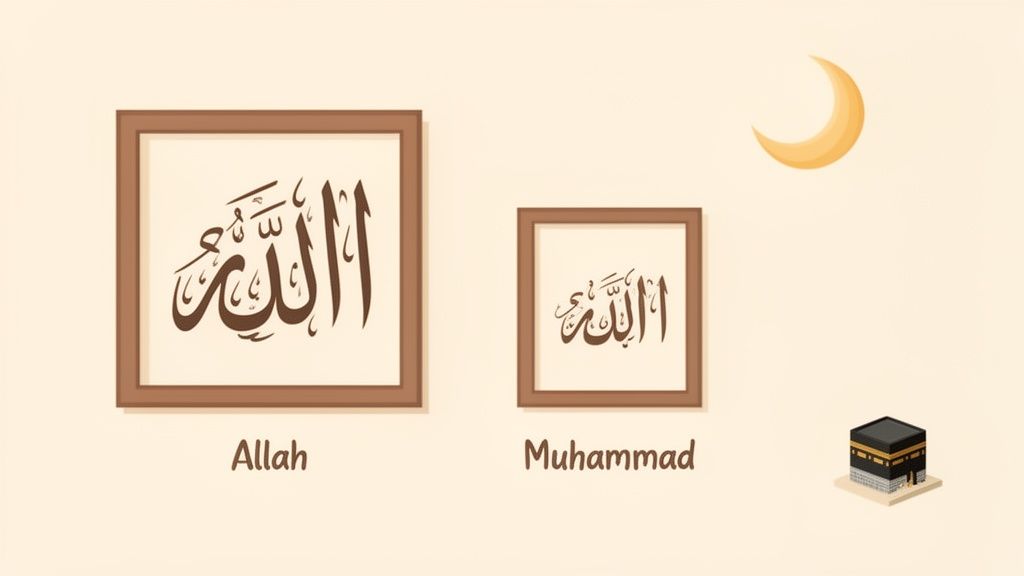
- Allah (الله): This is the most central and beautiful word of all. The calligraphy for "Allah" is almost always elegant and prominent, serving as a constant, visual reminder of the Creator's presence. Simply pointing it out—"Look, that says Allah"—builds an immediate, loving association for your child.
- Muhammad (ﷺ): The name of our beloved Prophet (peace be upon him) is another cornerstone of Islamic art. You’ll often see the honorific ﷺ (Sallallahu ‘alaihi wa sallam) written beside his name. It's a small but powerful symbol of the immense respect and love we hold for him.
- Bismillah (بسم الله): The full phrase, Bismillah ir-Rahman ir-Rahim ("In the name of Allah, the Most Gracious, the Most Merciful"), is our gateway to every good deed. Seeing its beautiful, flowing script at the entrance of a home or the start of a chapter in the Quran reinforces the habit of beginning everything in Allah's name.
These calligraphic designs turn words into powerful visual anchors for a child's growing faith. They learn that these names are special—so special that they are presented with such care and beauty.
When your toddler points to a piece of calligraphy in your home and you respond with a warm, simple explanation—"That beautiful word is 'Allah'"—you are planting a seed of spiritual recognition. You're teaching them that our deen is not only heard and felt but also seen.
Beloved Symbols of Our Ummah
Beyond specific words, certain visual motifs have become deeply connected with Muslim culture and identity all over the world. They carry with them layers of shared history and meaning.
The Crescent Moon and Star (Hilal)
The Hilal, or crescent moon, is probably one of the most recognizable symbols associated with Islam. Its significance is very practical: the Islamic calendar is lunar, so sighting the new crescent moon signals the start of important months like Ramadan and Dhul Hijjah. For a child, it’s a simple, magical shape they can spot in the night sky, creating a direct link between Allah's creation and our faith's most special moments.
The Kaaba
The simple, powerful image of the cube-shaped Kaaba in Makkah is a symbol of our unity. It is the direction we all face for Salah, connecting Muslims worldwide in a single, beautiful act of worship. Showing pictures of the Kaaba to your child helps them grasp that they are part of a vast, global family, all connected to this blessed and sacred place.
By introducing your child to these artistic and symbolic expressions, you are enriching their world with the beauty of their Islamic heritage. This creates a comforting and identity-affirming environment where the symbols of our faith are a natural and cherished part of everyday life.
Playful Ways to Introduce Arabic to Your Toddler
It's one thing to understand the beautiful meanings behind Arabic symbols, but it's another thing entirely to share them with your toddler in a way that’s joyful and fits into a busy day. The secret? Focus on playful, gentle exposure, not formal teaching. For little ones aged 0-3, learning is all about their senses and the comforting rhythms of daily life.
Your real goal is to make Arabic feel like a warm, familiar part of their world. This isn't about drills or memorization. It’s about connecting these new sounds and shapes to feelings of love, comfort, and fun. Every little interaction you have builds a positive foundation for a lifelong relationship with the language of our faith.
Weave Arabic into Your Daily Routines
Often, the most powerful learning moments are the ones that don't feel like lessons at all. When you sprinkle Arabic into everyday activities, you’re naturally weaving it into the fabric of your family’s language.
- Mealtime Connections: Before a meal, as you say "Bismillah," point to a colorful magnet of the letter 'Ba' (ب) on the fridge. It’s a simple action that links the sound, the symbol, and a cherished routine.
- Story Time Sounds: While snuggled up with a book, you can point to things and say their Arabic names. Point to the moon and say "Qamar" (قمر), or the sun and say "Shams" (شمس).
- Greeting Guests: When a loved one arrives, you can say, "Let’s say 'Salaam'!" and make the 'ssss' sound for the letter 'Seen' (س). This connects the language directly to happy, social moments.
As you plan these little moments, it helps to keep in mind the principle of comprehensible input, which is really just about making sure the language they hear is at a level they can start to understand.
Sensory Play with Letters
Toddlers are wired to learn by touching, feeling, and exploring with their hands. That’s why sensory activities are such a brilliant way to introduce the shapes of Arabic letters in a pressure-free, engaging way.
Let your child's hands do the learning. When they trace a letter in sand or feel the smooth wood of an alphabet block, they are building a deep, physical memory of its shape that goes far beyond just seeing it on a page.
Here are a few simple ideas you can set up in minutes:
- Tracing Tray: Pour a little rice, salt, or sand into a shallow tray. Gently guide your toddler’s finger to trace a simple shape, like the straight line of 'Alif' (ا).
- Playdough Shapes: Roll out playdough "snakes" together and help them form letters. The letter 'Noon' (ن) is a perfect one to start with—it looks just like a little bowl!
- Alphabet Blocks: A good set of wooden Arabic alphabet blocks is a wonderful investment. They’re fantastic for stacking, touching, and just having around the play area, making the letters a normal part of their environment.
You can also bring in other physical tools to support this learning. Well-designed visuals, like our 1st words flash cards, provide clear, engaging images that help link Arabic words to familiar objects. These simple, playful interactions are the true building blocks of a beautiful and lasting connection to Arabic.
Your Questions About Teaching Arabic to Toddlers Answered
Embarking on the beautiful journey of sharing Arabic with your little one is exciting, but it naturally comes with a few questions. It’s completely normal to wonder about the best approach, so we’ve gathered some common queries to bring you some peace of mind as you get started.
When Should I Start Introducing Arabic Symbols?
For our precious little ones aged 0-3, the focus should always be on gentle, positive exposure—not formal teaching. You can begin right from birth, simply by letting your baby hear the soothing rhythm of your Quran recitation and the loving Arabic words you use every day, like ‘habibi’.
As your toddler's curiosity blossoms around 18 months, you can introduce things like colorful flashcards, gentle alphabet songs, and simple wooden puzzles. The goal isn't memorization. It's about building a warm, happy connection to the language's beautiful sounds and shapes.
Is It Important to Teach Arabic if My Family Isn't Arab?
Absolutely. For Muslim families from every corner of the world—whether you're South Asian, African, or European—Arabic is the sacred language that unites us. It's the language of the Quran and our daily Salah.
Giving your child early, gentle exposure helps connect them to these core parts of their faith. You're building a foundation of familiarity that will, inshaAllah, make their formal learning feel much more natural later on. It’s not about fluency at this age; it’s about nurturing a love for the language of our deen and fostering a deep sense of belonging to the global ummah.
Your effort, no matter how small it feels, is what matters most. Learning alongside your child is a beautiful bonding experience that models a love for our deen. Your positive attitude is the most powerful lesson you can offer.
For parents looking for new ideas, it can be helpful to look into the best practices for online teaching and adapt some of those effective strategies for home learning.
What Are the Best Resources for Toddlers?
The key is to look for resources that are colorful, engaging, and designed specifically for this tender age group. Think board books with large, clear letters, chunky wooden alphabet puzzles that are easy for little hands to grasp, and soothing nasheeds.
If you choose to use screen time, look for platforms that offer safe, ad-free, and Islamically-aligned content. These can provide spiritually sound exposure to the Arabic alphabet and Quranic stories. The main thing is to choose tools that feel like play, not work.
At Babymode, we create a safe, halal, and ad-free screen time experience designed for Muslim children aged 0–3. Our content nurtures a love for Arabic and Islam through gentle, age-appropriate stories and songs, giving you complete peace of mind.
Join the Babymode waitlist for a calmer, faith-aligned start for your child