As a Muslim parent, you know that building your child's vocabulary and their identity starts from day one. 1st words flash cards are a wonderfully simple and powerful way to do just that, creating gentle, screen-free learning moments in the quiet pockets of a busy day.
A Bridge to Faith and First Words
Life with little ones is a whirlwind, isn't it? Juggling prayer times, meal prep, and unpredictable nap schedules doesn't leave much room for structured activities. And like many parents, you're probably cautious about screen time, wanting to protect your child from overstimulating or inappropriate online content.
This is where the beautiful simplicity of first words flash cards shines.
They’re so much more than just learning tools. Think of them as a bridge connecting your child to language, the world around them, and their faith. A simple card showing a cat, a cup, or the moon can spark a moment of shared discovery. You’re not just teaching a word; you're building connections in their rapidly developing brain, all while snuggled together on the prayer mat or waiting for the baby's food to cool down.
Creating a Halal Learning Environment
One of the biggest challenges for Muslim families is finding resources that truly align with our values. Flash cards put you in complete control. You can curate a collection that reflects your family's world, seamlessly blending everyday English, Arabic, or Urdu words with foundational Islamic concepts.
Instead of only learning 'apple' and 'ball', imagine your child becoming familiar with words like:
- Allah (الله): The first and most important word.
- Bismillah (بسم الله): Connecting the word to daily actions like eating or drinking.
- Dua (دعاء): Gently introducing the beautiful concept of talking to Allah.
- Masjid (مسجد): Linking the image to your family outings for prayers.
This approach weaves their Muslim identity into the very fabric of their earliest learning experiences. It makes faith a natural, loved part of their world. You can learn more about how these simple tools work in our detailed guide on what flash cards are and why they're so effective.
It's no surprise that the demand for these tactile, educational tools is growing. The global market for early learning flashcards has soared to over $1.43 billion as parents everywhere look for effective, screen-free ways to support their child's cognitive growth. For Muslim families, this trend is a perfect opportunity to select or create content that is both educational and spiritually enriching.
Choosing the Right Flash Cards for Your Child
Walking into a shop or browsing online for baby products can feel overwhelming. But picking out the perfect 1st words flash cards doesn’t need to be complicated. The secret is simple: match the cards to your child's developmental stage. You want something that’s engaging, safe, and fits with your family’s values.
For the tiniest babies, it’s all about visual stimulation. Their world is just coming into focus, and simple, bold images are what grab their attention. As they grow, their needs shift from just looking to making real connections with the world around them.
Matching Cards to Your Child's Age
Choosing age-appropriate cards makes a world of difference. What mesmerises a newborn is a world away from what will capture the attention of a curious toddler who’s busy exploring everything.
This handy table breaks down what to look for at each stage, making it easier to find the perfect fit for your little one.
Flash Card Guide By Age and Stage
Use this table to choose the best type of '1st words flash cards' for your child's developmental stage.
| Age Range | What to Look For | Example Words (English/Arabic/Urdu) | Parenting Tip |
|---|---|---|---|
| 0–6 Months | High-contrast, black-and-white images. Simple shapes, no text. | N/A (Focus is on visuals, not words) | Hold cards about 8–12 inches from their face during tummy time to help build neck strength. |
| 6–18 Months | Simple, clear photos of everyday objects on a white background. | Cup (كوب), Ball (كرة), Moon (قمر/Chaand), Water (ماء/Paani) | Say the word clearly and point to the real object if it's nearby. Repetition is everything! |
| 18–36 Months | More detailed cards with colours, animals, and simple concepts. | Dua (دعاء), Cat (قطة/Billi), Hands (يد/Haath), Thank You (شكراً/Shukriya) | Start asking, "Where is the cat?" to see if they can point to the correct card. |
As you can see, the journey with flash cards grows with your child—from basic visual development to building a rich vocabulary.
This simple timeline visualises how flash cards can support your child's journey from early connection to building a strong sense of identity.
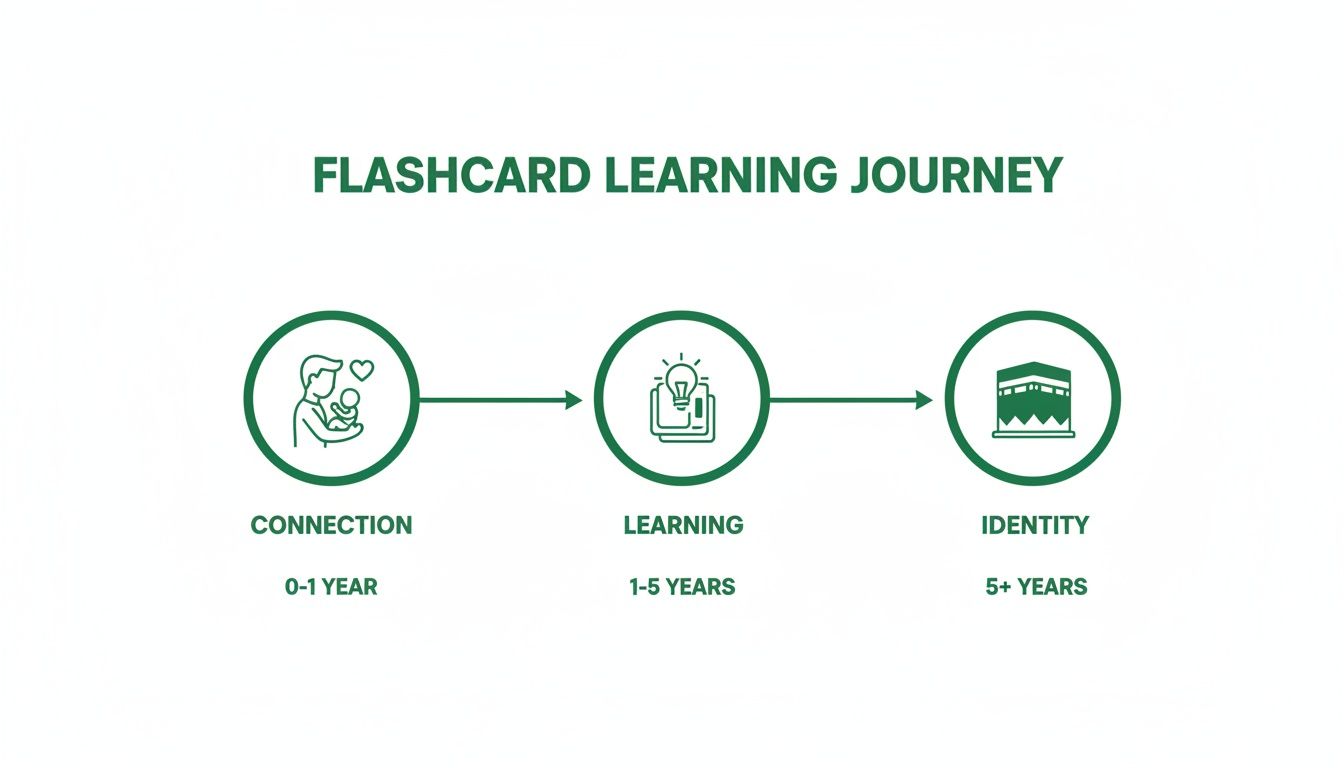
This journey shows that learning isn't just about memorising words; it's about building a foundation of connection first, then knowledge, and finally, a confident Muslim identity.
Safety and Durability First
Let’s be honest: whatever you give your baby is probably going to end up in their mouth. That’s why safety is non-negotiable. Always look for cards made from non-toxic, BPA-free materials. Rounded corners are a must to avoid accidental pokes, and thick, sturdy cardstock will save you from replacing bent and chewed-up cards every other week.
The global flash cards market has grown to $2.5 billion for a reason. Parents are looking for quality and safety. In fact, top-selling sets often boast 96-97% positive reviews for their high-contrast designs, which makes sense when you consider that 90% of a baby's sensory input is visual in their first year. For a deeper dive into these market trends, you can check out the analysis on cognitivemarketresearch.com.
Parent Tip: My go-to trick is to look for cards with a matte or laminated finish. They're a lifesaver for wiping off sticky fingerprints, and the reduced glare makes the images much clearer for your baby’s developing eyes.
Keeping Content Halal and Positive
Finally, and most importantly, take a close look at the content on the cards. You'll want to choose sets that avoid any imagery that conflicts with Islamic values, such as animate beings in certain contexts or pictures with inappropriate dress.
The best cards are those that celebrate Allah’s beautiful creation—think animals, fruits, and scenes from nature. By being mindful about the first learning materials you bring into your home, you’re creating a wonderful, enriching environment that nurtures your child's mind and soul right from the start.
Making Flashcard Time a Joyful Routine
For 1st words flash cards to really work their magic, they have to feel less like a lesson and more like a fun game. The whole idea is to weave these little learning moments into the natural rhythm of your day, turning a simple activity into a cherished bonding experience. Forget about pressure and schedules; just think of it as sharing a few special minutes of discovery with your little one.
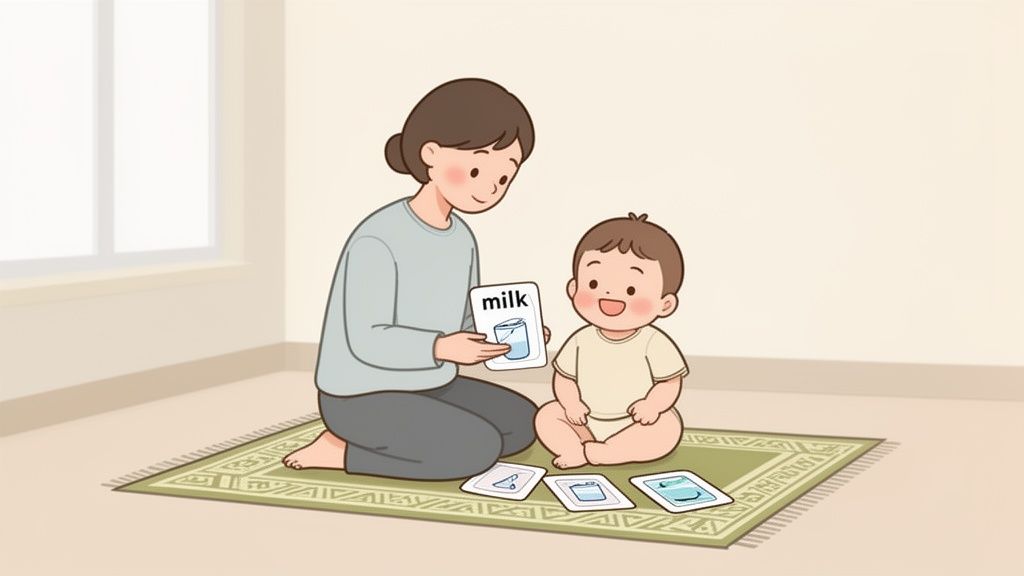
Finding the right time and place is everything. A calm, quiet environment helps them focus. This could be a cosy corner on the prayer mat after you’ve finished Salah, when the house is still and peaceful. Or maybe it's those few minutes after a nap when your baby is relaxed, content, and ready for some gentle interaction.
The key is to keep your sessions short and sweet. For babies and toddlers, attention spans are fleeting. Honestly, just 5-10 minutes a day is more than enough. This "little and often" approach is what keeps them excited for flashcard time, rather than seeing it as a chore.
Weaving Cards into Daily Life
The most powerful way to use flashcards is to connect them to what’s happening in your child's world right now. When you link a picture to a real object or a part of their routine, you're helping their brain build strong connections. It makes learning feel real and meaningful.
Here are a few simple ideas to get you started:
* Meal Times: Just before you give your baby their bottle, show them the 'milk' card. As you do, say "Bismillah, time for some milk!" You’re connecting the word, the picture, and the blessed routine.
* Story Time: Before you cuddle up to read, pull out the 'book' card. This builds anticipation and helps them understand the routine: first the card, then our story.
* Bedtime Routine: As you look out the window together before bed, show them the card for 'moon' (Qamar/Chaand). Point to the moon outside and then the card, repeating the word softly.
A warm, animated tone of voice is your secret weapon. Your child responds more to your enthusiasm and affection than anything else. Smile, use playful sounds, and just enjoy that moment of connection—that’s what makes the learning stick.
And it doesn't just have to be about objects. You can explore how emotion cards can be used to build emotional intelligence right from the start. This adds another beautiful layer to their development, helping them name their big feelings, which is a vital skill for life.
Keeping Your Toddler Engaged
As your baby grows into a busy toddler, sitting still might be the last thing on their mind! This is completely normal—it’s a sign of their healthy, wonderful curiosity. Instead of trying to force them to sit, adapt the activity to match their energy.
Let's turn it into a game:
* Find the Card: Lay out a few cards on the floor. Ask, "Where is the cat?" and celebrate with lots of praise when they point to or pick up the right one.
* Match the Object: Place the 'car' card right next to their favourite toy car. Put the 'spoon' card on their highchair tray. This helps them make that crucial link between the 2D image and the 3D object in their hands.
* A Simple Treasure Hunt: For older toddlers, hide a familiar card in an obvious spot and ask them to find it. The excitement of the search makes the word even more memorable.
At the end of the day, the goal is joyful repetition, not rigid instruction. By making it fun, you’re nurturing a lifelong love for learning, rooted in the warmth and safety of your home. You're not just teaching first words; you are building beautiful memories, one card at a time.
Building a Bilingual and Islamic Vocabulary
For Muslim families, 1st words flash cards are more than just a learning tool; they're a beautiful way to nurture a rich, bilingual vocabulary that embraces your heritage and faith. It's an opportunity to build a world for your child where their identity is woven into the very words they learn, making Islam a natural and beloved part of their daily life.
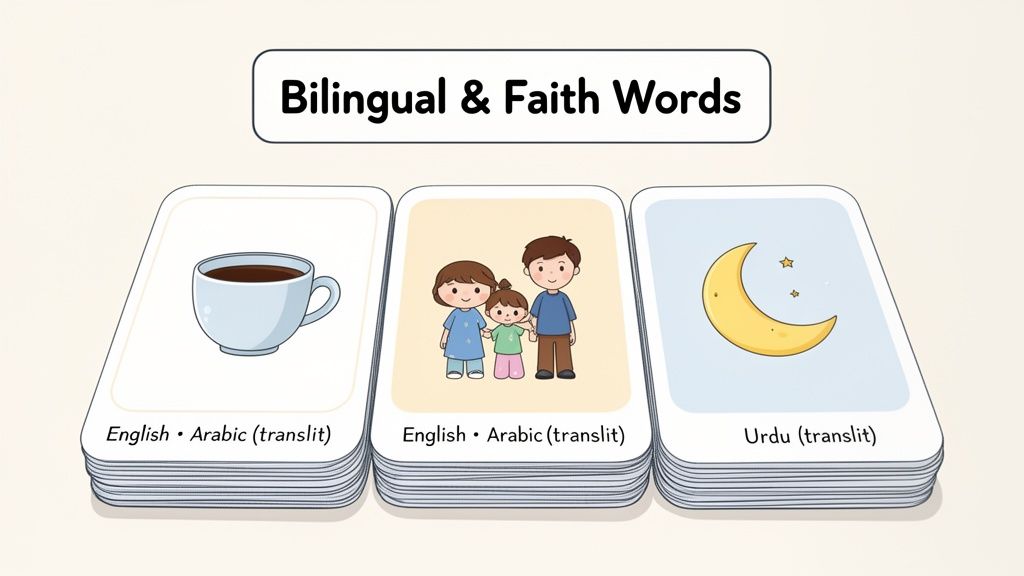
You can easily introduce words in English right alongside Arabic, Urdu, or any other language spoken at home. This doesn't confuse little ones at all. In fact, a child’s brain is incredibly well-equipped to soak up multiple languages right from birth. This early exposure is a priceless gift that strengthens their connection to family, culture, and the Quran.
Getting Started with Your First Words
The best place to start is with words that are immediately relevant to your child’s world. Try mixing everyday objects and familiar faces with gentle Islamic concepts. This approach makes the whole process feel practical and spiritually grounded, turning it into a loving interaction rather than a memorisation drill.
You don't need a huge list to begin. A few key words are all it takes.
- Everyday Objects: Kick things off with words for things your child sees and touches every single day. Think cup (كوب / koob), water (ماء / maa'), and book (كتاب / kitaab).
- Family Members: Reinforce those precious first connections with cards for Mama (أمي / Ummi) and Baba (أبي / Abi). Seeing your face and hearing the word is pure magic for them.
- Simple Islamic Phrases: Gently introduce the beautiful sounds of our faith. You could show a card for Alhamdulillah (الحمد لله) after a meal or use Insha'Allah (إن شاء الله) when talking about fun future plans, like a trip to the park.
Context is everything. As you show the 'food' card before a meal, say "Bismillah" together. This creates a powerful and memorable link between the word, the action, and the blessing. For more ideas on making vocabulary stick, it can be helpful to look into evidence-based strategies for learning vocabulary.
Our First Islamic and Bilingual Word List
Here's a simple starter list to inspire your own flash card collection, blending everyday life with the foundations of our faith.
| Category | English Word | Arabic Word (with transliteration) | Urdu Word (with transliteration) |
|---|---|---|---|
| Family | Mama | أمي (Ummi) | امی (Ammi) |
| Family | Baba | أبي (Abi) | ابو (Abbu) |
| Objects | Water | ماء (Maa') | پانی (Paani) |
| Objects | Book | كتاب (Kitaab) | کتاب (Kitaab) |
| Faith | Praise God | الحمد لله (Alhamdulillah) | الحمدلله (Alhamdulillah) |
| Faith | If God wills | إن شاء الله (Insha'Allah) | ان شاء الله (Insha'Allah) |
| Faith | Peace | سلام (Salam) | سلام (Salam) |
| Nature | Moon | قمر (Qamar) | چاند (Chaand) |
This is just a starting point, of course! Think about what's important and present in your family's daily routine and build from there.
Pronunciation and Making it Natural
Please don't stress about perfect pronunciation, especially with Arabic or Urdu words if you're not a native speaker. Your effort, your intention, and the love you show are what truly matter. Just say the words clearly and confidently, and your child will learn right alongside you.
Parent Tip: A lovely idea is to record a grandparent saying the words in your family's mother tongue. You can play the recording while showing the cards. It's a wonderful way to connect your child with their extended family and heritage, even if they live far away.
A word only becomes part of a child's active vocabulary through repeated, meaningful exposure. If you want to dive deeper into this fascinating process, our guide on your child learning to talk has some great insights. The goal isn't just for them to recognise a word on a card but to truly understand its place in their world. By blending faith, family, and language, you're giving your child a vocabulary that nurtures their mind and their soul, insha'Allah.
Making Screen Time a Helper, Not a Hindrance
Let's be honest. As much as we love those focused, hands-on moments with our little ones, real life happens. Sometimes you just need five minutes to get dinner ready before Maghrib, a quiet moment for your Dhuhr prayer, or even just a chance to sip your chai while it's still hot.
While 1st words flash cards are fantastic for direct interaction, it's not realistic to think we can avoid screens completely. The key isn't to ban them, but to be incredibly intentional about how we use them. It's about finding screen time that supports your child's development, rather than just distracting them.
This is where having a truly trustworthy digital resource in your back pocket makes all the difference. It's not about replacing that precious connection you build during flashcard time, but about having a reliable option for those moments you need an extra pair of hands.
A Purpose-Built Tool for Muslim Families
We felt this need deeply, which is why we created Babymode. It was designed from the ground up to be a halal, ad-free, and calm digital space that reinforces the very concepts you're teaching with flashcards. No surprise ads, no overstimulating cartoons, and no sketchy algorithms pushing random videos.
Instead, your child will find a library of content that aligns with your family’s values:
- Gentle Nasheeds: Sweet songs that teach good manners, sharing, and kindness.
- Quranic Stories: Simple, beautifully told stories about our Prophets and Allah's creation.
- Vocabulary Building: Content that introduces letters, colours, and animals in a peaceful, age-appropriate way.
This shift towards quality, educational tools is part of a bigger picture. The global market for sight word flashcards has soared to $1.2 billion, as more parents look for effective ways to support early literacy. Digital resources are a huge part of this trend, turning static cards into interactive experiences. You can dive deeper into how technology is shaping this space in the latest market report from marketintelo.com.
The goal isn't to use a screen as a babysitter, but as a supportive tool that extends the positive learning from your flashcard sessions. When chosen carefully, digital content can be a valuable part of a balanced learning environment.
We explore this balanced approach in more detail in our guide to Islamic screen time guidelines for young children.
Babymode is designed to put you in the driver's seat. The parent-first dashboard lets you set screen limits, choose content categories, and track milestones without any invasive data collection. Think of it as a trusted partner, here to support your parenting journey by providing a safe, enriching space for your child to explore when hands-on play just isn't possible.
Answering Your Top Questions
As you start using flash cards, you'll naturally have a few questions. We all want to do what’s best for our little ones while weaving our faith and culture into their learning. Here are some of the most common things I hear from other parents, along with my best advice.
What’s the Right Age to Start?
You can get started much earlier than you might think! For the littlest ones (0–6 months), high-contrast black-and-white cards are brilliant. They’re not about words yet; they’re about stimulating your baby's developing vision and helping them learn to focus.
Once they hit around 6 months, you can bring in simple, colourful cards showing everyday objects. The goal is connection, not memorization. Think of it as a fun, quick bonding moment, not a formal lesson.
My Toddler Just Won’t Sit Still!
Welcome to toddlerhood! It’s their job to move, wiggle, and explore. If you try to make them sit for a formal "session," you're both going to end up frustrated. The trick is to match their energy.
Turn flash cards into a game:
- Go on a "Treasure Hunt." Hide a few familiar cards around the room and make a big deal of it when they find one. "You found the kitaab (book)!"
- Match It Up. Place the 'car' card next to their favourite toy car, or put the 'spoon' card on their highchair tray before a meal. It connects the picture to the real world.
- Just Stick 'Em Up. Pop a few relevant cards on the fridge at their eye level. Point to the 'milk' card before you grab the carton. It’s all about gentle, repeated exposure.
Will Teaching English, Arabic, and Urdu Confuse My Child?
Absolutely not. In fact, you're giving them an incredible gift. A child’s brain is literally built to soak up multiple languages from birth, and a mountain of research shows bilingualism comes with huge cognitive perks.
The key is being consistent. You can say the word in both languages back-to-back ("This is water... and in Arabic, we say maa' ماء"), or maybe one parent sticks to one language. By building this bilingual foundation, you’re connecting them to their heritage and the language of the Qur'an from day one.
Are Digital Flash Card Apps Okay?
While nothing beats hands-on, physical cards for tactile learning, let's be realistic—sometimes you need a screen-based option. The most important thing is choosing the right kind of app.
Steer clear of anything with ads, sneaky in-app purchases, or loud, overstimulating chaos. You want something that complements, not distracts. A platform like Babymode is designed to be a safe, halal alternative, offering calm, age-appropriate content with full parental controls.
Babymode offers a safe, halal, and ad-free screen time experience that works alongside your child's hands-on learning. Join the waitlist for early access and explore a world of enriching stories, nasheeds, and learning that truly aligns with your family’s values.