That quiet worry you feel when your toddler isn't chatting as much as their cousins? You're not alone. The journey of supporting your toddler's speech at home starts with simple, love-filled interactions. It’s all about turning everyday moments into powerful language-learning opportunities that honour your faith and fit right into your daily life.
Your Gentle Start to At-Home Speech Support
As Muslim parents, we naturally want to give our children the best possible start, and helping them communicate is a huge part of that. The beautiful thing is, you don't need a bunch of special tools or a rigid schedule. Your home, already filled with the routines of Islamic life, is the perfect classroom.
Think of this guide as a reassuring starting point, designed to help you feel confident and empowered. It’s about gently encouraging speech in a way that feels completely natural, not forced. We'll explore how simple, consistent efforts can make a world of difference.
The Power Is in Your Hands
You are your child's first and most important teacher. That unique connection you share is the foundation for all their learning, especially language.
Let's be real: formal therapy isn't always accessible or a quick process. Globally, an estimated 7–10% of children have identifiable speech or language disorders, but many never get professional help due to long waiting lists or other access gaps. This makes what you do at home absolutely crucial. You can learn more about these speech therapy statistics and see just how impactful your role is.
This reality highlights just how vital your role is. By creating a nurturing environment, you can provide powerful early support right where your child is most comfortable. The key is to transform your daily activities into moments of genuine connection and communication.
Your voice, your patience, and your presence are the most effective tools you have. By simply talking, singing, and playing with your toddler, you are laying the groundwork for strong communication skills, Insha'Allah.
Four Pillars of At-Home Speech Support
To get started, it helps to focus on a few core principles. These pillars are easy to remember and can be woven into your day without disrupting your family’s rhythm. They are designed to build a language-rich home where your toddler feels safe and encouraged to communicate.
Here’s a quick look at the core strategies you can start implementing today.
Four Pillars of At-Home Speech Support
| Pillar | What It Means for Your Family |
|---|---|
| Narrate Your Day | Talk about what you’re doing, seeing, and hearing. Describe the steps of making wudu, folding laundry, or preparing a meal. |
| Follow Their Lead | Pay attention to what interests your toddler. If they’re staring at a cat, talk about the cat—its colour, its meow, how it feels. |
| Create Opportunities | Gently prompt communication. Instead of just handing them a snack, offer a choice: "Do you want a date or a banana?" |
| Listen Patiently | Give your child plenty of time to respond. It’s so tempting to jump in, but try to avoid interrupting or finishing their sentences. Your quiet patience is powerful. |
By embracing these simple ideas, you're not just teaching words; you're building your child's confidence and strengthening your bond. Simple tools can help, too. For some playful and interactive ideas, check out our guide on using first words flash cards.
Getting to Grips With Your Toddler's Communication Journey
It’s completely normal to feel a little anxious about your toddler’s speech, especially when you see other little ones chatting away. But remember, every child's journey is unique, unfolding at its own perfect pace, by Allah's will. Knowing what to expect can transform that worry into confidence, helping you tune into and celebrate your child's progress.
Think of it less like a race and more like a series of small, wonderful steps. From those first precious babbles to stringing words into little sentences, each moment is a milestone. When you understand these stages, you can offer the right kind of support at the right time, turning simple daily moments into powerful learning opportunities.
What to Listen For: Typical Speech Milestones (12-36 Months)
While every child follows their own timeline, language development does have some general patterns. These milestones are simply guideposts to help you see where your child is now and what might be just around the corner.
Here's a simple breakdown of what you might see and hear as your little one grows:
- 12-18 Months: This is often when first words make their debut! You'll likely hear "Mama," "Baba," or their version of "milk" or "ball." They're also starting to understand simple commands, like "Give me the block," and will point to tell you what they want.
- 18-24 Months: Their vocabulary really starts to take off, often exploding to around 50 words or more. This is also when you'll hear those first little two-word phrases, like "More juice" or "Go car." It’s a huge leap in their ability to express themselves.
- 24-36 Months: Get ready for more complex communication! Three-word sentences and short conversations become more common. The famous "What?" and "Why?" questions begin, and they can now follow two-step directions, like "Pick up your teddy and put it in the basket."
The timeline below gives you a bird's-eye view of how you can gently support this growth, starting from their very first year.
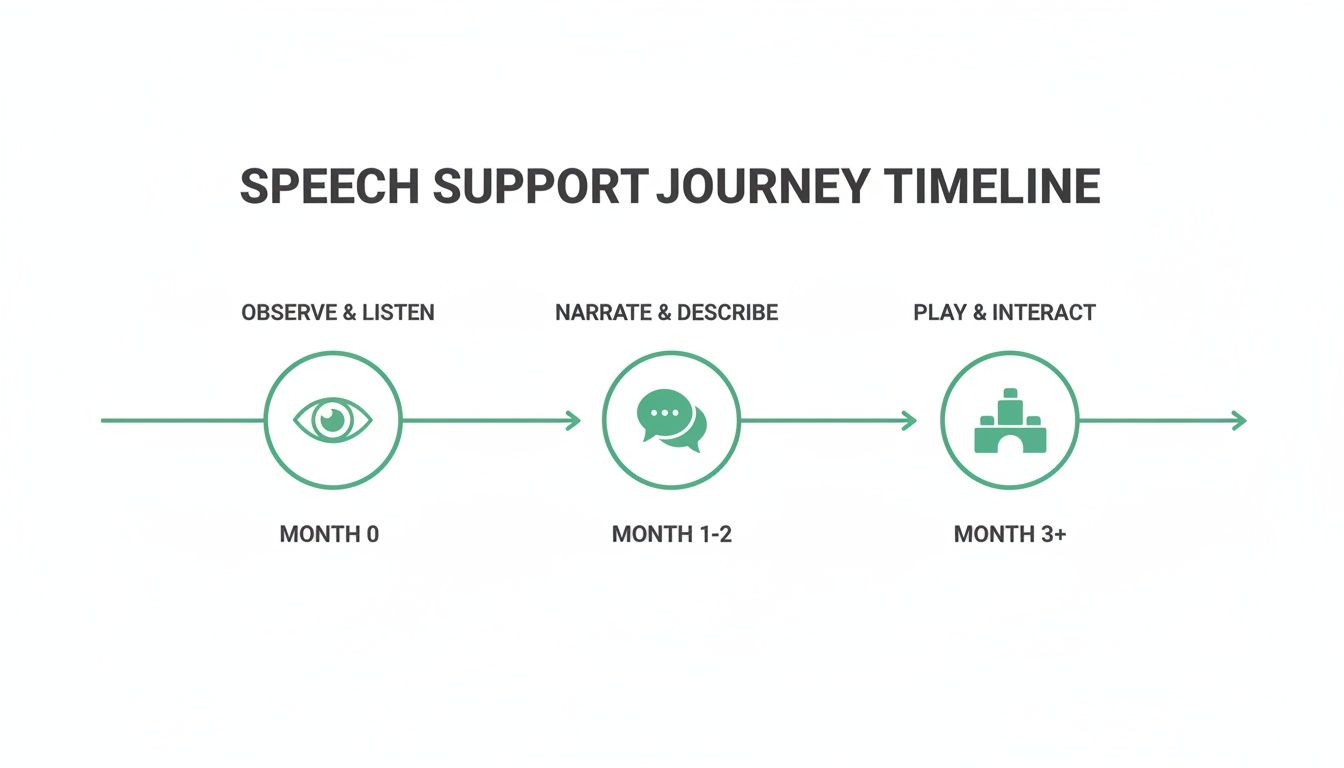
This simple visual shows how your at-home efforts can naturally evolve from quiet observation to rich, interactive play as your child blossoms.
The Gift of a Bilingual Home
In many families, speaking more than one language is just a normal part of life. You might be chatting in English with the nursery teacher and then switching to Arabic or Urdu at home with the grandparents. It’s a common concern—will this confuse my toddler or slow down their speech?
Let me put your mind at ease: bilingualism is a superpower. Research consistently shows that young children are perfectly wired to learn multiple languages at once.
Yes, some bilingual toddlers might mix words from different languages or start talking a little later than their monolingual peers, but this is a totally normal and temporary part of the process. It's not a sign of a delay.
Raising a child with multiple languages enriches their mind and deepens their connection to their faith and heritage. Trust the process and know you're giving them a priceless gift for life.
Think of it this way: their brilliant little brain is building two language systems at the same time, which is an incredible feat! They aren't just learning words; they're learning different cultures and ways of seeing the world. This is a huge strength that strengthens their ties to family and their identity. So, keep speaking your heart's language, whether it's Urdu, Arabic, or Somali. It’s one of the most powerful things you can do.
Creating a Language-Rich Islamic Home
Your home is your child’s very first madrasah—their first classroom. It's where they learn about the world, their faith, and their place in it. When you're supporting your toddler's speech at home, this blessed space is your greatest asset. Forget clinical-feeling exercises; we're going to weave language into the beautiful fabric of your daily Islamic life, making it feel completely natural.
Let’s get practical and talk about real scenarios that happen in Muslim households every single day. The idea is to make language support a joyful part of your family’s identity, not another task on your to-do list. You don't need special flashcards or equipment. All you need is to be intentional during the moments you're already sharing.
When you mindfully narrate your day through an Islamic lens, you provide a constant, gentle stream of rich vocabulary. This turns your home into a place where words are tied to love, faith, and family.
Turn Daily Routines into Talking Routines
The secret to helping toddlers learn new words is repetition and context. Luckily, our Islamic routines are filled with both. These predictable, comforting moments are the perfect opportunity to model words and phrases. Think of it as being a commentator for your child's world. We often call this "parallel talk" (narrating what your child is doing) and "self-talk" (narrating what you are doing).
Start with simple actions that happen over and over again.
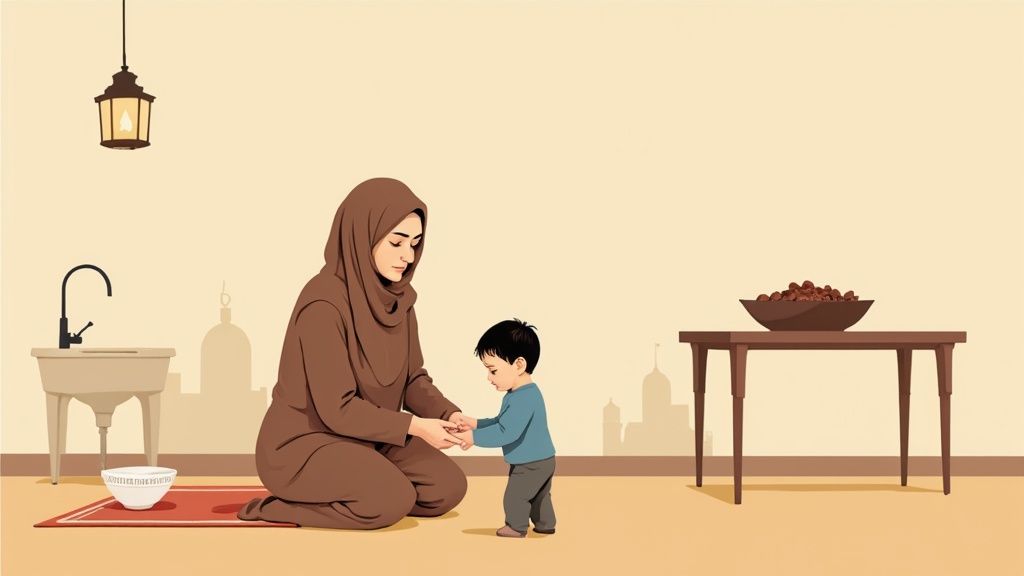
- During Wudu: Talk through each step. "Bismillah! Time to wash our hands. Splash, splash! Water feels cool. Now, let’s rinse your mouth. Good job! Time for the nose." This directly connects the physical action to a clear, simple word.
- Meal Times: Use descriptive words. "Mmm, this date is so sweet." "Do you want the soft bread or the crunchy cucumber?" "Alhamdulillah, we finished our yogurt! All gone."
- Prayer Times: Even if your little one is just wiggling beside you on their own little mat, involve them. "It's time for Dhuhr prayer. Let's get the prayer mat." "Look, Baba is making sujood. Down we go!" "All done! Masha'Allah."
These small interactions compound. Day after day, your toddler starts linking these words to the comforting rhythms of home, helping that new vocabulary stick.
Weaving Language into Islamic Learning
All those moments you spend teaching your child about their deen are also powerful opportunities for speech development. Snuggling up with Islamic storybooks, listening to nasheeds, and reciting simple phrases together are both fun and incredibly effective.
The rhythm of nasheeds and short Surahs is especially helpful for a developing brain. Research has shown that music and repetition are fantastic tools for language acquisition because they help a child's brain pick up on patterns in speech.
When you chant "La ilaha illallah" together or sing a simple nasheed about the Prophet (SAW), you’re doing so much more than teaching faith—you’re laying neurological pathways for language. The melody and repetition make words memorable and fun to try.
Here are a few ways to merge Islamic education with speech practice:
- Make Story Time Interactive: When reading a Quranic story, don't just read the words on the page. Point to the pictures and label everything. "Look at the big, green tree!" "See the tiny little ant?" Ask simple "what" questions, and celebrate even if they just point in response.
- Nasheeds and Movement: Put on a gentle, instrument-free nasheed and add some actions. If the song is about thanking Allah, you can raise your hands up high. If it's about the animals on Nuh's (AS) ark, you can make the animal sounds together. This creates a strong mind-body connection to the words.
- Practice Simple Du'as: Build short, meaningful du'as into your routine. Always say, "Bismillah" before eating and "Alhamdulillah" after. Even if your toddler can only get out the "B" sound for Bismillah, praise their effort with a huge smile!
If you're looking for more inspiration, you can find a wonderful selection of songs for kids in Arabic that can help expand their vocabulary in a truly engaging way.
Using Everyday Moments to Build Vocabulary
Language learning doesn't have to be a scheduled "session." Honestly, the best moments are often the spontaneous ones, woven right into the flow of your day. Whether you're getting dressed for Jummah or just taking a walk around the block, your world is bursting with things to talk about.
Your job is simply to be an observant narrator for your child. By putting words to their experiences, you help them build a mental dictionary one word at a time.
Practical Examples from a Muslim Home
| Scenario | What You Can Say | Language Skill Targeted |
|---|---|---|
| Getting Ready for Jummah | "Let's put on your clean, white thobe. It's so soft!" | Adjectives (clean, white, soft) |
| Preparing for Iftar in Ramadan | "We need to cut the watermelon. Wow, it's big and heavy." | Size & Weight Concepts |
| Seeing a cat in the garden | "Look, a qittah! The cat says 'meow.' The cat is sleepy." | Naming & Sound Association |
| Folding the laundry | "This is your blue sock. Where is the other blue sock?" | Colours & Matching |
By focusing on these small but consistent interactions, you transform your home into a thriving, language-rich environment that’s deeply connected to your Islamic faith. This approach makes toddler speech support feel less like therapy and more like simply living a full, connected Muslim family life. Insha'Allah, your efforts, filled with love and patience, are the perfect foundation for your child's communication journey.
Playful Activities That Get Your Toddler Talking
Play is a toddler's most important work. It’s how they figure out the world, make sense of things, and connect with the people they love most. So, when it comes to supporting your child's speech at home, harnessing the power of play is hands-down your best strategy. We’re not talking about expensive, light-up electronic toys—in fact, the simplest, screen-free activities often open up the best opportunities for genuine communication.
The real goal here is to create these little moments of connection where talking feels natural and fun, not like a chore. You’ll be modelling simple words, giving them plenty of time to respond, and showing them what you mean in a way that feels completely pressure-free. These playful routines don't just build vocabulary; they boost confidence and make your bond even stronger.
Everyday Items Are Your Best Tools
You absolutely do not need a special "therapy room" or a closet overflowing with educational toys. I promise. The best tools for encouraging your toddler to talk are often the everyday items you already have. This approach is not only practical but also helps your child learn the words for the real things they see and use every single day.
Research consistently points to a child's home environment as a massive factor in their language journey. Studies on play have found that traditional toys lead to more words and a richer vocabulary compared to their electronic counterparts, which tend to reduce that crucial back-and-forth interaction between you and your child. For a closer look at the data, you can read the full research about how home environments affect speech. This is exactly why focusing on simple, hands-on play is so effective.
Think about what's already in your kitchen, living room, or your child's bedroom. A laundry basket can easily become a boat. A set of plastic bowls can be a drum kit or a stacking tower. Each of these simple things offers a brand-new context for language.
Making Play Interactive and Language-Rich
The secret to turning playtime into speech practice is getting right in there with them. Instead of just watching from the sidelines, become their play partner. This is your chance to use a couple of powerful techniques: modelling and expansion.
- Modelling: This just means saying the word for an object or action. If your toddler hands you a block, you say, “Block! A red block.” Simple as that.
- Expansion: This is where you take what your child says (or tries to say) and add one or two more words to it. If they point and say, “Car,” you can respond with, “Yes, a big blue car!”
This doesn’t need to be a constant stream of chatter. One of the most important things you can do is pause. After you say something, just wait for a few seconds with an expectant look on your face. That silence creates a little space for your toddler to try and communicate, whether it’s with a sound, a gesture, or a word.
Your goal isn't to get your toddler to perform. It's to create a fun, interactive conversation where they feel safe and motivated to participate. Celebrate every little attempt, even if it's just a point or a grunt!
Fun and Simple Game Ideas for Your Home
Ready to give it a try? Here are some incredibly simple, screen-free games you can play using things you probably have right now. These ideas are designed to be flexible and fit right into your daily routine.
Here are some simple, engaging activities you can do with items you already have at home to encourage communication.
Screen-Free Play Ideas for Speech Practice
| Activity | Language Skills Targeted | How to Play |
|---|---|---|
| The "What's in the Box?" Game | Naming Objects, Answering "What" | Place a few familiar items (a spoon, a toy car, a sock) in an empty tissue box or a bag. Pull one out at a time and say with excitement, "What's in the box? It's a... spoon!" Encourage your child to name the item. |
| Indoor Scavenger Hunt | Following Directions, Vocabulary | Give a simple instruction like, "Let's find something red!" Then, look for red things together, like a red prayer mat, a red apple, or a red book. Name each item as you find it. |
| Bubble Pop Party | Requesting, Body Parts, Action Words | Blow bubbles and wait for your toddler to ask for "more" or "bubble." You can also model action words ("Pop! Pop!") and name body parts as the bubbles land on them ("A bubble on your nose!"). |
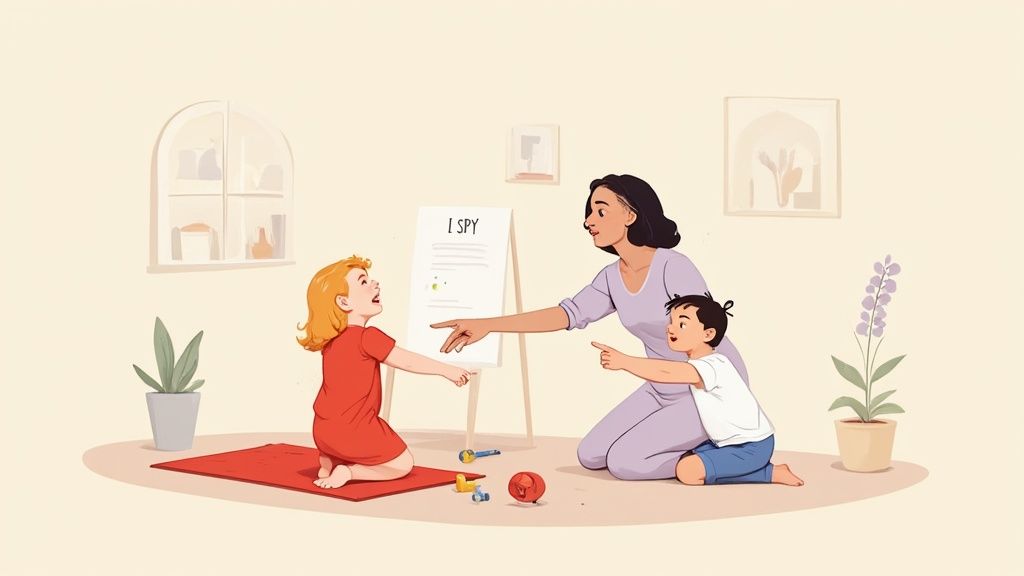
| "I Spy" on a Walk | Colours, Naming, Describing | On your way to the park or shops, play a simple version of "I Spy." Say, "I spy with my little eye something... green!" Then look for a tree, a green car, or green grass and point it out together. |
| Making Animal Sounds | Imitation, Vocabulary, Turn-Taking | Use toy animals or pictures and take turns making the sounds. "The cat says 'meow.' Your turn!" This is a fun, low-pressure way to practice imitation. To discover more about this, check out our guide on teaching animal sounds and names. |
By weaving these playful activities into your week, you’re doing so much more than just home-based speech support. You're building beautiful memories and creating a foundation for communication that will last a lifetime, Insha'Allah.
When to Seek Professional Guidance
While everything you’re doing at home is incredibly powerful, sometimes a child’s journey needs a little extra, specialised support. The most important tool you have is your own intuition. If you have that nagging feeling that something isn’t quite clicking, it’s always worth looking into.
Reaching out for professional advice isn't a sign that you’ve done something wrong—it's an act of love and a way to be the best possible advocate for your child. Think of it this way: your work at home and professional therapy aren't two separate things. They work together, hand-in-hand, to give your toddler the strongest foundation for communication.
Recognising Communication Red Flags
It’s so easy to fall into the trap of comparing your toddler to their cousins or the other kids at the park. But remember, every child truly does bloom on their own timeline. That said, there are some general guideposts that can help you decide if it’s time to chat with a professional. These aren't meant to cause worry, but to empower you with information.
Here are a few things to keep an eye on for different age groups:
- By 18 Months: I start to pay attention if a toddler isn't using any single words yet, like "Mama," "Baba," or "milk." A lack of pointing to show you interesting things or not responding to their own name can also be an early sign.
- By 24 Months: At this stage, a vocabulary of fewer than 50 words is something to note. Also, watch to see if they're starting to put two words together into little phrases, like "more juice" or "my ball."
- By 36 Months: If your toddler isn't using three-word sentences, or if their speech is very difficult for even you or your spouse to understand, it’s probably a good time to get an evaluation. You might also notice they struggle with simple two-step directions like, "Get your shoes and bring them to me."
Trusting your gut as a parent is one of your greatest strengths. If you have a persistent worry about your child’s communication, seeking a professional opinion provides clarity and peace of mind, allowing you to move forward with confidence.
How to Start the Conversation
Taking that first step can feel like a huge hurdle, but it's often simpler than you imagine. Your child’s GP or family doctor is the perfect place to start. They're your partners in your child's health and can provide a referral to a speech-language pathologist (SLP).
When you go to the appointment, try to be ready with specific observations. It’s more helpful than just saying, "I'm worried about his speech."
What to Say to Your Doctor
"Assalamu alaikum, Doctor. I wanted to talk about my son's speech. He's 2 years old now, and while he understands everything, he's only using a few single words and isn't combining them. He mostly points and grunts to tell us what he wants. Could we discuss a referral for a speech evaluation?"
Finding a Culturally Sensitive Therapist
It is so important to find a therapist who understands and respects your family’s background and values. You need to feel comfortable and seen. As you speak with potential SLPs, don’t hesitate to ask questions to make sure they're the right fit for your family.
Here are a few things you might ask:
- "We are a Muslim family and bilingualism is very important to us. How do you support children who are learning English alongside another language like Arabic or Urdu?"
- "Could you tell me about your experience working with families from diverse cultural backgrounds?"
- "Our family routines are centred around prayer times and Islamic values. How can we weave speech therapy goals into our existing daily life?"
Finding the right professional means finding a partner who will honour your faith and family life while providing expert support for your child's beautiful communication journey, Insha'Allah.
Questions on the Minds of Muslim Parents
As you guide your little one through their first words and sentences, it's only natural to have questions. When you're also weaving in your faith and cultural heritage, those questions can feel even more specific. Let's walk through some of the most common concerns I hear from Muslim families, offering practical advice that respects your values.
Will Raising My Child Bilingual Cause a Speech Delay?
This is, without a doubt, one of the biggest worries for parents in homes where English, Arabic, Urdu, or another heritage language are spoken side-by-side. I want to put your mind at ease: the answer is a resounding no.
Giving your child the gift of another language is incredible for their brain and their identity. Sure, you might notice your toddler mixing languages in one sentence—something like, "Mama, give me haleeb (milk)!"—or they might start talking just a little bit later than their monolingual peers. This isn't a sign of a delay. It's the sign of a brilliant little mind building two entire language systems at once.
Your home language is a treasure. It connects your child to their grandparents, their heritage, and the beautiful sounds of the Quran. Embrace it as a strength, not a weakness, in their speech journey.
So, keep speaking both languages with confidence. You're giving them a gift that will last a lifetime.
How Can We Handle Screen Time in a Way That Feels Right?
In a world filled with questionable content, finding safe, appropriate screen time is a huge priority for so many Muslim families. The secret isn't to ban screens entirely, but to be incredibly intentional about how you use them.
Passive viewing, where your toddler is just zoned out in front of a screen, does very little for their language skills. The real magic happens with interactive co-viewing. That just means you're in it with them.
You can turn screen time into a powerful language tool:
- Watch together and talk: When you find a short, halal-aligned video, narrate what's happening. "Look, the boy is sharing his dates! That's so kind, Masha'Allah."
- Ask simple questions: Pause the video and engage them. "What colour is his thobe?" or "What sound does the sheep make?"
- Link it to their world: If you watch a video about animals, you can make a connection. "That's just like the qittah (cat) we saw in the garden today!"
The goal is to use the screen as a launchpad for conversation, not a substitute for it. Look for content that's slow-paced, gentle, and reinforces the beautiful manners and concepts you're already teaching at home.
How Do I Fit This Into Our Already Packed Islamic Routines?
Between prayer times, meal prep, and everything else, adding one more "to-do" to your list can feel impossible. But here's the good news: this approach isn't about scheduling "speech practice." It's about weaving language into the rhythms you already live by.
Your daily Islamic routines are filled with perfect, natural opportunities for connection and communication.
Think about it:
- Before Maghrib: As you're setting the table, you can talk through your actions. "Time to get the plates. One for Mama, one for Baba, one for you."
- While folding laundry: This is a great time to practice colours and naming items. "This is your blue sock. Where is the other blue sock?"
- Getting ready for Jummah: You can talk about the special clothes you're wearing and what you'll do. "Let's put on your clean shirt for the masjid."
When you shift your perspective, you'll start to see that your day is already rich with moments to model language and encourage your toddler to talk—all within the beautiful, predictable flow of your Muslim family life.
Are you looking for a safe, ad-free screen time solution that’s truly designed for your family’s values? Babymode offers a library of gentle, halal, and educational content created for Muslim toddlers. From Quranic stories to the Arabic alphabet, every video supports healthy development and aligns with your faith. Join the waitlist today for early access. Learn more about Babymode.