At their core, first-words flash cards are a wonderfully simple, screen-free way to help your baby connect images with words. For Muslim parents, they're also a beautiful opportunity to bond with your child through a calm, focused activity that feels right at home in a faith-centered life.
How Flash Cards Gently Nurture Your Baby's Brain
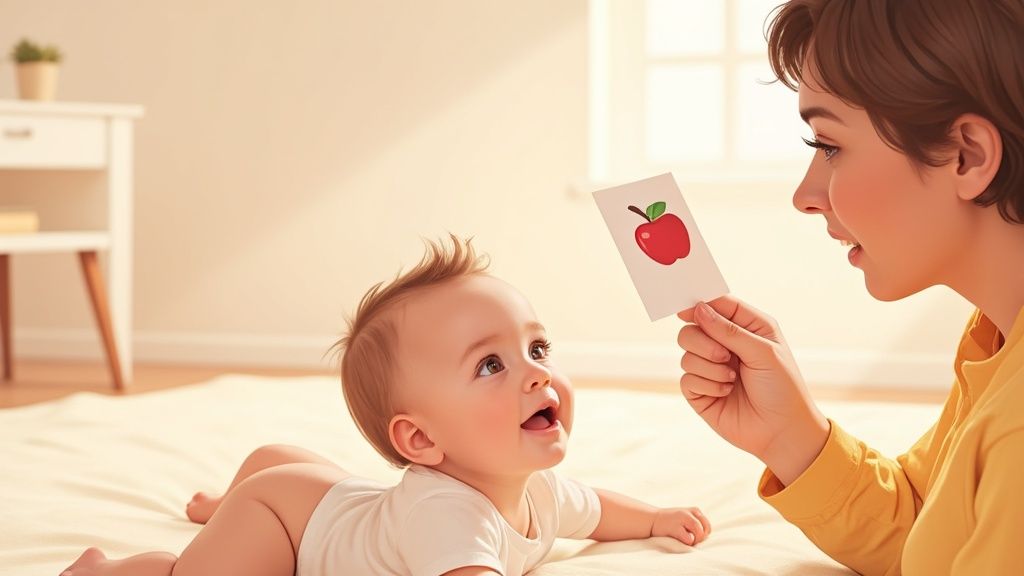
In a world buzzing with screens and digital distractions, the simplicity of first words flash cards is a welcome relief. If you're trying to create a peaceful, intentional environment for your family, these cards become so much more than a learning tool. They are moments of quiet connection.
They offer a real, tangible alternative to screens, helping you guard your child's innocence while nurturing their amazing, developing mind.
This isn't about pushing academics or drilling your baby with facts. It’s about starting a playful conversation. When you show a card with a picture of a cat and say the word "cat," you're helping your baby build vital neural pathways in their brain. It’s a foundational step in their cognitive journey, done in a way that feels natural, loving, and completely unforced.
A Tool for Connection and Calm
What I love most about using flash cards is how seamlessly they fit into the natural rhythm of a Muslim home. A joyful five-minute session can easily happen on the prayer mat after you've finished your Salah, while your toddler is munching on snacks in their high chair, or as a sweet, calming ritual just before naptime.
These shared moments are incredibly powerful. They deepen your bond and help your child build a positive, happy association with learning right from the start. This approach beautifully reflects the Islamic value of seeking knowledge—planting a seed of curiosity that’s rooted in love, not performance. To learn more about the basics, check out our guide on what flash cards are and how they work.
Building Essential Early Skills
When you keep it light and playful, flash cards are a fantastic way to stimulate your child's natural fitrah (their innate disposition to learn and do good). They help nurture several core skills without ever feeling like a formal lesson:
- Object Recognition: This helps your baby make the connection between a 2D picture and a real-life object.
- Vocabulary Building: You're introducing them to the sounds and words that will become the building blocks of their language.
- Memory Development: Gentle, repeated exposure strengthens their ability to remember and recall what they've seen.
- Fine Motor Skills: As they get a bit older, toddlers can practice pointing to the cards, picking them up, and handing them to you.
It's no surprise that parents everywhere are turning to these classic tools. The global flash cards market was valued at around USD 2.5 billion in 2023, with much of that growth coming from parents looking for effective, hands-on learning resources. You can read more about the growth of the educational tools market to see the data. It just goes to show a shared desire among parents worldwide to give their little ones the best possible start.
Creating the Perfect Flash Cards for Your Muslim Home
Finding the right learning tools that click with your family's values can sometimes feel like a real challenge. You want something educational and fun, but it also needs to fit into the wholesome, nurturing environment you're building. This is especially true when it comes to something as simple as first words flash cards.
Whether you decide to buy a ready-made set or get creative and make your own, the real aim is to gather a collection that mirrors your child’s world—a world that is both universally curious and uniquely Muslim.
Choosing the Right Store-Bought Cards
Walking down the toy aisle or scrolling online for flash cards can be overwhelming. So many sets are cluttered with distracting backgrounds or contain images that just don't feel right for our homes. I've found that keeping a few simple things in mind makes it much easier to spot a winner.
Here’s what I look for:
- Simple and Clear: The best cards for tiny learners feature one big, realistic photo or a simple drawing on a plain white background. It really helps your baby focus on the object without getting lost in visual noise.
- Durable and Safe: We all know where everything ends up—in their mouth! Look for thick, laminated cards with rounded corners, made from non-toxic materials. They need to survive being chewed, bent, and generally well-loved.
- Culturally Appropriate: Before you buy, do a quick flip-through of the images. You want to make sure everything is halal-friendly and aligns with your family’s values. It’s worth checking for things like non-halal foods (like pork products) or other imagery you’d rather skip.
A great set of flash cards will grow with your child. What starts as a tool for object recognition can later be used for colour matching, sorting, and even early letter sounds.
A Guide to Making Your Own DIY Flash Cards
There's something incredibly special about creating things for your child with your own hands. Making your own first words flash cards is a wonderful project that gives you complete control to tailor the content to your family's specific languages, culture, and deen.
Plus, it's a surprisingly simple and rewarding activity—perfect for when your little one is napping.
What You'll Need:
* Sturdy Cardstock: I recommend a thick paper, at least 200 gsm, so it can withstand eager little hands. White or off-white is best for making the images stand out.
* A Printer: Any standard home colour printer will do the job perfectly.
* A Laminator: This is the secret to making your cards drool-proof and tear-resistant. A basic home laminator is a fantastic investment for all sorts of family projects.
* Scissors or a Paper Cutter: A paper cutter will give you those lovely, clean, straight edges.
* A Corner Rounder (Optional): This handy little tool is what gives homemade cards that professional, baby-safe finish.
The process itself is easy: find your images, pop them into a document (one image per card), print them out, cut, and laminate. The real magic of going DIY, though, is in the words you choose. You can create a powerful tool for building a vocabulary that truly represents your child's life, including those precious words of faith and family.
Building a Bilingual Brain with English and Arabic Words
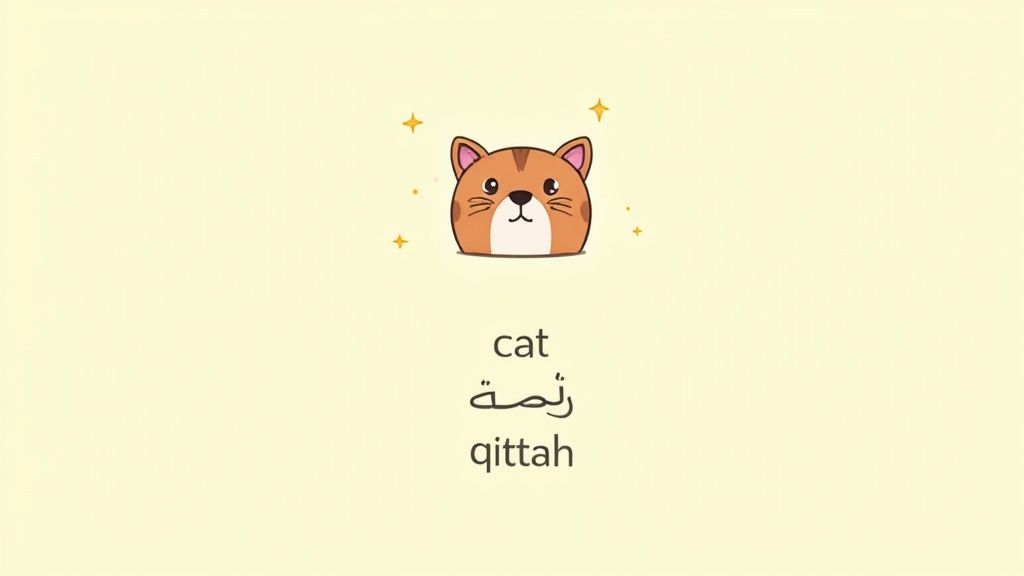
For so many of us, passing on our heritage language is one of the most beautiful gifts we can give our children. Whether your family speaks Arabic, Urdu, Somali, or another language at home, first words flash cards are a simple, joyful way to start building a bilingual brain right from the beginning.
This isn’t about formal lessons or adding any pressure. It's really about weaving multiple languages into the fabric of your daily life, making it a natural and celebrated part of how you connect. You’re strengthening their bond with family, with culture, and with their Muslim identity, all through play.
Gentle Bilingual Teaching Strategies
The incredible thing about a young child's brain is its capacity to soak up languages like a sponge. You don't need a complex system to introduce a second or third language. The real key is gentle, consistent exposure in a loving environment.
Some families swear by the one-person, one-language approach, but let's be honest, that doesn't always fit into real life. A much more flexible strategy is to simply introduce both words together during your flash card sessions.
For example, while playing, you could hold up a card and say:
* "Look, it's a cat! In Arabic, we say qittah."
* "This is an apple. Baba calls it a saib in Urdu."
This simple act shows your child that both words point to the same exciting thing, building a rich and diverse vocabulary without any stress.
Don’t ever worry about "confusing" your child by using multiple languages. Research consistently shows that children's brains are wired to learn more than one language at the same time. Giving them this exposure early on is a powerful advantage that enriches their cognitive development and strengthens their cultural roots.
A Starter Word List for Your Bilingual Home
To get you started, I've put together a list of common first words that are a part of a young child's everyday world. These are perfect for creating your first set of bilingual first words flash cards.
First Words for Your Bilingual Baby
| Category | English | Arabic (Transliteration) | Urdu (Transliteration) |
|---|---|---|---|
| Family | Mother | Umm (أُمّ) | Ammi (امی) |
| Family | Father | Ab (أَب) | Abbu (ابو) |
| Family | Baby | Tifl (طِفْل) | Bacha (بچہ) |
| Food | Water | Maa' (مَاء) | Paani (پانی) |
| Food | Milk | Haleeb (حَلِيب) | Doodh (دودھ) |
| Food | Apple | Tuffah (تُفَّاح) | Saib (سیب) |
| Home | House | Bayt (بَيْت) | Ghar (گھر) |
| Home | Book | Kitab (كِتَاب) | Kitaab (کتاب) |
| Home | Moon | Qamar (قَمَر) | Chaand (چاند) |
| Animals | Cat | Qittah (قِطَّة) | Billi (بلی) |
| Animals | Bird | 'Asfour (عُصْفُور) | Chidiya (چڑیا) |
Of course, this list is just a starting point! Think about your own family's routines and cultural touchstones. You could add words for traditional foods (like dattel for dates), items of clothing (like hijab), or special objects from your heritage. Personalizing the cards makes the whole experience more meaningful and effective, building a beautiful bridge between the language they hear at home and the world they see around them.
Nurturing Faith with Islamic First Words
As Muslim parents, one of our deepest hopes is to gently introduce our children to the beauty of our deen. Using first words flash cards for Islamic vocabulary isn't about diving into complex theology. It's about making words like 'Allah', 'Dua', and 'Masjid' as familiar and comforting as 'mama' and 'baba'.
This is how we begin to build a warm, loving connection to Islam. It’s about creating a positive Muslim identity through play and affection, making faith feel like a warm hug, not a formal lesson. When these words are among their very first, faith becomes a natural and cherished part of who they are.
Making Islamic Words Part of Everyday Life
The real magic happens when you connect these special words to your child's own life. The goal isn't just for them to recognize a card, but to link that word to a feeling, an action, or something they can see and touch. This approach turns abstract concepts into real, lived experiences.
Here are a few simple ways to weave these moments into your daily rhythm:
- The 'Bismillah' Card: Before you start a meal or offer them their bottle, show them the card with a big smile and say, "Bismillah." They'll quickly connect the word with the happy feeling of receiving something good.
- The 'Dua' Card: Hold up the 'Dua' card and raise your hands together right before bedtime or snack time. This simple, repeated gesture connects the word 'Dua' with a moment of peace, gratitude, and closeness to you.
- The 'Masjid' Card: On a Friday morning, you could show them the 'Masjid' card and say, "Look! Baba is getting ready for Jummah at the Masjid." This helps them understand it's a special place for prayer and community.
- The 'Allah' Card: While looking at a beautiful flower in the garden or the moon in the night sky, you can point, show the 'Allah' card, and say, "SubhanAllah, look at what Allah made." This nurtures a sense of wonder and gratitude from the very beginning.
This gentle, consistent approach helps your child build a positive emotional bank with these words. They learn that Islam is a source of comfort, routine, and beauty in their family life. It’s a wonderful first step in learning how to teach Islam to toddlers in a way that truly connects with their little hearts.
Age-Appropriate Islamic First Words
The first Islamic words your child learns should be simple, positive, and tied directly to their world. You don’t need an exhaustive list. Just a few powerful words, introduced with love and consistency, will have a beautiful, lasting impact.
A Starter List for Your Home:
* Allah (الله)
* Dua (دعاء)
* Bismillah (بسم الله)
* Alhamdulillah (الحمد لله)
* Masjid (مسجد)
* Salah (صلاة)
* Eid (عيد)
* Salam (سلام)
By weaving these words into your daily chats, cuddles, and routines, you're planting seeds of faith. Insha'Allah, these seeds will grow and blossom right alongside your child. You’re not just teaching vocabulary; you're sharing the heart of your deen.
Fun and Easy Ways to Play with Flash Cards
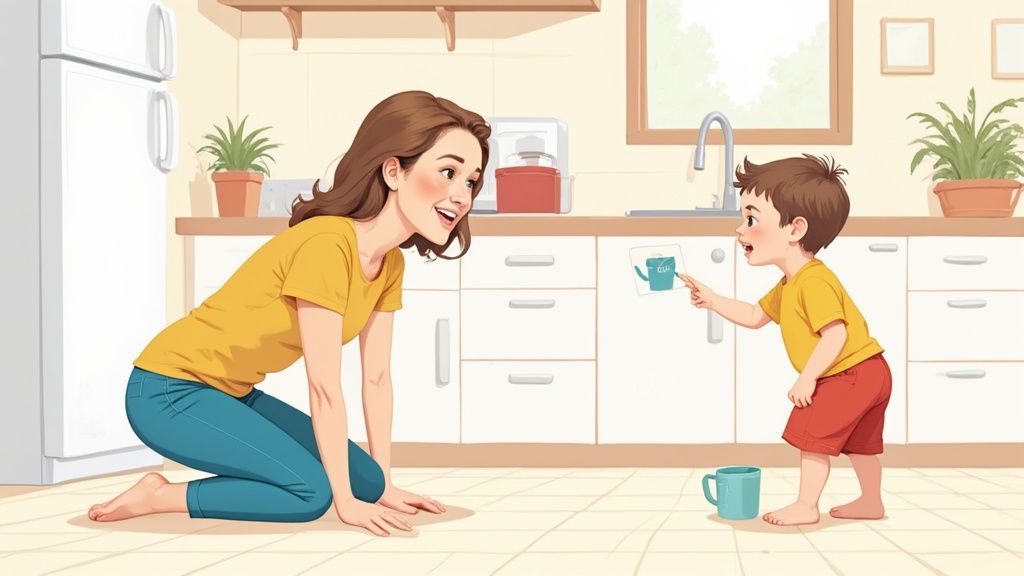
Let's be honest, just holding up a flash card and saying the word can get a little repetitive—for both of you! The real magic happens when you treat the cards less like a quiz and more like a toy. We want to weave these first words flash cards into the natural rhythm of your day, turning them into a source of connection and fun.
These little games don't require any fancy setup. They're designed to fit into the beautiful chaos of life with a toddler. Got five minutes while the rice is cooking before Maghrib? A quiet moment while an older sibling is occupied? Perfect. That's all you need to create a meaningful learning experience.
Bring the Cards to Life
The quickest way for a toddler to grasp a new word is by connecting the picture on the card to the real thing. It helps their brain make that crucial link: the flat image represents a real, touchable object in their world.
Here are a few "find it" games we love:
* Kitchen Quest: As you're getting a snack ready, show them the 'cup' card. "Where is your cup?" Then, lead them over to find it on the counter. Simple, but so effective.
* Living Room Safari: Spread a few toys on the floor. Hold up the 'ball' card and watch their eyes light up when they point to or grab the actual ball. Don't forget to celebrate the find!
* Getting Dressed Game: Before you put on their shoes, flash the 'shoe' card. This turns a mundane daily task into a tiny, fun vocabulary lesson.
These aren't just matching games. They're powerful exercises for a developing brain. Your child is building vocabulary, sure, but they're also honing crucial cognitive skills like object recognition and memory. It feels like a game, but it's serious work for them!
Parents everywhere are catching on to this kind of playful learning. In fact, the global market for toddler flash cards has swelled to around USD 1.34 billion. This shows a huge appreciation for simple, hands-on tools that genuinely support early childhood development. You can read more about the rising popularity of toddler educational tools to see the data for yourself.
Make it a Hands-On Experience
Babies and toddlers are sensory beings—they learn by touching, feeling, and doing. When you bring that sensory element to flash cards, the learning sticks so much better. It taps right into their innate curiosity.
A few ideas to get you started:
* Fruit Basket Fun: Pop an 'apple' or 'banana' card into a basket with some play fruit. Let your little one enjoy the process of digging through to find the card and its matching fruit.
* Animal Hide-and-Seek: Have some animal figurines? Hide the 'cat' or 'bird' card under a blanket with the corresponding toy and let them discover it. It's a fantastic little activity for building their pincer grasp and fine motor skills.
These tactile games are a win-win. They are especially great for kinesthetic learners who need to move and touch to understand. You're teaching words while also building dexterity. For more ideas on this, check out our guide on the best hand-eye coordination toys for babies, which are a perfect complement to this kind of play.
When learning is joyful, you’re not just teaching vocabulary; you're nurturing a love of discovery that will last a lifetime.
Answering Your Questions About First Words Flash Cards
It's totally normal to have a few questions when you're thinking about using something like first words flash cards. We all wonder if we're starting too early or if we're even "doing it right."
Let's walk through some of those common worries. My goal is to give you gentle, practical answers so you can feel confident and happy about sharing this activity with your little one.
When Is the Right Time to Start Using Flash Cards?
You can actually start earlier than you might think. Simple, high-contrast image cards are fantastic for babies as young as a few months old to help stimulate their developing vision.
For actual words, the sweet spot is usually between 6 and 12 months. This is when babies are really starting to tune in and connect the sounds they hear with the objects they see.
The golden rule? Follow your baby's cues. Keep your "flash card time" super short—a minute or two is perfect at the beginning. If they get fussy or lose interest, just put the cards away and try again another day. This is all about gentle, happy exposure, not a strict lesson plan.
Are Flash Cards Too Serious for a Baby?
This is such a valid concern. We all want our kids to learn through joyful play, not feel pressured by drills. The secret really is in how you use them.
Think of flash cards as just another toy in the box. They're no different than a rattle or a soft book. When you use them playfully to spark curiosity and start a little back-and-forth, they become a loving tool that supports your child’s natural desire to learn.
It’s not about drilling for memorization; it’s about connecting with your child.
How Do I Fit Flash Cards into Our Day?
A healthy mix of activities is always best for a developing baby. Flash cards are a wonderful way to have some focused, one-on-one time to introduce a specific idea, like the word "apple."
But that’s just the beginning! This one little activity can beautifully complement everything else you’re doing.
For instance, you could:
* Connect to Books: Show the 'apple' card, then find an apple in one of their favorite storybooks.
* Involve the Senses: After seeing the picture, let them hold and feel a real apple. Talk about how it’s smooth and round.
* Point it Out in Real Life: The next time you're at the grocery store, make a big deal of pointing out the apples. "Look! Just like your card!"
Think of flash cards as just one small, colorful piece of the amazing learning puzzle you're already building with your child every single day.
At Babymode, our mission is to support your child’s growth in a way that honors your faith and values. Hands-on tools like these flash cards are perfect for building those core skills. For those moments when you need a digital companion, our platform provides a safe, halal, and ad-free screen time experience.
See how Babymode can complement your at-home learning. Explore our approach and join our waitlist to be the first to know more.