Welcome, dear parent. Watching your little one begin to talk is one of those incredibly precious journeys in life. This guide is here to support Muslim families like yours, sharing gentle, faith-based ways to encourage those first beautiful sounds—from 'Mama' and 'Baba' to their first sweet 'Bismillah'.
Nurturing Your Baby's First Words
Every single coo and gurgle from your baby is a tiny miracle, a beautiful gift from Allah (SWT) and the very first step on their language journey. As a parent, you aren't a formal teacher giving lessons; you're the creator of a warm, loving, and language-rich world for them to blossom in.
Think of it like tending a garden. Your gentle words and consistent interactions are the water and sunlight that help those little seeds of language sprout and grow.
The wonderful thing is, learning to talk fits so naturally into the rhythm of a Muslim family's day. It happens in the quiet moments before Fajr, amid the happy chaos of preparing iftar, and during cozy cuddles after a long day. You already have everything you need to be your child's very best teacher.
This guide will walk you through the typical stages of language development, offering practical, simple strategies you can easily weave into your daily life. Our hope is to help you feel confident and supported as you nurture your child’s speech, inshaAllah.
What to Expect on This Journey
We'll explore simple yet powerful ways to support your little one, focusing on a few key areas:
- Building a Strong Connection: It all starts here. We'll look at how your loving bond creates the safest space for your child's communication to truly flourish.
- The Power of Everyday Talk: You don't need special flashcards. We'll show you how to turn daily routines—from changing nappies to trips to the grocery store—into meaningful language lessons.
- Integrating Our Faith Naturally: This is about gently introducing beautiful words like 'Alhamdulillah' and 'Allahu Akbar' in a way that feels organic and joyful. For more ideas on this, our guide on the Song of Bismillah offers some lovely insights.
- Playful, Screen-Free Learning: We’ll share simple games and activities that make learning language fun and engaging, strengthening your connection at the same time.
Remember, every child develops at their own unique pace. Your loving presence, your patience, and the sound of your voice are the most powerful tools you have in this beautiful process.
As you watch your little one grow, it’s only natural to wonder if they’re on the right track with their talking. Every child’s journey is unique, unfolding at its own pace, but knowing the typical signposts of language development can give you incredible peace of mind. It helps you celebrate every little achievement and spot when a bit of extra support might be helpful.
This simple timeline gives you a great visual of that amazing progression—from those first precious coos to more complex babbling and, finally, those heart-melting first words.
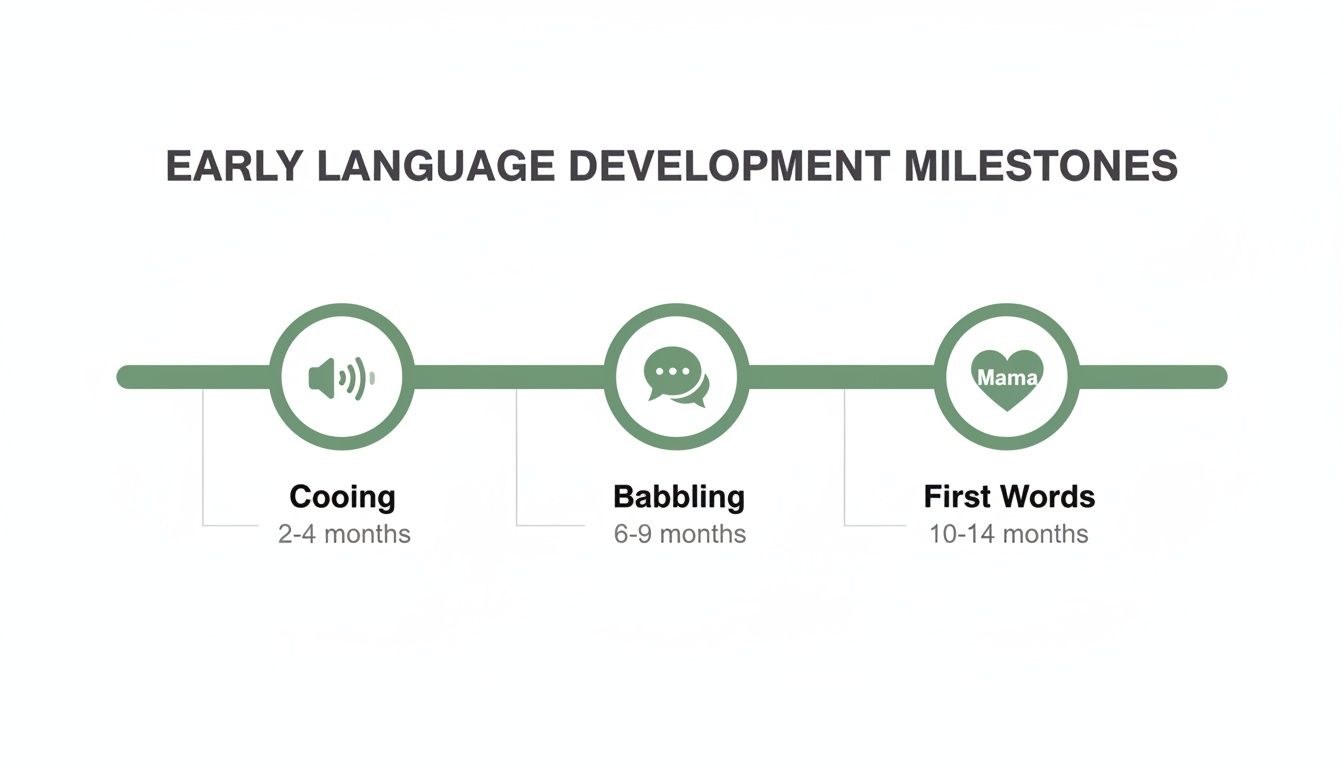
Think of each stage as a building block. Each new sound and skill lays the foundation for the next, preparing their mind and mouth for the incredible job of speaking.
From Coos to First Words
It all starts with those simple, joyful noises. These early vocal experiments are so important—it’s your baby discovering their own voice and figuring out how to control it.
Birth to 6 Months: You'll start hearing those sweet coos, gurgles, and happy squeals. They’ll also begin to react to the world around them, turning their head toward sounds like your voice saying "As-salamu alaykum."
6 to 12 Months: Welcome to the age of babbling! Get ready for lots of repeated sounds like "ba-ba-ba" or "da-da-da." At this stage, they're also starting to connect words with actions and can understand simple requests and gestures, like waving "bye-bye."
Somewhere around their first birthday, many babies surprise us with their first real words, often "Mama" or "Baba." What a moment!
Every single sound your baby makes, from a quiet gurgle to a loud babble, is a sign of their brain working hard. When you hear them, smile and repeat the sounds back. This simple act of connection tells them, "I hear you, and what you have to say matters."
The Toddler Talk Take-Off
Get ready for what parents often call the "language explosion." Between one and two years old, your toddler’s vocabulary will likely start to grow at a dizzying pace, masha'Allah. It’s a truly exciting time.
You'll also notice that their understanding of language races ahead of their ability to speak. A child’s receptive language (the words they understand) is almost always bigger than their expressive language (the words they can say). For example, an 18-month-old might understand up to 80 words but only say a handful of them. This gap is totally normal and expected.
That said, it's also why staying aware of milestones is so useful. Research suggests that around 15% of toddlers experience some form of language delay, so catching things early can make a world of difference. For a deeper dive, these developmental language charts on socialsci.libretexts.org/11:OverviewofLanguageDevelopment/11.09:Chartinglanguagegrowthininfantsand_toddlers) offer more detail.
By the time they hit their second birthday, many toddlers start putting two words together to make little phrases like "more milk" or "my ball."
If you ever feel concerned that your child isn't meeting these milestones, don't panic. There are so many wonderful, playful ways to support them right at home. In fact, our guide on toddler speech therapy activities you can do at home is a great place to start.
Speech and Language Milestones At a Glance (0–3 Years)
To make things easier, here is a simple table that breaks down what you can generally expect to see and hear as your child grows. Just remember, these are averages—not deadlines!
| Age Range | What You Might See and Hear (Receptive Language) | What Your Child Might Do (Expressive Language) |
|---|---|---|
| 0–6 Months | Recognizes your voice, turns toward sounds, smiles when you speak. | Makes cooing and gurgling sounds, cries differently for different needs. |
| 7–12 Months | Responds to their name, understands "no," follows simple directions like "come here." | Babbles with chains of sounds (e.g., "bababa"), uses gestures like waving. |
| 12–18 Months | Points to body parts when asked, follows simple one-step commands. | Says a few single words, tries to imitate words you say. |
| 18–24 Months | Points to pictures in a book when named, understands simple questions. | Uses at least 20-50 words, starts putting two words together. |
| 2–3 Years | Understands two-step directions, knows concepts like "in" and "on." | Has a word for most things, uses 2-3 word sentences, speaks clearly enough for family to understand. |
Use this table as a gentle guide to celebrate your child’s progress on their unique path to becoming a confident little communicator.
Weaving Language Into Your Daily Islamic Routines
The most beautiful and effective way to help your little one start talking is to simply fill their world with your voice. You don't need special lessons or expensive toys. The real magic happens in the small, everyday moments you already share.
When you narrate your day, you create a rich, loving language environment that invites them to listen, learn, and eventually, join in.
This technique, often called self-talk, is incredibly powerful. As you go about your day, just talk about what you're doing, seeing, and thinking out loud. It's that simple.
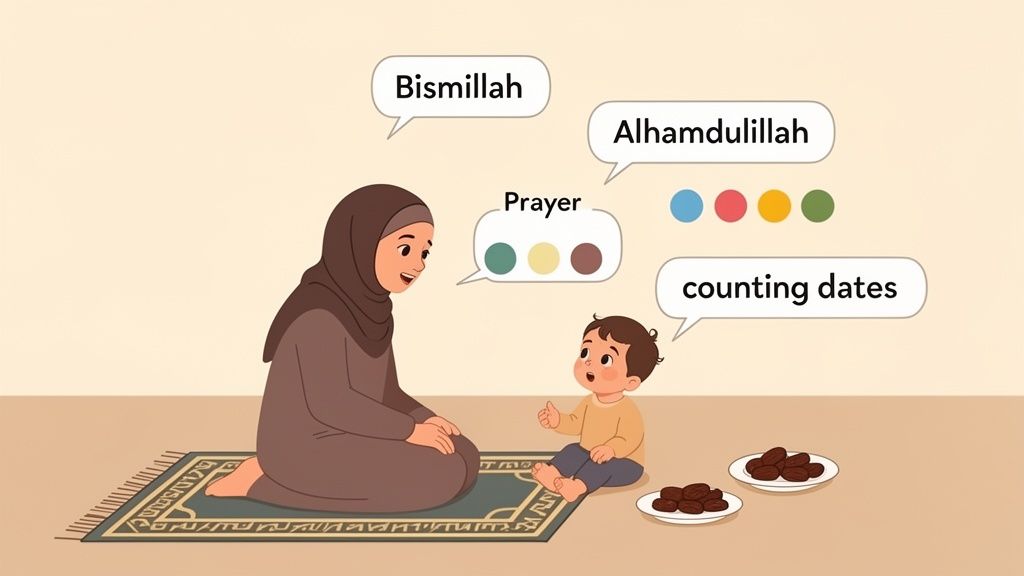
This constant stream of language is like watering a garden—it nourishes their developing brain with the sounds, rhythms, and vocabulary they need to grow.
Turning Routines Into Rituals of Connection
Your daily life as a Muslim family is already packed with routines. With a little intention, these can become powerful opportunities for language learning. Think about all the things you do without even thinking.
Meal Prep: While washing vegetables for dinner, you could say, "I'm washing the red tomato. Wash, wash, wash. Now for the green cucumber. Bismillah, let's chop."
Tidying Up: While tidying the living room before Maghrib, try narrating your actions. "Let's put the blocks in the box. One block, two blocks. Alhamdulillah, all clean now."
Getting Ready for Jummah: As you dress your little one in their special clothes, you can talk about it. "Here is your beautiful white topi. And your soft trousers. We are getting ready to go to the masjid, inshaAllah."
The key is keeping your language simple, repetitive, and connected to what's happening right in front of them. This is how they build those crucial bridges between words and their meanings.
Infusing Faith Into Everyday Chatter
Our deen gives us so many beautiful, meaningful words to share. Gently weaving them into your narration makes them a natural part of your child’s world from the very beginning.
Point to the moon and say, "SubhanAllah, look at the beautiful moon!" When they finish their milk, smile and say, "Alhamdulillah." Count the dates you're eating during Ramadan in English, Arabic, or Urdu. This isn't about formal teaching; it's about sharing the language of your heart.
Takeaway: Your child’s brain is literally wired to learn from you. The more they hear words in a loving, meaningful context, the more connections they make. You are their first and most important language model.
And this isn't just a nice idea—it's backed by science. The sheer volume of words a baby hears directly impacts their own vocalizations. Large-scale studies found that the amount of adult talk is a huge predictor of a child's early language skills.
For every 100 adult vocalizations they hear per hour, children produce roughly 27 more of their own. It creates a powerful feedback loop for learning. You can explore the research on how adult talk drives early language growth at PNAS.org if you're curious.
Ultimately, every word you speak is a gift. Whether you're talking about the color of a prayer mat or humming a simple nasheed, you are laying the foundation for your child's first "Bismillah" and all the wonderful conversations that will follow.
Playful Activities That Encourage Talking
Play is how children learn about the world. It’s their first and most natural language. When it comes to encouraging your little one to talk, those simple, joyful moments of connection are far more powerful than any structured lesson. You don't need a room full of fancy, light-up toys; the best tools are your voice, your hands, and your full attention.
The real goal here is to create interactions that are so fun and engaging that your child wants to communicate—whether that’s with a sound, a gesture, or, eventually, their very first word.
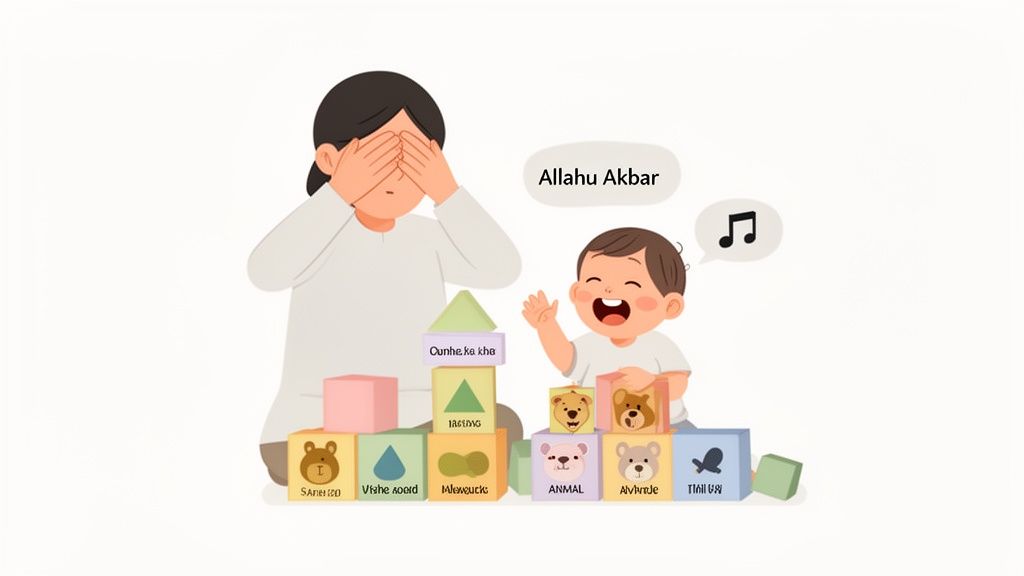
This is where the magic happens. Turning simple games into powerful brain-building activities is the secret to helping your child find their voice.
Everyday Games Filled with Language
Classic baby games have stuck around for a reason—they are absolute powerhouses for language development. They’re built on repetition, anticipation, and turn-taking, which are the fundamental building blocks of conversation.
Faith-Filled Peek-a-Boo: Take this classic to the next level. Instead of the usual, try hiding your face and saying, "Allahu Akbar!" as you pop out. The surprise and your big, happy expression will make them giggle and want you to do it over and over.
Building Block Conversations: Get down on the floor and narrate your play. "Let's put the blue block on top. Uh-oh, it fell down! Alhamdulillah, let's try again." You're effortlessly teaching colors, actions, and simple, common phrases.
Making Animal Sounds: Don't be afraid to be silly! Moo like a cow or meow like a cat while looking at pictures in a book. Animal sounds often use simple consonants and vowels, making them easier for little mouths to imitate than more complex words.
The Power of Rhymes and Reading
Cuddling up with a book or singing gentle nasheeds are some of the most effective ways to immerse your child in the rhythm and flow of language. These activities literally tune their ears to the sounds and patterns they'll need to speak.
Look for colorful, sturdy board books, especially ones with simple stories about the Prophets or Allah’s creations. As you read, make it interactive. Point to the pictures and name what you see. "Look, a big boat for Prophet Nuh (AS)!" This helps your child connect words to the world around them. For more ideas on vocabulary building, check out our guide on using first words flash cards.
Instrument-free nasheeds about the moon, stars, or saying 'Bismillah' are also fantastic. The melody and repetition help words stick in a way that’s both fun and memorable.
Play isn't just a break from learning; it is learning. When you follow your child's lead, get a little silly, and share in their joy, you're building the perfect foundation for their first words to blossom.
Gently Introducing a Second Language
For many Muslim families, raising bilingual children is a cherished goal. The good news is that play provides the perfect, low-pressure environment to introduce words in Arabic, Urdu, or whatever your mother tongue may be.
- Name Body Parts: During bath time or while getting dressed, playfully touch their nose and say "naak" (Urdu) or "anf" (Arabic), immediately followed by "nose." The physical connection helps them learn.
- Count Everything: Count the stairs as you climb them or the dates on their plate. Do it in both languages. The repetition turns it into a natural, fun game.
The secret is to keep it light and joyful. By weaving these words into your everyday play, you’re making language a seamless part of their world—a beautiful gift connecting them to their faith and heritage.
Can Halal Screen Time Actually Help My Child Talk?
Let's be honest: managing screen time with little ones feels like one of the biggest challenges of modern parenting. We all worry about what they’re seeing and how it’s shaping their tiny, developing minds.
The goal isn’t to banish screens entirely—that’s just not realistic when you’re trying to get dinner on the table or find a quiet moment for prayer. It’s about being intentional. When used the right way, screens can be a genuinely helpful tool that supports their language journey, rather than getting in the way of it.
The secret is to shift screen time from a passive, 'zoning out' activity to one that's active and engaging. With the right content, it can become a fantastic supplement, especially when you need a few safe, peaceful minutes in your day.
Finding Content You Can Trust
For Muslim families, what our children watch is a matter of faith and values. We need complete peace of mind that the content is not just "educational" but truly wholesome and halal. It has to be gentle on their senses and free from the relentless ads and overstimulation that are so common on mainstream platforms.
When you're searching for apps or videos, here's what really matters:
- Completely Ad-Free: This one is a deal-breaker. Ads are designed to grab attention and can introduce things you’d rather your child not see.
- Rooted in Islamic Values: Look for content that models kindness, good manners (akhlaq), and gentle interactions. Think beautiful stories from the Quran, instrument-free nasheeds, and simple videos celebrating Allah's creation.
- A Calm, Toddler-Friendly Pace: A lot of kids' cartoons move way too fast for a toddler’s brain to keep up. Slower shows with clear, simple language give your child the space they need to actually hear and process new words.
- Bilingual Language Support: Content that introduces the Arabic alphabet or simple words in Urdu or your family's language is a wonderful way to connect your child to their faith and heritage from the very beginning.
It’s Not Just What They Watch, It’s How
The most powerful way to use screens for language is to watch with your child whenever you can. This is called co-viewing, and it turns a solo activity into a back-and-forth conversation. You are the link between what’s happening on the screen and their real world.
So, instead of just handing over the tablet, try to sit with them, even if it's just for five minutes. Talk about what you're both seeing. If a video shows a farm, you could say, "Look at that fluffy sheep! A sheep says Baa! Can you say baa?"
Think of it like reading a picture book. You wouldn’t just give them the book and walk away. You point to the pictures, make the animal sounds, and enjoy it together. Bring that exact same energy to screen time.
Let’s say you’ve just watched a short, sweet video about the Arabic letter 'Alif'. You can easily carry that learning into the rest of your day. Later, while looking at a book, you might see the letter and say, "Hey, look! There’s 'Alif,' just like we saw in our video!"
This simple connection reinforces the new concept and helps your child see how it fits into their world. Suddenly, screen time isn't just a distraction—it's a real, supportive piece of their language-learning puzzle.
Noticing the Signs: When to Chat with a Pro
Every child develops on their own unique timeline, a pace perfectly set by Allah. It's completely normal for one child to be chatty early while another takes their time. But as a parent, you have a powerful intuition. If you have a nagging feeling that something isn't quite clicking with your child's communication, it's always wise to trust that instinct.
This isn't about creating worry. It’s about being your child's best advocate. Knowing a few key signs can help you feel confident and prepared to take the next step if you ever need to.
What to Look Out For
Think of these as gentle signposts, not a rigid checklist. If you notice any of the following, it might just mean it’s time for a conversation with your pediatrician or GP.
- By 12 months: You aren't hearing much babbling, or the sounds are not very varied (like "ma-ma-ma," "ba-ba," "da-da").
- By 18 months: Your little one hasn't started using any single, meaningful words yet, like "Mama," "Dada," or "juice."
- By 24 months: Their vocabulary is smaller than about 50 words, and they aren't trying to put two words together to make little phrases ("more milk," "my ball").
- At any age: This is a big one—if your child seems to lose speech or social skills they previously had.
It's so important to remember that many children who are "late talkers" catch up all on their own. Still, if there is an underlying delay, catching it early can make a world of difference.
How to Start the Conversation
Bringing up your worries with a doctor can feel intimidating, but it doesn't have to be. The key is to be specific.
Instead of saying something general like, "I'm worried about his speech," try giving a concrete example. You could say, "He's 18 months old now and doesn't use any words, but he seems to understand everything, like when I ask him to bring me his shoes."
Your day-to-day observations are gold. No one knows your child better than you do. Sharing what you see is a powerful act of love that opens the door for your child to get the support they need to flourish.
Your doctor will take your concerns seriously. They'll likely ask some questions, do a quick assessment, and might suggest a referral to a speech and language therapist (SLT) or another specialist. This is just the first step on the path to making sure your child's wonderful little voice is heard, inshaAllah.
Lingering Questions Parents Often Ask
As you watch your little one start to make their first sounds and words, a million questions probably pop into your head. It’s completely normal! Here are some of the most common concerns we hear from parents, along with some straightforward answers.
"My Toddler Is Mixing English and Arabic. Should I Be Worried?"
Absolutely not! This is a fantastic sign that your child's brain is working hard to learn two language systems at once. This mixing, often called code-switching, is a totally normal—and healthy—part of becoming bilingual.
Think of it as their brain cleverly using all the words it has available to get a message across. Just keep speaking both languages to them naturally. Over time, they'll learn to differentiate between them. You're giving them an incredible gift that connects them to their faith and heritage.
"I've Heard Boys Talk Later Than Girls. Is That True?"
You’ll hear this one a lot, and while some large-scale studies might show slight differences in averages, the reality is that the range for "normal" development is incredibly wide for all children. The most important thing isn't comparing boys to girls, but rather tracking your own child’s unique progress against the established developmental milestones.
If you have a feeling your son might be falling behind, don't just brush it off as a "boy thing." The best course of action is always to chat with your pediatrician. They can give you personalized advice based on your child, not on generalizations.
"How Can I Help My Toddler When They Get So Frustrated Trying to Talk?"
It’s heartbreaking to watch, isn't it? Their little minds are buzzing with ideas, but their mouths just can't keep up yet. This gap between what they want to say and what they can say is a major source of toddler frustration.
Your role here is to be their calm, patient translator.
- First, get down on their level and validate their feelings: "You look so frustrated. You really want that cup."
- Then, calmly model the word they're looking for: "Water. You want water."
- You can also introduce simple signs for common words like "more," "eat," or "all done." This gives them a way to communicate and can really cut down on meltdowns while their vocabulary catches up.
Key Takeaway: When your toddler is frustrated, acknowledge their emotion first, then provide the word. This shows them you understand and helps them learn at the same time.
For a safe, halal, and ad-free screen time experience that supports your child's language development with Islamic values, check out Babymode. Learn more and join the waitlist at https://babymode.ai.