There’s nothing quite like hearing your child’s first words. In a home filled with the beautiful sounds of ‘Alhamdulillah’ and ‘Bismillah’, that journey is even more special. It’s a slow, beautiful process, and you’ll be amazed at how simple, everyday moments can become the most powerful teaching tools.
This guide is designed to show you exactly how to transform those daily routines into rich, meaningful conversations that nurture your little one's language and Islamic identity all at once.
A Muslim Family’s Journey to First Words
From the very first coo to that exciting first word, you are your child's most important guide. We've created this resource specifically for Muslim families, understanding that the rhythm of your life is unique—shaped by prayer times, big family gatherings, and often, a beautiful blend of English and a heritage language like Arabic or Urdu.
You’re not just teaching your child to talk; you're helping them form their identity as a young Muslim. The words they hear and learn first will become the foundation of their world. This journey is about so much more than vocabulary lists or flashcards. It's about connection.
This isn't about clinical exercises. Think of it as deepening your bond through conversation, creating a language-rich home that reflects our faith. Every narrated wudu, every chat during meal prep, and every story before bed is a precious building block.
We'll walk you through the practical steps, keeping your family’s lifestyle in mind. We know life gets hectic, balancing work, home, and community commitments, so our advice is designed to fit right into the moments you already have.
What You Will Discover
This guide offers clear, reassuring, and practical information to help you along the way. We'll explore:
- Age-Specific Milestones: Get a clear picture of what to expect from birth to age three, so you can confidently celebrate every new sound and word.
- Daily Routines as Learning Tools: Learn how to use everyday activities—from getting dressed in the morning to preparing for Maghrib—to naturally expand your child's vocabulary.
- Guidance for Bilingual Homes: Find simple, effective strategies for raising a bilingual child, whether you're blending English with Arabic, Urdu, or another heritage language.
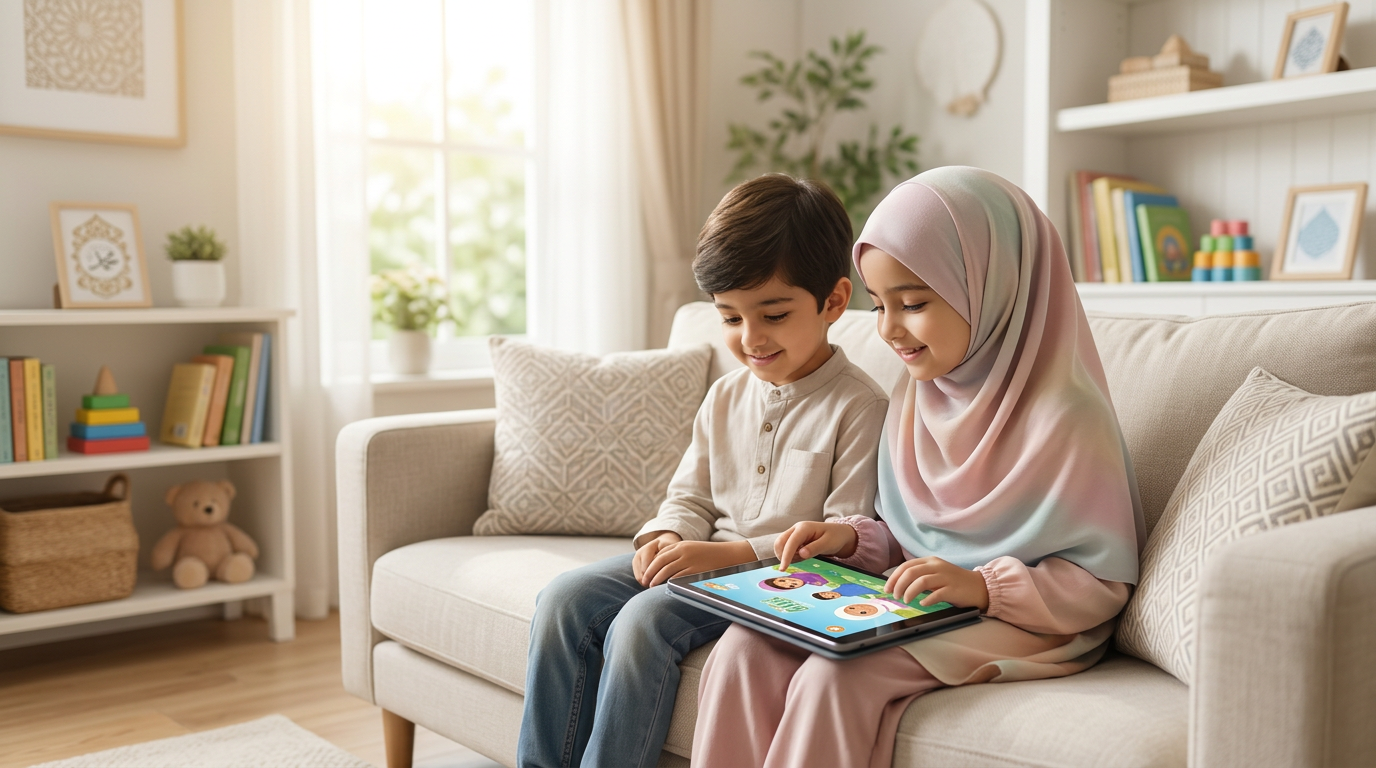
- Mindful Screen-Time Strategies: Get practical tips on using media in a healthy, halal-aligned way that can support language development, not get in the way of it.
Our goal is to give you the confidence to make your child’s journey to their first words a joyful and faith-filled one, inshaAllah. Let's start by looking at how those precious first sounds lay the groundwork for a lifetime of conversation.
Laying the Foundation from Birth to 12 Months
The first year of your baby's life is pure magic. It’s a whirlwind of precious firsts, and some of the most heart-melting are those early sounds—the coos, gurgles, and happy babbles that are the real building blocks of speech. During these months, your baby is a tiny sponge, soaking up every sound and rhythm of your home. This is your chance to create a rich, nurturing world for them to begin their journey toward talking.
Think about the sounds that fill your day. The gentle, melodic recitation of the Quran, a soft nasheed playing while you prepare a meal, or the adhan called five times a day. These aren't just background noise; they are powerful tools for tuning your baby's ears to the different tones, patterns, and rhythms essential for language.
Every interaction, no matter how small, is a chance to connect and teach. When you lean over their cot after Fajr and respond to their morning babbles, you're telling them their voice matters.
Turning Everyday Moments into Conversations
You don't need special toys or complicated activities to get started. Honestly, your voice and your attention are the most powerful tools you have. The real secret is transforming ordinary moments into meaningful interactions that build both their vocabulary and your bond.
This simple act of narrating your day is incredibly effective. Use a soft, high-pitched, sing-song voice—what experts call "parentese"—as you go about your routine. This way of speaking is naturally engaging for babies and helps them tune into your words.
Here are a few ways this might look in your home:
* During Wudu: As you wash your hands, you can say, "Bismillah, Mama is washing her hands now. See the water? Splash, splash!"
* On a Walk: Point out Allah's beautiful creations. "Look, mashAllah, a bright yellow flower. And see that little bird in the tree? SubhanAllah."
* Getting Dressed: Talk about their clothes. "Let's put on your soft, blue jumper. One arm in... now the other arm. There we go, all cosy!"
By consistently talking to your baby, you're laying the neural pathways for language. This timeline gives a wonderful overview of this incredible journey from first sounds to first words.
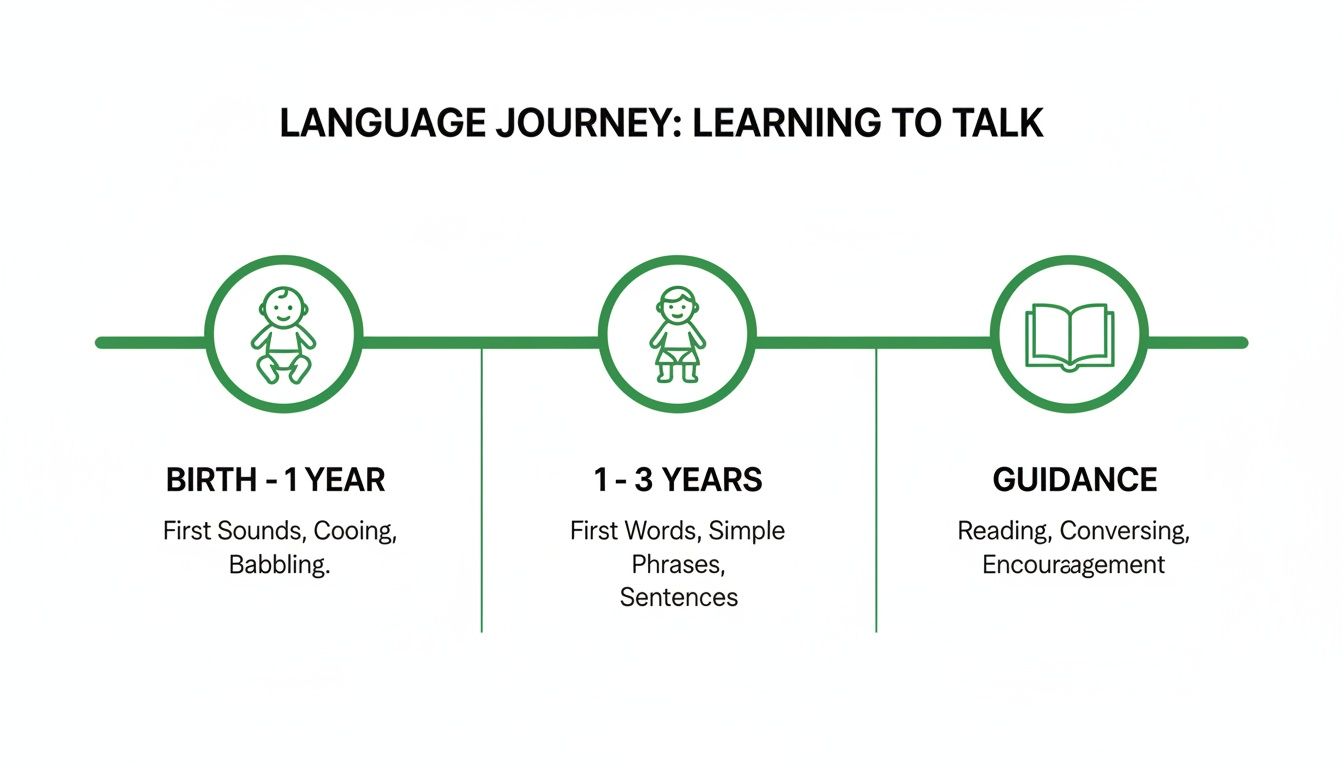
As you can see, language skills build on one another, starting with listening and babbling in this first year and progressing toward more complex speech as they grow.
To help you track these amazing changes, here's a quick look at what to expect month by month.
Language Milestones in the First Year
This table is a simple reference guide to help you spot and encourage your baby's budding communication skills from birth to their first birthday.
| Age Range | What to Listen For | How to Encourage Them |
|---|---|---|
| 0–3 Months | Cooing, gurgling, and making pleasure sounds. Crying differently for different needs. | Respond to their coos with a smile and soft words. Mimic their sounds back to them to start a "conversation." |
| 4–6 Months | Babbling with different sounds, like "ba-ba" or "ma-ma." Chuckling and laughing. | Get face-to-face and babble back. Use hand gestures while you talk and sing simple songs. |
| 7–12 Months | Using longer strings of babbles. Imitating speech sounds and gestures. | Narrate your day. Play peekaboo. Read colorful board books and point to pictures, naming what you see. |
Remember, every baby develops at their own unique pace, so use this as a general guide, not a strict checklist.
The Power of Your Voice
The amount of language your baby hears has a direct impact on how much they "talk" back. It can feel like a one-sided conversation at first, but every word you say is a seed being planted.
Imagine your little one babbling away, practicing the sounds they hear around them. It's an incredible sight, but did you know your speech directly fuels their own? A huge global study that analyzed over 40,000 hours of audio found that for every 100 adult vocalizations a child hears per hour, they produce 27 more of their own. Chatting with your baby isn't just sweet—it’s foundational.
Responding to your baby’s babbles teaches them the back-and-forth rhythm of conversation. When they say "ba-ba," and you smile and say, "Yes, ba-ba! Are you talking to me?" you are showing them how communication works.
This responsive "chatting" reinforces their attempts to communicate and encourages them to keep trying. It strengthens your bond and shows them their voice has power and meaning. As they grow, you can introduce other simple tools to support their learning—our guide on how to use first words flash cards can playfully introduce new concepts and vocabulary.
It's through these thousands of small, loving interactions that your baby’s journey to learning how to talk truly begins. Every word, every song, and every response is a gift that will last a lifetime.
Navigating the Toddler Talk Explosion from 1 to 3 Years
Welcome to the toddler years! This whirlwind stage, from your child's first birthday to their third, is a time of incredible growth in every area, but especially in learning how to talk. SubhanAllah, it feels like one day you have a babbling baby and the next, a little person with opinions, requests, and entire stories to tell.
This period is often called the "language explosion" for a reason. Around 18 months, many toddlers have a vocabulary of about 50 words, and by age two, they're often stringing together simple two-word sentences. It’s a fast-paced and exciting time, and your role is to be their gentle, patient guide through it all.
Weaving Language into Your Daily Islamic Life
The beautiful thing about supporting your toddler's speech is that it doesn't require special classes or expensive toys. The most powerful learning happens right within the fabric of your daily life, especially in a Muslim home where routines are guided by faith and culture.
Think about the words and phrases that fill your day—these are your unique teaching tools.
During Meal Prep: While chopping vegetables for dinner before Maghrib, just name everything you touch. "This is a red tomato. We need one more onion." If your toddler points and grunts, be their voice. "You want the cucumber? Here is the cucumber, bismillah."
Practicing Simple Duas: Language isn't just about naming objects; it's about expressing faith. After a snack, you can gently say, "Alhamdulillah," and encourage them to repeat it. Soon, it becomes a natural part of their routine.
Reading Together: Islamic picture books are a treasure. Cuddle up before naptime and point to the pictures. "See the boy making wudu? Look at the Kaaba, mashAllah." Reading introduces new words in a fun, engaging way.
You can find more simple yet effective language development activities for toddlers to sprinkle throughout your day and encourage conversation.
Powerful Techniques to Gently Build Sentences
As your toddler starts using single words, you can help them build longer sentences without any pressure. One of the most effective methods I recommend to parents is expansion.
Expansion is simply adding a little more detail to what your child says. It validates their attempt to communicate and shows them what comes next.
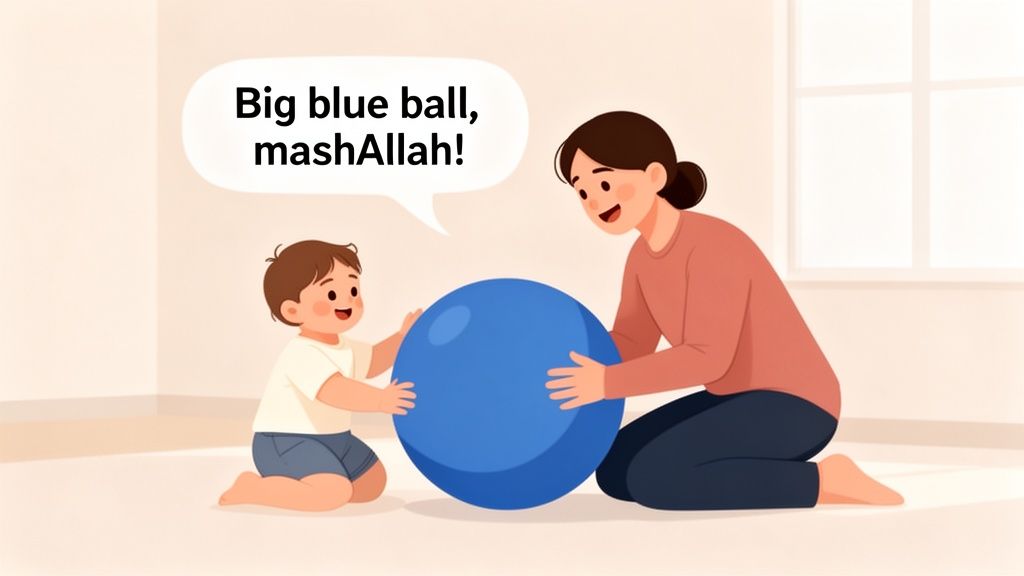
For example, if your toddler points to a ball and says, "Ball," you can smile and respond, "Yes, that's a big blue ball, mashAllah!" You've confirmed their word and added two new ones: 'big' and 'blue'.
This gentle modeling is far more effective than correcting them or demanding they repeat a "right" phrase. It’s a natural, encouraging way to build on their efforts and expand their world of words.
Understanding Global Language Milestones
Ever wondered why some toddlers are chatterboxes while others take their time? While every child's timeline is unique, children everywhere build their vocabulary through consistent exposure to language.
Interestingly, Stanford-led research tracking first words across 29 languages—from English to Mandarin and Kiswahili—confirms that many children hit universal milestones, like having about 50 words by 18 months. What changes is the pace and type of words they learn first, which is often shaped by their culture.
This is especially reassuring for bilingual families. Whether your child is learning English and Arabic, or English and Urdu, rest assured they are fully capable of learning both without confusion or delay.
Practical Tips for the Toddler Years
Supporting your toddler's speech is all about making communication a joyful part of your day. The goal is connection, not perfection.
Here are some easy ideas to try:
Offer Choices: Instead of asking a yes/no question, offer a choice. "Do you want to wear the green shirt or the yellow shirt today?" This prompts them to use words to express their preference.
Sing Nasheeds and Rhymes: The rhythm and repetition in songs are fantastic for language learning. Singing about the Arabic alphabet or simple nasheeds about Allah's creation makes learning feel like pure play.
Listen Patiently: Toddlers are still figuring out how to get their thoughts out. Give them your full attention when they're trying to tell you something. Make eye contact, nod, and give them the time they need without jumping in to finish their sentences for them.
By creating a warm, responsive, and language-rich environment, you give your child the greatest gift—the confidence to connect with the world, all within the beautiful context of their Muslim identity.
Nurturing a Bilingual Home with Islamic Values
For many Muslim families, our homes are a beautiful mix of languages. One minute you're speaking English with your toddler about their building blocks, the next you're saying ‘SubhanAllah’ in Arabic, and then you switch to Urdu when Nani calls on FaceTime. This isn't a complication—it's an incredible gift for your child.
One of the biggest worries I hear from parents is whether speaking more than one language will confuse their child or cause a speech delay. Let’s put that myth to rest, once and for all.
Study after study confirms that bilingualism does not cause speech delays. Children are amazing little language sponges, perfectly capable of soaking up multiple languages simultaneously. It’s actually a huge boost for their brain development and strengthens their connection to their cultural identity.
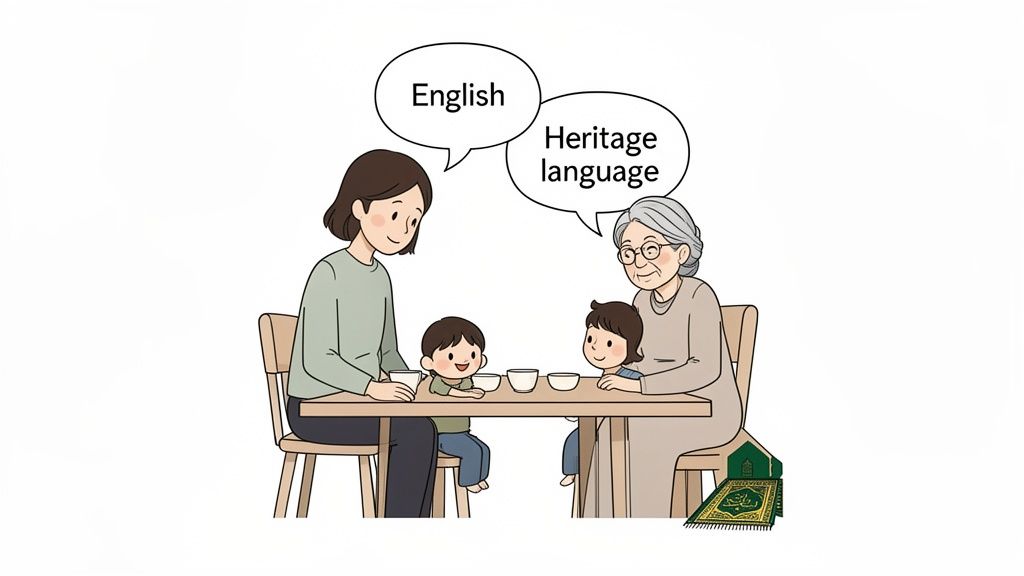
Think of it this way: you're giving your child multiple keys to unlock the world. Your heritage language is the key that connects them to their grandparents, their culture, and the richness of their Islamic roots.
Practical Strategies for Your Bilingual Family
So, how do you actually make this work day-to-day without it feeling like a chore? The secret isn't a formal curriculum. It's all about consistency and weaving it naturally into your life.
A popular method that works well for many is One Parent, One Language (OPOL). It’s pretty straightforward: one parent sticks to one language (maybe Mum speaks English), while the other parent consistently uses another (Baba speaks Arabic, for example). This creates very clear and predictable language exposure.
Another great approach is tying languages to specific situations, something often called Context-Based Learning.
Here’s what that can look like in real life:
* Islamic Concepts in Arabic: Reserve Arabic for all things deen. This means saying ‘Bismillah’ before a meal, ‘Alhamdulillah’ after, or ‘JazakAllah Khair’ to show gratitude.
* Heritage Language at Meal Times: The dinner table could become a special "Urdu-only" or "Somali-only" zone, making it a fun and consistent family ritual.
* English for Playtime: You might use English as the main language for reading storybooks, playing with toys, and watching educational shows.
Don't stress about being perfect! If you mix languages in the same sentence (linguists call this 'code-switching'), it's completely normal. Your child's brain is more than equipped to sort it all out. It’s how bilingual families naturally communicate.
Weaving Languages into Everyday Fun
The most important thing is to make it joyful. You want your child to love their languages, and the best way to do that is through play.
Start building a little library of bilingual board books, especially those with Islamic themes. When you point to the moon in a book, you can say both "moon" and "qamar" (قمر). Just like that, you've doubled their vocabulary in a way that feels meaningful. Sing nasheeds in different languages—the melodies are fantastic memory aids for new words.
And don't forget your greatest resource: your family. Regular calls or visits with grandparents (Jaddah, Dada, Avo) who speak the heritage language are priceless. It gives your child real-world practice and shows them that this language is a living, breathing part of the people they love.
If you ever have specific worries and feel you need more tailored guidance, you might find it helpful to explore effective bilingual speech therapy.
Ultimately, by embracing all of your family's languages, you're doing so much more than just teaching your child to talk. You are handing them a deeper connection to their deen, their culture, and their place in the world—a beautiful foundation you're building, one word at a time.
Using Screen Time to Support Speech Safely and Halal
Let's be honest, screen time for little ones is a tricky subject. For Muslim parents, it’s even more so, as we try to guard our children’s hearts and minds. In the middle of the pre-Maghrib dinner rush or when you just need a quiet moment for prayer, handing over a screen can feel unavoidable.
So, instead of a hard "no," let's talk about how.
When we approach it with intention, screen time can actually become a helpful tool in our child's language journey, not a hindrance. The goal is to shift from passive watching to an active, shared experience filled with high-quality, halal content. It’s less about what they watch and more about how they watch it with you.
Choosing Content That Nurtures Faith and Language
Finding content that aligns with our Islamic values is probably the biggest hurdle. Mainstream platforms are a minefield of hyper-fast cartoons, sneaky ads, and algorithms that can serve up questionable videos in a heartbeat. This kind of overstimulating content also tends to rely on simplistic "baby talk" that doesn't build a strong vocabulary.
For a child's language to truly blossom, they need to be exposed to rich, complex speech—the kind we use every day. They need to hear full sentences, a wide range of words, and clear pronunciation. This is where a carefully curated platform makes all the difference.
A trusted solution like Babymode offers a safe alternative. Its AI-generated, ad-free videos are all reviewed by Islamic educational experts to ensure every story and song nurtures good manners and Islamic values. This provides the kind of calm, high-quality language environment that research shows is vital for learning.
When you can trust that the content is safe, you can finally relax and use it as a starting point for connection and conversation. For a deeper look at this, our guide on a healthy, Islamic perspective on screen time for the 0-3 age group is a great resource.
From Passive Babysitter to Interactive Tool
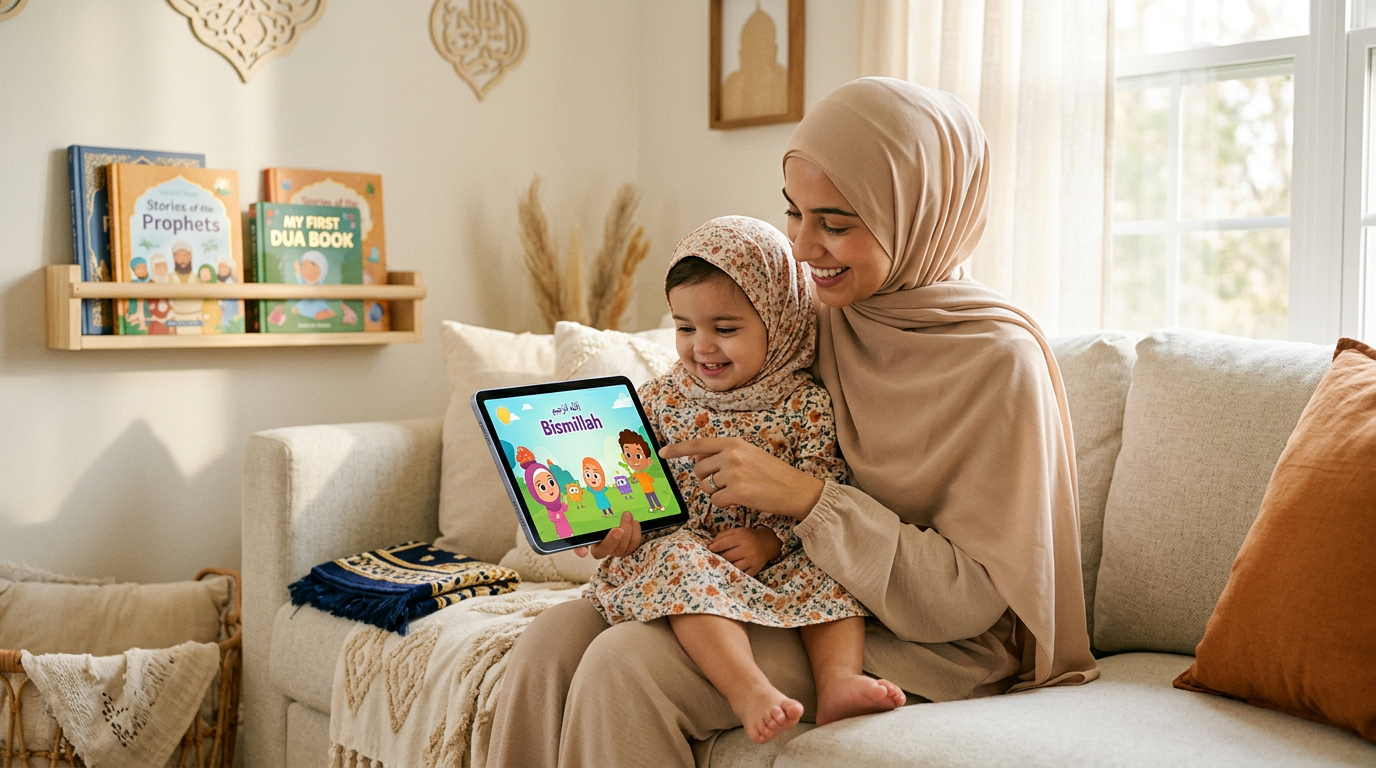
The single most effective way to use screens is to make it a team effort. This is called co-viewing, and it turns a passive activity into a fantastic learning opportunity. Instead of just setting your toddler up with a screen, take a few minutes to sit with them and become their tour guide.
Here are a few simple ways to make any screen time interactive:
- Ask questions: "Look, the boy is sharing his dates! Isn't that kind, mashAllah? What colour is his thobe?"
- Connect to real life: If you're watching a video about farm animals, you might say, "That’s a cat, just like Nani’s cat! What sound does a cat make?"
- Pause and discuss: Hit the pause button to point things out or ask what they think will happen next. This slows everything down and gives their brain a chance to process and respond.
By making it a shared activity, you’re not just a spectator; you're actively reinforcing the words they hear and showing them how those words connect to the beautiful world Allah created around them.
Choosing Halal and Helpful Screen Time
Not all screen time is created equal. The platform you choose can make a world of difference in whether the experience is overwhelming or genuinely beneficial for your child's development and deen.
| Feature | Typical Platforms (e.g., YouTube Kids) | Babymode |
|---|---|---|
| Content Vetting | Algorithm-based, with risk of inappropriate content slipping through filters. | All content is reviewed and approved by Islamic educational experts. |
| Pacing & Style | Often fast-paced, loud, and overstimulating, which can hinder language processing. | Designed to be calm, gentle, and paced for a young child’s developing brain. |
| Advertising | Filled with ads that promote consumerism and create distractions. | 100% ad-free, ensuring an uninterrupted, wholesome viewing experience. |
| Values | Content is secular and may include themes that conflict with Islamic values. | Every video is infused with Islamic manners (adab), concepts, and positive values. |
| Language Quality | Varies widely; often uses simplistic or unhelpful "baby talk." | Focuses on clear, rich language and storytelling to build a strong vocabulary. |
Ultimately, this approach ensures screen time serves your family’s goals, helping your little one learn to talk within a safe, faith-filled context.
Knowing When to Seek Professional Guidance
It's completely normal to feel a little worried if you think your child isn't quite hitting those talking milestones you've been tracking. Every child's path to language is wonderfully unique, but it’s just as important to trust your gut. You know your child better than anyone, and if something feels off, you are their best and most powerful advocate.
Seeking a professional opinion isn't about failure—it's a proactive step rooted in love. The goal is never to create anxiety, but to make sure your child has every bit of support they need. Getting help early is always a blessing (barakah) and can truly make a world of difference.
Common Red Flags to Gently Monitor
Your pediatrician is always your first stop, but here are a few signs that might mean it's time to start a conversation about your child's speech progress:
- By 12 months: You aren't hearing much babbling with a variety of sounds (like "ba-da-gi"), or they aren't using gestures like pointing and waving.
- By 18 months: They haven't started using any single, meaningful words yet, like "Mama," "Baba," or "dada."
- By 24 months: Their vocabulary is less than 50 words, or they aren't beginning to put two words together (e.g., "more milk," "go car").
- By 36 months: They aren't speaking in simple sentences, or you find it very difficult to understand what they're saying.
Who to Talk To and What to Expect
If any of this sounds familiar, the first thing to do is book an appointment with your child’s pediatrician or family doctor. They can do an initial screening, rule out any underlying issues like hearing problems, and provide a referral if it seems necessary.
Trusting your gut is key. You see your child every single day. If you feel that gentle nudge that something needs a closer look, it is always worth discussing with a professional.
From there, you might be referred to a speech-language pathologist (SLP). These are wonderful, trained experts who can assess your child’s communication skills in a fun, playful, and totally stress-free way. They'll give you a clear picture of what's going on and, if needed, map out a plan to help them thrive. Our guide on toddler speech therapy at home has some simple ideas you can use to support any professional guidance you receive.
Remember, the journey to talking starts from day one, but the window for language learning is wide open for a long time. In fact, fascinating research from MIT shows that while the foundation is laid in these first few years, the ability to master a language actually peaks as late as 17-18 years old. You can learn more about these language learning findings from MIT cognitive scientists. Taking action now simply gives your child the best possible head start.
Got Questions About Your Toddler’s Talking?
As you walk this path with your little one, a million questions can pop up. It's completely normal. Let's tackle a few of the most common ones I hear from parents, keeping our unique Muslim family life in mind.
What if My Toddler Starts Stuttering?
It can be a little jarring when your toddler suddenly starts repeating sounds or words, like "C-c-can I have...?" First, take a deep breath. This is incredibly common.
Many children between two and three years old go through a phase of what experts call "developmental disfluency." Their brains are firing off ideas much faster than their little mouths can form the words to keep up!
The best thing you can do is give them space. Don't interrupt or try to finish their sentences for them. Just listen patiently. If it lasts for more than a few months or your child seems genuinely distressed by it, it’s worth a quick chat with your pediatrician.
Is It a Problem That My Toddler is So Quiet?
You’re at an Eid get-together, and your cousin's child is chattering away while yours is silently observing. It's so easy to fall into the comparison trap, isn't it? But remember, every child unfolds at their own pace.
Some kids are natural observers. They spend months soaking everything in, building a huge internal library of words and concepts before they decide to start sharing them out loud.
Your job is to keep creating that rich language environment without any pressure. Keep narrating your day, reading those beloved Islamic storybooks, and singing your favorite nasheeds together. As long as they're hitting their other milestones—like understanding what you say ("Bring me your shoes, please!") and using gestures to communicate—they are very likely on the right track.
Every child's journey is unique. The real measure of progress isn't a word-for-word comparison to another child, but steady, forward movement in their own communication skills.
Always trust your gut. If a worry keeps nagging at you, bring it up at your next well-child visit. A professional can give you personalized feedback and, most importantly, peace of mind.
Babymode offers a safe, halal, and ad-free screen time experience designed to support your child’s development with content that reflects your family’s values. Join the waitlist for a calmer, more intentional approach to media at https://babymode.ai.