Using flash cards for first words is one of the simplest, most gentle ways to introduce language and connect with your baby, completely screen-free. It's all about sharing a quiet moment, using simple, high-contrast images that naturally grab your little one’s attention and build a calm foundation for communication.
A Gentle Start to Your Baby’s First Words
In a world buzzing with noise and digital distractions, many of us are looking for simpler, more grounded ways to connect with our babies. We want to nurture their development without overwhelming their little senses or introducing them to things we haven't carefully chosen ourselves. This is where the beauty of flash cards truly shines. This isn't about drills or academic pressure; it's about sharing a moment.
Think about it. You could be sitting with your toddler after Fajr prayers, while the house is still peaceful, and show them a card with a picture of the moon. Or, in that hectic pre-Maghrib window while dinner is cooking, you can take just two minutes to show them a card for "water" right before you hand them their cup. It’s these small, intentional moments that build a big foundation.
More Than Just a Game
Flash cards are so much more than a vocabulary tool. They offer a focused, one-on-one activity that deepens your bond and supports healthy cognitive growth. For a young child, having your undivided attention is pure gold. It builds their sense of security and makes learning feel like a natural, loving part of their day. This fits so beautifully with the Islamic value of seeking knowledge right from the start, in a way that nurtures their fitra (natural disposition).
The idea isn't new, either. Flashcards have been a staple in early childhood education for decades, helping toddlers grasp their first words through visual association and repetition. Educators back in the 1960s were already pioneering methods where parents would show cards with words and pictures to expand a baby's vocabulary, a technique that’s been refined and loved ever since. You can actually dive deeper into the history of this learning tool in this detailed journal article.
For Muslim parents, flash cards offer a unique opportunity. They are a completely controllable, offline tool. This lets you introduce words that truly matter to your family—from everyday objects to concepts central to your faith.
Why This Method Works So Well
This simple tool is so effective because it taps directly into how young children are wired to learn. Babies and toddlers are naturally drawn to clear, simple images. When you hold up a picture and say the word out loud, you're helping their developing brain forge a crucial connection.
This method supports language development in a few key ways:
- Visual Learning: It directly links an image of an object to its name.
- Repetition: Seeing the same card over and over helps cement it in their memory.
- Focused Attention: Short, engaging sessions are perfect for building their concentration span.
- Parent-Child Bonding: It creates a positive, shared experience centered on connection and discovery.
At the end of the day, using flash cards is a gentle, powerful way to build your child's first vocabulary while honouring your family's values of calm, connection, and a faith-centered upbringing.
Picking the Right Flash Cards for Your Muslim Home
Finding the perfect set of flash cards can feel like a big decision, but it really doesn't have to be overwhelming. The best cards are simply the ones that fit your family, supporting both your little one’s development and your own values. Whether you decide to buy a pre-made set or create your own, there are a few key things to look for.
Start with the Basics: Quality and Clarity
First things first, let's talk about the physical cards themselves. For babies and toddlers who explore the world with their hands (and mouths!), durability is non-negotiable. You'll want cards made from thick, non-toxic cardstock, ideally with a wipeable surface for those inevitable spills and smudges. Rounded corners are another must-have safety feature to prevent any accidental pokes.
Next, look at the images. The most effective cards feature clear, simple pictures—real photos are often best. A photograph of a real apple is much easier for a baby's developing brain to connect to the real thing than a stylized cartoon. This direct link between the image and the object is what helps build that early vocabulary. You can learn more about what makes flash cards effective in our detailed guide.
Weaving Your Faith and Family Into Learning
This is where the magic really happens. You can go beyond the standard "cat" and "dog" to introduce words that resonate with your daily life and faith. It’s a beautiful way to weave your values into their very first lessons.
Think about including flash cards that feature:
- Words from around your home: Simple nouns your child sees every day, like cup, light, keys, or the most important names like Ammi and Abbu.
- Words from Allah’s creation: Images of the moon, sun, water, and trees can spark an early appreciation for the natural world.
- Gentle Islamic introductions: You can start with simple words like Allah, du’a (supplication), salaam (peace), and masjid (mosque).
- Culturally familiar items: Cards showing a prayer mat, dates, or a kufi help make learning feel deeply personal and rooted in their identity.
For many of us raising children across different cultures, bilingual flash cards are a fantastic tool. Finding cards that show a word in English alongside its Arabic, Urdu, or Bengali transliteration is a natural way to nurture language skills while honouring your heritage.
DIY vs. Store-Bought Flash Cards: A Quick Comparison for Busy Parents
Deciding whether to make your own flash cards or buy a set can be tough. I get it—time and budget are real factors! Here’s a quick breakdown to help you figure out what works best for your family right now.
| Factor | DIY Flash Cards | Store-Bought Flash Cards |
|---|---|---|
| Customization | High. You can tailor words, images, and languages (like Arabic/Urdu) to your child’s exact needs and your family's values. | Low to Medium. You’re limited to the publisher's word list, though some sets offer specific themes (animals, Islamic words, etc.). |
| Cost | Low. The main cost is your time, plus basic supplies like cardstock and a printer. | Medium to High. Professionally made sets can be an investment, but they often come in durable, high-quality formats. |
| Time Investment | High. It takes time to find images, print, cut, and laminate the cards. | Low. Ready to use right out of the box. A huge plus for busy parents! |
| Durability | Variable. Laminated homemade cards can be quite sturdy, but they might not hold up as well as professionally manufactured ones. | High. Usually made from thick, coated cardstock with rounded corners designed specifically for little hands. |
Ultimately, there’s no wrong answer here. If you have a specific vision and a bit of time, DIY is fantastic. But if you need something durable and ready to go, a quality store-bought set is a lifesaver.
This decision tree can help you visualize the best approach for your child's current stage.
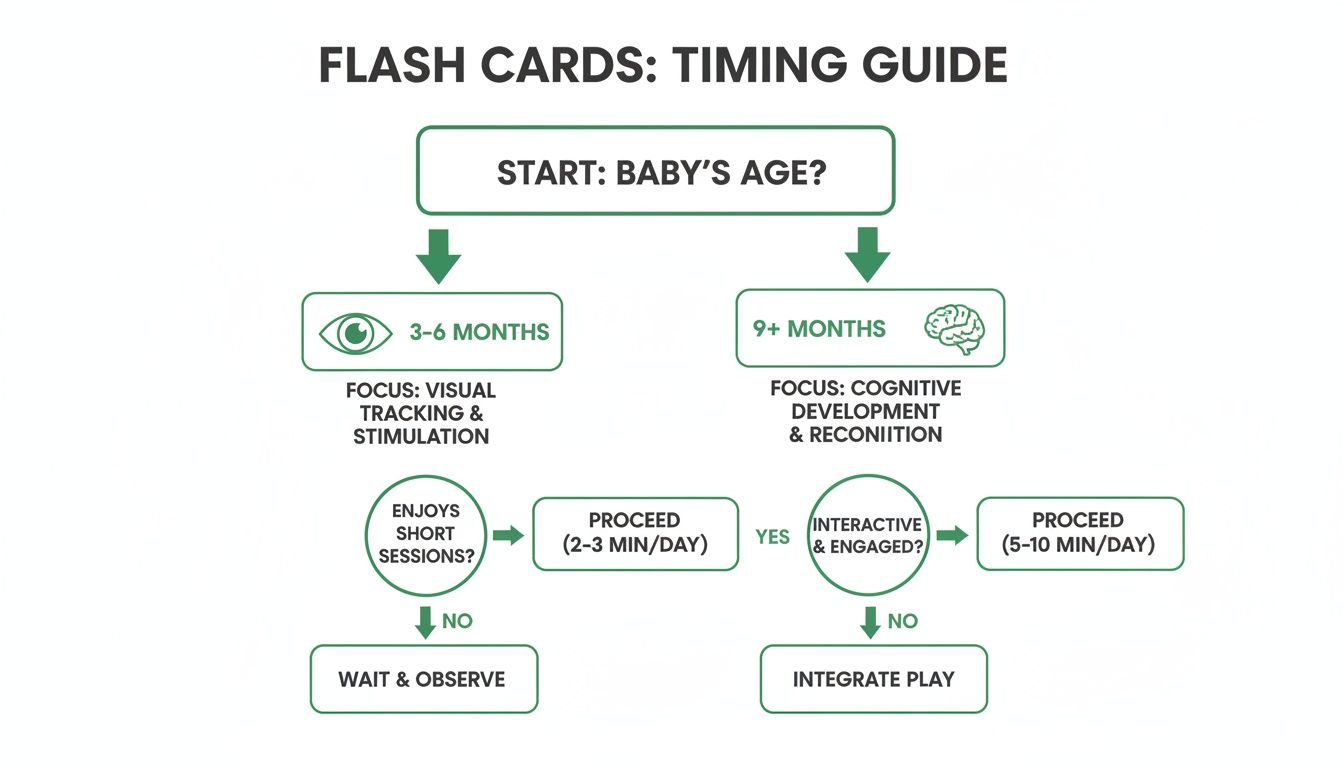
As you can see, the focus naturally shifts from simple visual stimulation for the youngest babies to more active vocabulary building as they grow into toddlers.
My Two Cents: Choosing flash cards is about more than just pictures. It’s about finding a tool that feels like a natural part of your family’s life, faith, and love for learning.
Whether you're holding a card that says 'moon' while pointing to the night sky or showing one for 'dates' as you prepare Iftar, you're not just teaching a word. You're building a world of meaning, connection, and identity, one card at a time.
Making Flash Cards a Natural Part of Your Day
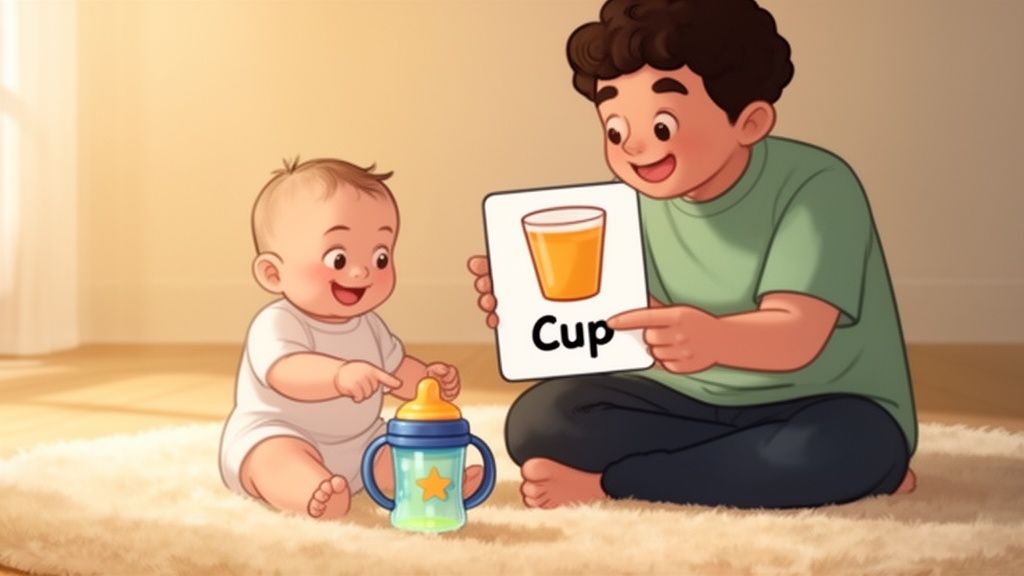
The idea of using flash cards shouldn't feel like another chore to cram into your already busy day. Think of it less as a "lesson" and more as creating little pockets of connection and playful learning. You’re simply weaving these moments into the natural rhythm of your Muslim home.
Forget about needing a formal schedule or a dedicated hour. A few focused, happy minutes are far more powerful. The real secret is to keep it simple, fun, and always follow your child’s lead.
For the youngest babies, maybe 3 to 6 months old, it's all about visual stimulation. Just showing them a few high-contrast, black-and-white cards for a minute or two while they're on their play mat is a perfect, gentle start.
As they get a bit older and start noticing objects and sounds, you can bring in cards with pictures of real items. This is when the magic really starts—connecting those little pictures to their big, new world.
Weave Learning into Everyday Moments
The best way to use flash cards for first words is to tie them directly to what's happening right now. This transforms a simple picture into a real, tangible concept.
Here are a few ways this can look in real life:
- At Snack Time: Right before you hand your toddler their sippy cup, show them the 'cup' flash card. Say the word clearly, then point to their actual cup. "Look, cup! Here is your cup." This simple 'say and show' technique forges a powerful link.
- While Getting Dressed: As you're pulling on their socks, you can flash the 'socks' card. Suddenly, the routine of getting dressed becomes a tiny, effortless learning opportunity.
- Before Heading Out: Show them a card with a 'tree' or 'cat' before you go for a walk. When you spot one outside, you can get excited. "SubhanAllah, look! A big tree, just like on our card!"
Keep It Short and Sweet
With toddlers, attention spans are notoriously short. That's why the golden rule is to keep flash card sessions incredibly brief—just two to five minutes is perfect. Trust me, a joyful two-minute session every day is infinitely better than a frustrating ten-minute battle once a week.
Always, always stop before your child gets bored or fussy. The second you see them start to squirm or look away, just put the cards down with a cheerful, "All done!" This keeps the whole experience positive, ensuring they'll be happy to see the cards again tomorrow.
A landmark study highlighted just how powerful this tool can be for early literacy. Researchers found that before using flash cards, only 25% of preschoolers could identify five or more basic words. After just four weeks of these short activities, that number soared to 90%. You can discover more about these findings on early language development.
This research just confirms what so many parents have seen firsthand: consistent, brief exposure with flash cards can give a child a huge boost in recognizing and naming their first words.
The key is consistency, not duration. A few minutes while you're waiting for the kettle to boil or during a quiet moment after prayers can be incredibly effective. By folding these little learning games into your daily flow, you make vocabulary building a natural part of life, not a forced activity. This gentle, child-led approach fits so beautifully with the Islamic principle of nurturing a child’s love for learning with kindness and patience.
Building a Meaningful First Vocabulary for Your Little Muslim
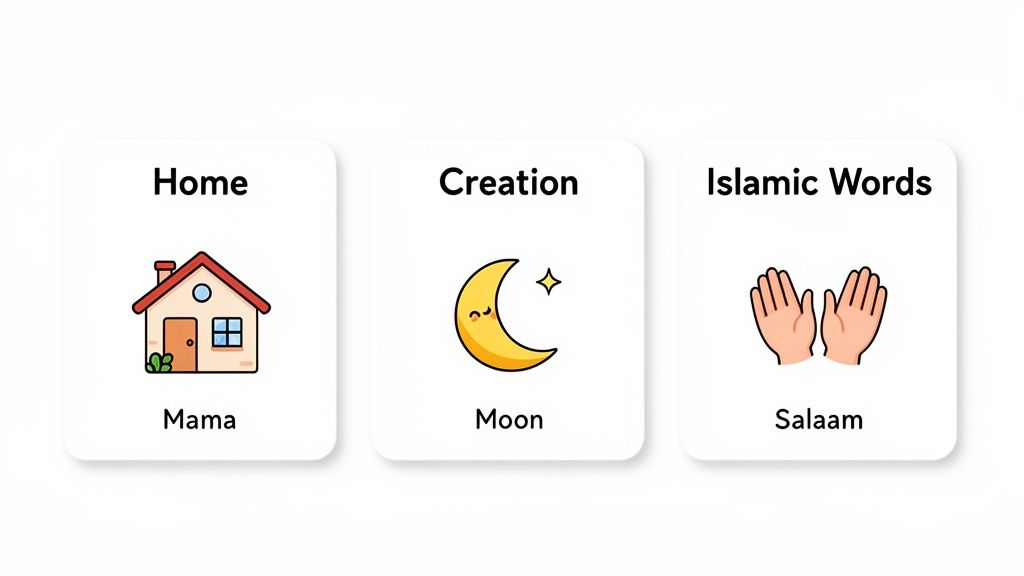
The words you choose for your child’s first flashcards can do so much more than just teach them to name objects. They can be a beautiful reflection of your family's life, faith, and heritage. When you move beyond generic word lists, you turn a simple learning game into a powerful way to nurture your child's identity right from the start.
Think about creating a set of words that feels like home. Imagine the look on their face when you show them a card for Abbu right as he walks through the door, or a card for the moon while you’re looking out the window together before bed. It's these real-world connections that make language click.
Words from Our Home
The very best place to begin is with the world your child sees, hears, and touches every day. These words are instantly relatable, creating a strong foundation for learning because your child can immediately connect the picture to a person or thing right in front of them.
You can’t go wrong with these essentials:
- Family: Ammi, Abbu, Dada (grandfather), Dadi (grandmother)
- Objects: Cup, ball, light, book, keys, chair
- Actions: Eat, sleep, play, walk
These simple nouns and verbs are the true building blocks of communication. When you show the 'cup' card and then point to their actual sippy cup, you’re building a bridge between a 2D image and their 3D reality. It’s a huge developmental leap! For a deeper look into these incredible connections, check out our guide on how babies learn to talk.
Words from Allah’s Creation
Once you've covered the basics at home, you can gently expand their world by introducing the wonders of nature. This is a lovely way to foster an early sense of awe for Allah’s creation. Best of all, these are words you can easily point out on a walk to the park, in your garden, or just by gazing out the window.
Start with elements they can see and experience directly:
- Nature: Sun, moon, star, tree, flower, water
- Animals: Cat, bird, fish, ant
Connecting the picture of the sun on a card to the feeling of its warmth on their skin is a powerful, multi-sensory learning experience. It links the idea on the card to the beautiful world Allah (SWT) has made.
Our First Islamic Words
Introducing faith-aligned words early and naturally helps them become a familiar, comforting part of your child’s world. You don't need complex theological explanations at this age. Just hearing these words in a warm, loving context is enough to plant a beautiful seed.
The key is simple, consistent exposure. When your child hears 'Salaam' every time someone enters a room or 'Alhamdulillah' after a meal, these words become woven into the fabric of daily life. The flashcards just give them a visual anchor for those familiar, comforting sounds.
For families wanting to embrace their heritage, using words in English, Arabic, and Urdu is a wonderful approach. It’s especially helpful in bilingual households for honouring and preserving your family’s linguistic roots.
Here is a small starter list to give you some ideas.
Faith-Aligned First Words Vocabulary List
This is a starter list of meaningful words in English, Arabic, and Urdu for Muslim families to use with their flash cards.
| Category | English Word | Arabic (Transliteration) | Urdu (Transliteration) |
|---|---|---|---|
| Our Home | Mum | Ummi | Ammi |
| Our Home | Dad | Abi | Abbu |
| Our Home | Water | Ma' | Pani |
| Creation | Moon | Qamar | Chand |
| Creation | Sun | Shams | Suraj |
| Islamic Words | Peace | Salaam | Salaam |
| Islamic Words | Prayer | Du'a | Dua |
| Islamic Words | Thank You | Shukran | Shukriya |
Feel free to expand on this with words that are special and meaningful to your own family. The more personal the list, the more your little one will connect with it.
Balancing Physical Flash Cards with Mindful Screen Time
Navigating the world of screens with a little one is one of the biggest challenges for parents today. We want to protect their precious minds from overstimulation, yet we live in a world where technology is impossible to escape. The secret isn't to demonize screens, but to use them with clear intention and purpose.
When used thoughtfully, technology can be a fantastic supplement to the learning you’re doing with physical flash cards for first words. It’s not about replacing that one-on-one connection, but reinforcing it. Think of it as another helpful, halal-aligned tool in your parenting toolkit.
Using Screens to Support, Not Replace
Let’s walk through a real-life example. This morning, you and your toddler spent a few happy minutes with your animal flash cards. You held up the 'bird' card, you made tweeting sounds, and you both had a laugh.
Later, while you need a moment to prepare lunch, you can play a gentle, ad-free nasheed about Allah's beautiful creations that happens to feature birds. This creates a powerful learning loop. Your child hears the word 'bird' again in a new, engaging context, which helps cement the vocabulary you introduced earlier.
This approach, often called co-viewing, is all about being present and intentional. It turns what could be passive screen time into an active, shared experience.
Digital flashcards have also come a long way. Many apps now use smart algorithms to repeat words at just the right interval to help them stick. Research has shown this can be incredibly effective. One study on cognitive skills development found that proficiency in recognizing symbols—a skill very similar to linking words and images—jumped from just 38.46% to a perfect 100% after participants used slower, adaptive digital flashcard sessions.
Setting Boundaries for Peace of Mind
The goal is to stay in the driver's seat, ensuring that any screen time serves a clear educational and faith-aligned purpose. This is where setting firm but gentle boundaries becomes so important for creating a calm, predictable home.
Here are a few practical tips I’ve found helpful:
- Curate Your Content: Stick to safe, curated platforms that share your values. This completely removes the risk of your child stumbling upon ads or inappropriate content.
- Set Clear Limits: Decide on a specific, short amount of screen time for the day and stick to it. Toddlers thrive on consistency. For more ideas, check out our guide on how to limit screen time for your little ones.
- Connect to Real Life: Always bring the digital content back to the real world. If you watch a video about colours, spend the next five minutes on a "colour hunt" around the house.
By framing screen time as a specific tool for a specific purpose—like reinforcing the word 'cat' after seeing the flash card—you can use it confidently, knowing it aligns with your family’s values and supports your child's learning journey without compromising their well-being.
Common Questions from Muslim Parents
It's only natural to have a few questions when you're starting a new learning journey with your little one. I hear from so many Muslim parents who are excited to use flash cards for first words but want to make sure they're doing it in a way that feels gentle, positive, and connected to our faith. Let's walk through some of the most common ones.
When Is the Best Age to Start Using First Words Flash Cards?
You can actually start much earlier than you might think! As early as 3–6 months, simple, high-contrast black-and-white cards are fantastic for pure visual stimulation. They help your baby’s developing eyes learn to focus.
For actual vocabulary building, the real magic often happens between 9 and 18 months. This is when you'll notice your child becoming more curious about the world, pointing at things, and babbling with intent.
Ultimately, the calendar doesn't matter as much as your child. Watch their cues. If they're engaged and you're both smiling, you're doing it right. It’s all about joyful connection.
Do Flash Cards Just Encourage Rote Memorization?
This is a great question, and a common concern. The truth is, flash cards are only as effective as how you use them. If you just drill them, then yes, it can become about memorization. But when used playfully and interactively, they build deep, genuine understanding.
The goal is to bridge the gap between a picture, a word, and the real thing. Show your child the card for 'cup,' say the word, and then point to their sippy cup on the table. That’s how you build real-world connections, not just rote memory.
The secret is context. A picture of a masjid on a card becomes real when you point one out on your way to Jummah. It transforms a simple image into a lived experience, nurturing a deeper connection.
How Can I Make My Own Flash Cards Without It Taking Too Much Time?
I get it—life with a little one is busy! Don't let the idea of creating "perfect" flash cards stop you. The simplest way is often the best. Just print out pictures of everyday objects, family members (Nani, Dada, Ami, Abu), or familiar things from your home.
Glue them onto index cards or sturdy cardstock and write the word clearly underneath. You could probably make a great starter set of 10-15 cards during a single 30-minute naptime. Your baby will love the cards made by you far more than any store-bought set.
My Toddler Gets Bored Easily. How Do I Keep Them Engaged?
Welcome to the toddler years! Their attention spans are notoriously short, and that's completely normal. The key is to work with their nature, not against it.
Keep your flash card sessions super short—think 2–3 minutes max. Seriously, that's it!
Turn it into a game:
* "Where's the kibbeh? Can you find it?"
* Hide a card under a blanket for them to discover.
* Use silly voices for different words.
* Let them hold the cards and choose the next one.
The most important rule? Always stop before they get bored. End the game on a high note while they're still having fun. That way, they'll be excited to play again next time.
Are you looking for a way to mindfully supplement your hands-on learning with screen time that shares your values? Babymode offers a safe, ad-free, and halal digital space with gentle stories, nasheeds, and learning content created for Muslim children aged 0–3. Join the Babymode waitlist for early access.