As a parent, you’re always looking for gentle ways to show your little one the wonders of Allah’s creation. The desert, which many people think of as empty, is actually a beautiful gallery of His miracles. The amazing ways plants adapt to the desert are truly remarkable signs of Allah's perfect planning and power.
These plants don't just hang on in harsh conditions; they actually flourish using special features gifted to them by their Creator. They're a living example of incredible resilience, patience (sabr), and trust (tawakkul) in His divine plan.
Witnessing Allah’s Miracles in the Desert
Every single plant that pushes its way up from the dry earth is a testament to Allah's mercy and wisdom, perfectly designed to handle scorching heat and a constant lack of water.
Thinking about these tough little plants can be a gentle reminder for us, too. Just like a cactus stores every last drop of water to survive, we hold onto our faith during challenging moments. Watching them wait patiently for the smallest bit of rain can inspire a deeper sense of gratitude in our own hearts—a feeling we can share with our children long before they can even speak.
A Lesson in Every Leaf
Every part of a desert plant tells a story of survival and purpose.
- Thick leaves hold water like tiny, built-in water bottles.
- Sharp spines act as a protective shield, guarding the plant from thirsty animals.
- Deep roots search tirelessly underground for water, showing us what persistence looks like.
These aren't just random traits; they are meticulously planned solutions from Al-Khaliq (The Creator). In these clever designs, we see not just fascinating science, but clear signs (ayat) of a compassionate and all-knowing Planner. This perspective can turn a simple nature walk or even just looking at a picture book into a meaningful act of worship. For more ideas on weaving faith into everyday lessons, you might find our guide on sharing stories of the prophets with your kids helpful.
Allah's creation is perfect and balanced. Even in the harshest environments, He provides everything a living thing needs to flourish, reminding us that His mercy extends everywhere.
It's amazing to think that what we often see as barren landscapes are actually teeming with life. Drylands cover a staggering 45% of Earth's surface and are surprisingly diverse, especially in the driest spots where rainfall is almost non-existent. This variety is a critical part of Allah's design, allowing these ecosystems to adapt and survive. You can learn more about this unexpected plant diversity on INRAE.
How Desert Plants Survive with Allah’s Help
Have you ever looked at a plant in the desert and wondered how it can possibly live under the scorching sun with barely any water? It's one of the most beautiful and clear signs of Allah's perfect planning. He gives every single plant special tools and clever tricks to not just survive, but truly thrive, even in the harshest places on Earth.
By understanding these amazing designs, we can share the wonder of the adaptations of plants in the desert with our little ones in a simple, faith-filled way. These incredible abilities aren't just happy accidents; they are special gifts from Al-Musawwir (The Fashioner), who shapes everything in the most perfect form.
Let's explore the three main ways Allah helps these remarkable plants survive their tough home.
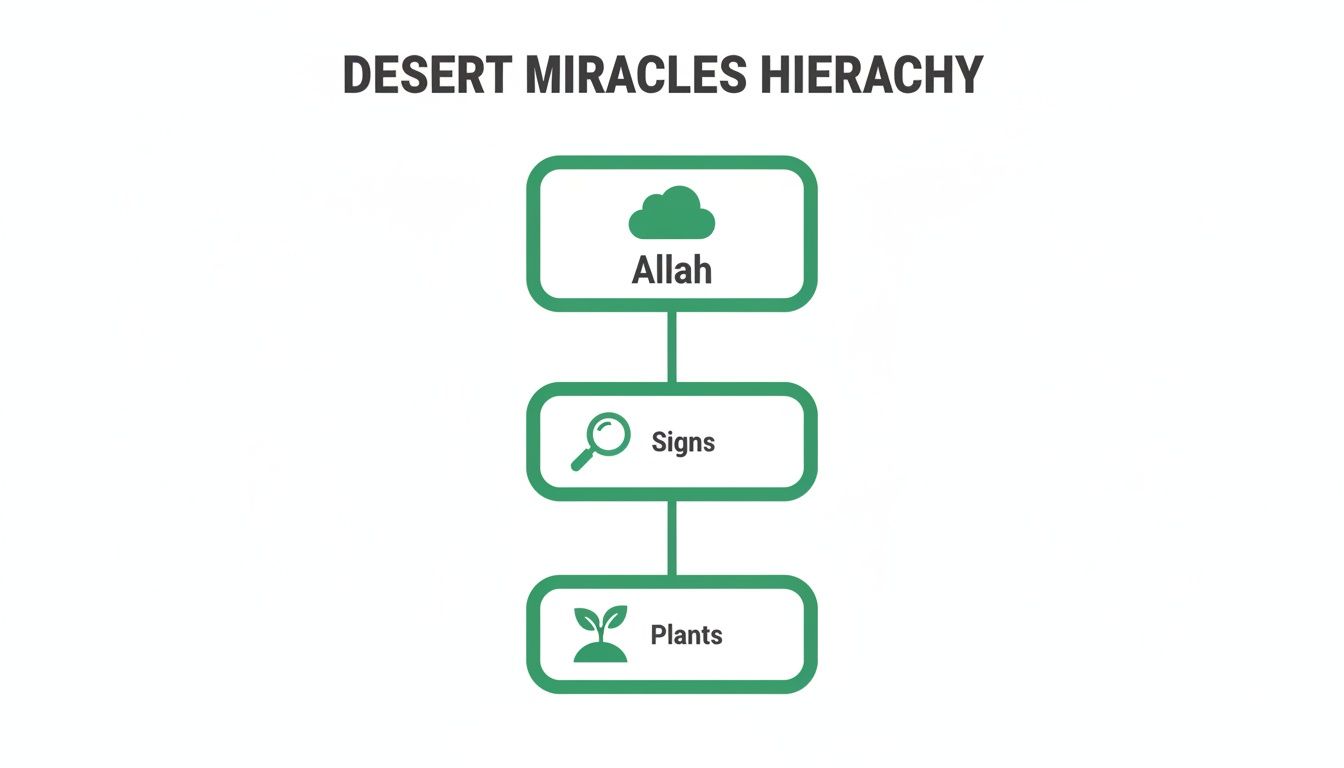
This simple diagram helps us connect the dots. When we see the incredible design of a desert plant, we are really seeing a sign that points us back to the power and wisdom of Allah.
To make this easier to share with your toddlers, think of these adaptations in three simple categories: clever body parts, smart inner workings, and wise behaviours. Each one is a testament to Allah's care for His creation.
| Type of Adaptation | What It Means | Simple Analogy for Toddlers |
|---|---|---|
| Morphological (Clever Body Parts) | The plant's physical shape and structure are designed to save water. | "It's like wearing a special raincoat and tiny sunglasses to stay cool!" |
| Physiological (Smart Inner Workings) | The plant has special abilities inside its cells to store water and make food differently. | "It's like having a big water bottle hidden inside its tummy for thirsty days." |
| Behavioral (Wise Behaviours) | The plant acts in ways that help it avoid the heat and find water. | "It's like taking a nap during the hot day and only waking up when it's cool outside." |
These analogies help make a complex topic feel simple and relatable, showing children how Allah’s plan is at work in every leaf and stem.
1. Morphological Adaptations (Clever Body Parts)
The first and most obvious way Allah helps desert plants is through their physical design—their "clever body parts." Think of these as built-in survival tools that we can actually see and touch.
- A Waxy Raincoat: Many desert plants are covered in a thick, waxy layer on their leaves and stems. This coating works just like a raincoat, locking precious moisture inside so the hot sun can't evaporate it away.
- Tiny Leaves or Spines: Have you noticed that cacti have sharp spines instead of big, green leaves? That’s because big leaves lose a lot of water. Allah designed many desert plants with very small leaves or spines to reduce the surface area exposed to the sun, which is a brilliant way to save water.
- Smart Root Systems: These plants have amazing roots! Some spread out like a wide, shallow net just under the sand, ready to quickly slurp up even the smallest drop of rain. Others send one super-deep "taproot" way down into the earth to find water hidden far below.
2. Physiological Adaptations (Smart Inner Workings)
The next strategy happens deep inside the plant, where we can't see it. These are the "smart inner workings" that are absolutely crucial for survival.
A camel can store water in its hump, right? Well, some plants do something very similar! Succulents and cacti are masters at this. They hold onto water in their thick, fleshy stems or leaves, using it bit by bit over long periods. It's like having a personal, built-in water bottle—a perfect gift for a place where rain is a rare treat.
Even more amazing, some plants have learned to make their food (photosynthesis) at night. Instead of opening their tiny pores (stomata) during the blistering heat of the day, they open them in the cool night air. This simple switch means they lose far less water. SubhanAllah, it's as if they know to be active only when it's safe! The incredible ingenuity of Allah's creation is perfectly shown in the variety of drought-tolerant landscape plants, each with its own unique way to thrive.
Just as these plants hold onto water, these examples can help our children hold onto the idea that Allah provides for all His creation, no matter the challenge.
3. Behavioral Adaptations (Wise Behaviours)
Finally, many desert plants show what we can call "wise behaviours." These are the smart actions they take to cope with their challenging environment.
A beautiful example is the desert flower that only blooms at night. These plants open their delicate petals in the cool, dark hours to attract pollinators like moths and bats, which keeps them safe from the sun's harsh and damaging rays.
Other plants have seeds that can lie dormant in the soil for years, just waiting patiently. They will only sprout when there's been enough rainfall to give them a real chance at life. This shows a perfect and beautiful trust in Allah’s timing.
Getting to Know Allah’s Amazing Desert Plants
Now that we’ve explored the clever ways Allah helps plants survive, let's meet some of the heroes of the desert! Putting a "face" to these ideas really helps them stick, turning abstract science into memorable stories you can share with your little one. Think of each plant as a superstar, gifted with its own unique set of superpowers from Allah.
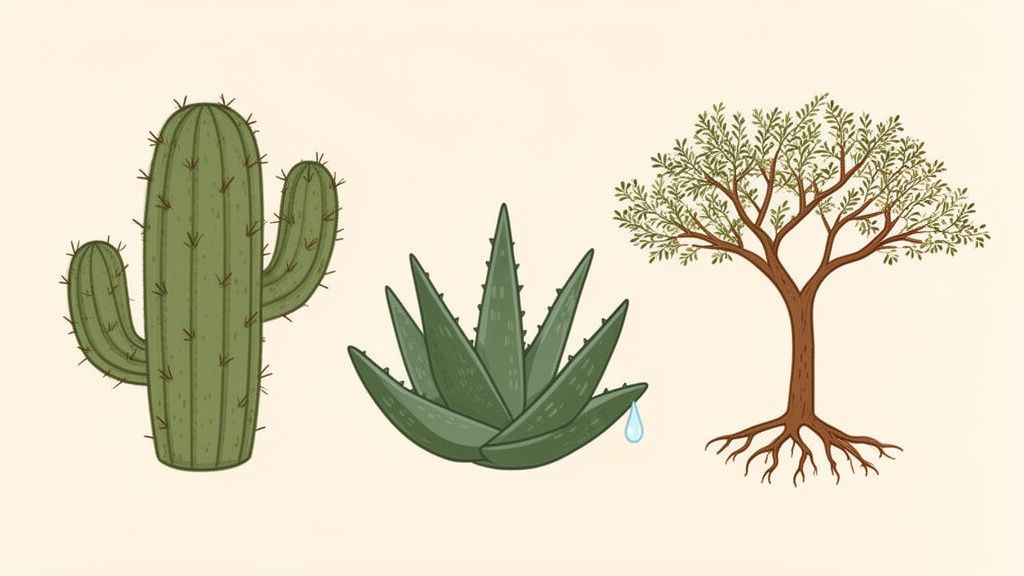
These examples are perfect for pointing out in books, during screen time, or even if you have one as a houseplant. They’re fantastic real-world examples of the adaptations of plants in the desert.
The Mighty Cactus
The cactus is probably the most famous desert resident, and for good reason! It’s a perfect showcase of Allah’s incredible engineering.
Protective Spines: Those sharp prickles aren't just for show. They’re the cactus’s personal security team, guarding its precious water from thirsty animals. You can tell your toddler, "SubhanAllah, Allah gave the cactus pokey spines to keep it safe!"
A Living Water Tank: The thick, green stem of a cactus works like a giant, expandable water bottle. Its special ribbed design allows it to swell up like an accordion to hold more water after a rare rainfall, then slowly shrink as it uses that water to live.
The Soothing Succulent
Succulents, like the beautiful Aloe Vera, are another of Allah’s amazing creations. They are masters of storing water and have a gentle, helpful nature that we can benefit from, too.
Their plump, fleshy leaves are filled with a special gel. This isn't just water; it’s a rich, nutrient-packed substance that keeps the plant going for months without a single drop of rain. It’s a beautiful lesson in how Allah provides everything His creation needs, right where it’s needed most.
When we look at these plants, we're reminded that Allah’s planning is perfect. He doesn't just help things survive; He gives them everything they need to be strong and resilient in their own special way.
The Patient Acacia Tree
Not all desert heroes are small and stout. The Desert Acacia tree is a powerful example of patience and strength, teaching us how to find nourishment even when it seems impossible.
This tree has perfected the art of saving water. Its leaves are tiny, which dramatically cuts down on water loss—a bit like us squinting on a super sunny day. Even more amazing are its roots. Some acacia trees can send roots searching for groundwater more than 50 meters deep underground!
That kind of powerful design, along with other tricks like leaves that can shrink to cut water loss by up to 90%, shows Allah’s perfect planning in action.
Each of these plants tells a story of survival, purpose, and complete trust in Allah’s plan. To truly appreciate the intricate details of plant life, you might enjoy exploring some amazing science experiments with plants that can inspire your own toddler-friendly activities. These hands-on explorations are a fantastic way to witness the wonders we've discussed.
The Purpose Behind Each Perfect Design
When you really look at the incredible ways plants survive in the desert, it’s impossible not to wonder why Allah designed them so perfectly. Every single feature, from a nearly invisible root hair to a thick, waxy leaf, serves a specific purpose. This isn't just about clever survival tricks; it’s a direct reflection of the profound wisdom (hikmah) behind His creation.
Thinking this way shifts our perspective. We move beyond just asking what a plant does and start asking why Allah (Al-Hakim, The All-Wise) made it that way. It's a beautiful lens through which we can see the intricate, balanced design woven into the natural world—a lesson that's easy to share with our children through simple observation.
A Design for Every Challenge
The desert throws two massive challenges at any living thing: a serious lack of water and a scorching, relentless sun. In His infinite mercy, Allah gave each plant the exact set of tools it needed to not just face, but overcome, these hurdles.
To Handle Thirst: Rain in the desert is a rare and precious gift. So, plants have to be masters at finding, storing, and protecting every last drop. Sprawling, shallow roots act like a giant net, ready to catch any sudden downpour. Meanwhile, deep taproots venture far underground, searching for hidden water sources. Their ability to then store that water in their fleshy stems or leaves is a direct provision to help them endure months without rain.
To Endure the Sun: The desert sun can be brutal. To counter this, Allah gave these plants their own built-in sunblock. Waxy coatings reflect the harsh rays and seal in precious moisture. Having tiny leaves—or even spines instead of leaves—drastically reduces the surface area exposed to the sun, preventing the plant from losing too much water to evaporation.
You can see a perfect, compassionate balance in this design. Nothing is wasted, and nothing is left to chance.
A Deeper Role in Allah’s Plan
These plants aren't just designed for their own survival. They play a crucial part in the entire desert ecosystem, fulfilling their role in Allah's perfectly balanced plan. They are a source of life for countless other creations.
Their leaves, fruits, and seeds are essential food for everyone from tiny insects to massive camels. Their roots and branches offer shelter from the sun and a safe place to live for lizards, birds, and other desert creatures. They even hold the fragile desert soil together, stopping it from being swept away by the wind.
This web of life is a powerful sign of a single Creator. In the Kuwaiti desert, for example, native plants show this perfect design by sending all their energy to their roots when a drought hits. One study found that when given just 50% of their normal water, some grasses dramatically boosted their root growth to pull in every bit of available moisture. That's a life-saving strategy in a place with scorching heat and very little rain. You can read more about these survival strategies in arid ecosystems on Frontiers.
By looking at why a plant is designed the way it is, we see a world full of purpose. We see that Allah’s creation is not just a collection of individual things, but a beautiful, interconnected family where every member helps and supports the others.
Simple Ways to Teach Your Toddler About Creation
It’s one thing to understand why Allah (SWT) designed desert plants with such incredible perfection, but sharing that sense of wonder with your little one is where the real magic happens. You don't need a formal science lesson or a long trip to the desert to get started.
The goal is simply to plant tiny seeds of awe in their hearts, connecting the amazing things they see in nature back to Allah’s boundless creativity and mercy.

Here are some simple, low-prep activities perfect for busy Muslim households. They're designed to turn everyday moments into opportunities for gentle, faith-based learning and connection.
Simple Activities to Explore Plant Adaptations
These hands-on ideas use items you probably already have around the house, making them perfect for short attention spans. They help toddlers grasp the clever ways plants survive in the desert through play.
| Activity Name | What You Need | What It Teaches |
|---|---|---|
| The Sponge Squeeze | A dry sponge, a bowl of water | Water Storage: Shows how succulents soak up and hold onto water, just like a sponge. |
| Wax Crayon Resist | A white or green wax crayon, paper, water dropper or spoon | Waxy Coatings: Illustrates how a waxy "coat" makes water roll right off, keeping moisture locked inside the plant. |
| The Bean Sprout Race | A clear jar, paper towel, a bean seed | Deep Roots: Lets them watch a root grow downwards, "searching" for the water it needs to live. |
These little experiments bring big ideas down to their level, making the adaptations of plants in the desert something they can see and feel for themselves.
Talking Points for Little Hearts and Minds
The words we use matter so much. Simple, consistent phrases can beautifully connect the wonders of nature directly to Allah’s power and love. There's no need to explain complex theology—just model a sense of gratitude and awe.
"SubhanAllah! Look how strong Allah made this plant to live in the sun!"
A simple comment like this, maybe while you’re watering a houseplant or spotting a tough little weed on the sidewalk, teaches your child to see strength and resilience as signs of Allah’s magnificent creation.
Here are a few more phrases you can weave into your day:
- "Masha'Allah, Allah gave the cactus its prickles to keep it safe."
- "Alhamdulillah for the rain! Allah is giving all the thirsty plants a big drink."
- "Allahu Akbar! Allah’s plan is so perfect. He helps every flower and every leaf."
For more ideas on weaving faith into these precious early years, our guide on how to teach Islam to toddlers offers gentle and practical tips.
These small, repeated moments build a beautiful foundation of faith. They teach your child that the world around them is filled with signs from a loving and wise Creator, turning every nature walk and sensory game into its own small act of worship.
Common Questions from Muslim Parents
It can feel like a big leap trying to connect the intricate world of desert plants to your toddler's everyday life, but it's actually much simpler and more natural than you might think. Let's walk through some of the questions I often hear from parents who want to weave these beautiful signs of Allah's creation into their family conversations.
The goal here isn't a science lesson, but a way to integrate the amazing adaptations of plants in the desert into your daily routine and faith in a way that feels gentle and spiritually nourishing for everyone.
How Can I Explain Adaptation to My Two-Year-Old?
You don't need the big scientific words at all! The trick is to use simple ideas your child already gets from their own world. Focus on the core idea: Allah’s loving care.
For instance, if you're looking at a picture of a cactus, you could say something like, "Allah gave the cactus a special shiny coat so it doesn't get thirsty in the hot sun. That’s just like how you wear your coat when it’s chilly outside!"
The aim is to spark a sense of wonder and show that Allah provides for all of His creation in perfect, special ways. Use analogies from their life, like storing toys in a box (storing water) or wearing sunglasses (leaves protecting themselves from the sun).
Are There Any Quranic Verses I Can Share?
Absolutely. While a toddler is too young for deep theological discussions, you can gently plant seeds of connection. The idea is to build a positive, loving association between nature and Allah's mercy and power.
- Mention Prophet Yunus (AS): When you see a plant with big leaves, you can simply say, "Look at the huge leaves! Allah protected Prophet Yunus with a beautiful, shady plant just like this one."
- Simple Verses: You can recite and gently translate a small part of a verse, like, "And it is He who sends down rain from the sky, and We produce thereby the growth of all things…" (Quran 6:99). Just the sound and the simple meaning is enough to make a connection.
We Live in the City. How Can I Make This Relevant?
This is such a great question, because it gets to the heart of the matter: signs of Allah's perfect design are everywhere. The lesson isn't just about deserts; it's about learning to see His wisdom all around us.
Why not bring a small succulent or cactus into your home? You can care for it together and notice how little water it needs to thrive. On walks, you can point out dandelions growing bravely through cracks in the pavement—another tough environment! This shows that resilience and clever design exist in a tiny pot on your windowsill just as much as in a vast desert. These little observations can become part of your daily rhythm, much like other gentle parenting practices. For more ideas on nurturing your child's growth within a faith-based framework, you might find our guide on Muslim parenting tips for babies helpful.
What if My Child Is Scared of a Cactus?
This is actually a perfect teaching moment about respecting Allah's creation. The first step is to acknowledge their feeling, then you can calmly explain the purpose behind the design.
You could say, "SubhanAllah, you're right, they do look sharp. Allah gave the cactus these prickles to protect itself so nothing would eat it. We can be gentle and look with our eyes, not our hands, to keep ourselves safe." This teaches them about boundaries and that everything in Allah's world has a purpose, even things that seem a little scary at first. It’s a wonderful, natural way to introduce the concept of adab (good manners) with all of creation.
At Babymode, we believe in nurturing a child's faith from the very beginning. Our platform provides a safe, halal, and ad-free space where your little one can explore Allah's creation through gentle stories, nasheeds, and animations designed just for them.