When you notice your child isn't quite hitting their communication milestones, professional support can make a world of difference. This process, known as speech delay therapy, often starts with a quiet worry in a parent's heart. Taking that first step is a proactive, loving way to understand and support your child's unique developmental journey.
For many Muslim families, it's about turning that fear into empowerment and finding resources that align with their faith and values.
What a Speech Delay Means for Your Family
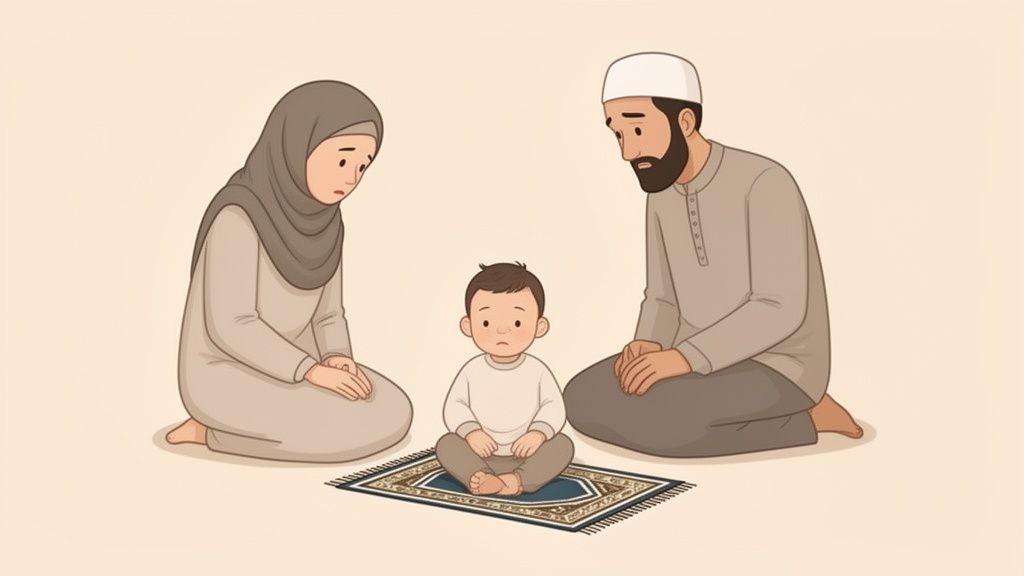
It’s that gentle nudge of concern you feel when you notice your toddler isn't chatting as much as their cousins or the other kids at Jummah prayer. You start to wonder, "Am I just being anxious, or is my parental instinct trying to tell me something?" Trust me, this feeling is incredibly common, and you are definitely not alone.
In fact, speech delay has become a more frequent worry for parents, especially over the last few years. Recent data shows that diagnoses among toddlers have held steady at around 16-17%, which is a noticeable increase from past numbers. You can find some fascinating insights on these post-pandemic trends from EPIC Research. Knowing this helps put your own concerns into a bigger picture that many other families are also navigating.
Late Talker or Speech Delay?
It's really helpful to understand the difference between a "late talker" and a child who might need speech delay therapy. A late talker is usually a toddler between 18-30 months who seems to understand everything you say and is hitting all their other developmental milestones, they just have a limited spoken vocabulary. These little ones often catch up on their own with a bit of extra encouragement.
A speech delay, on the other hand, can involve challenges with both speaking and understanding language. This is absolutely not a reflection of your parenting or your child's intelligence. It’s simply a sign that your child might need a different kind of support to unlock their natural ability to communicate.
Seeking help is a proactive act of love and trust in Allah's plan. It’s an opportunity to empower your child with the tools they need to express the beautiful thoughts and feelings inside them.
This journey isn't about "fixing" a problem. It’s about deeply understanding your child’s unique path, advocating for their needs, and finding support that respects your Islamic values. The goal here is to move from a place of worry to one of confidence, knowing that you are doing everything you can to help your little one thrive, insha'Allah.
Recognizing Milestones in Your Muslim Home
Watching your child’s personality unfold is one of the greatest joys Allah (SWT) blesses us with. Every coo, babble, and giggle feels like a precious gift. As parents, we naturally keep an eye out for signs of development, but it's important to do this gently, without letting anxiety overshadow the beauty of these moments.
These early years are full of tiny but significant steps in communication. Think of these milestones not as a rigid checklist to stress over, but as beautiful signs of connection to look for within the natural rhythm of your Muslim home. This mindset helps you stay aware and supportive while truly cherishing your child’s unique journey.
From Sounds to First Words
In the very beginning, communication isn't about words at all—it's about listening and reacting. When your baby turns their head at the sound of the Adhan from your phone, or startles when Dad says "Assalamu 'alaikum!" loudly at the door, these are the earliest signs they’re tuning into the world.
As they grow, these reactions become more intentional. They might start to coo back when you recite a short Surah or babble strings of sounds like "ma-ma" and "ba-ba" while playing on their mat. These are the foundational bricks of language, laid one sound at a time.
Milestones in a Bilingual Home
So many Muslim families are blessed with bilingualism, speaking English alongside Arabic, Urdu, Farsi, or another heritage language. A common worry is that this will cause a speech delay, but the research is overwhelmingly clear: this is simply not the case.
Raising a child with two languages is a strength, not a weakness. Bilingual children meet the same developmental milestones as monolingual children; they just have a richer, more diverse linguistic world to draw from.
It's also completely normal for a bilingual toddler to mix languages, a process called code-switching. Hearing them say "more pani" (water) or "look, sayara" (car) isn't a sign of confusion. It shows their clever brain is using all the words it knows to get their message across! The key is to provide consistent, natural, and loving exposure to both languages.
Speech and Language Milestones for Ages 0-3 in a Muslim Home
To give you a clearer picture, here’s a quick reference guide to track your child's communication development. We’ve included examples you might see in daily Muslim family life.
| Age Range | What to Look For (Communication Milestones) | Example in Our Home |
|---|---|---|
| By 6 Months | Responds to sounds by making noises; turns head toward voices. | Your baby coos and gurgles when they hear you reciting the Shahada softly to them before naptime. |
| By 12 Months | Babbles with changes in tone; says a few first words like "mama" or "dada." | Your one-year-old points to their cup and tries to imitate "Bismillah" before taking a sip of water. |
| By 18 Months | Can say several single words and points to show you something interesting. | Your toddler points to the picture of the Kaaba in their board book and says "Allah!" |
| By 24 Months | Speaks in simple two-word phrases; can follow simple instructions. | After finishing their dates, your two-year-old says "more please" or "all done." |
| By 36 Months | Has a word for almost everything; speaks in three-word sentences. | While getting ready for Eid prayer, your child says, "I wear new shoes" or "Baba go car." |
Remember, every child develops at their own pace, as ordained by Allah (SWT). This table is meant to empower you, not create worry. If you consistently notice your child is not meeting these milestones, it’s a sign to gently seek more information, trusting your gut instinct as a parent.
Finding the Right Speech Delay Therapy
Deciding to seek professional support is a huge, loving step forward. But let's be honest, it can also feel like you've been dropped into a new world with its own language—evaluations, therapy models, and specialists. This section is here to demystify that process, helping you feel clear and confident as you find the best path for your child.
Your first port of call is usually a chat with your GP or pediatrician. They can give you a referral to a Speech-Language Pathologist (SLP), the professional who is trained to assess and treat all kinds of communication disorders. This initial evaluation isn't a test your child can pass or fail; it’s just a way for the SLP to get to know your child's unique personality, strengths, and challenges through observation and, most importantly, play.
What Does Speech Therapy Look Like?
For toddlers, speech delay therapy is almost always centered around play. So, you can forget any images of sterile clinics and stressful drills—effective therapy for this age group should just look like a lot of fun! The SLP uses toys, games, and activities your child already loves to gently encourage communication.
These sessions are built on proven, evidence-based approaches that are both gentle and highly effective:
- Play-Based Therapy: The therapist follows your child's lead, turning their interests into teachable moments. If your little one is obsessed with cars, the therapist might make "vroom" and "beep" sounds, talk about "fast" and "slow," and model fun phrases like "ready, set, go!"
- Parent Coaching: This is an incredibly empowering model where the therapist teaches you the strategies. After all, you're your child’s very first and most important teacher. The SLP gives you practical tools you can weave into your daily routines, from mealtime chatter to bath time songs.
- Focused Stimulation: Here, the therapist will repeatedly model a specific word or phrase in a natural way, without ever pressuring your child to say it back. For example, they might say the word "open" many times while playing with a box of toys or stacking cups. Just hearing it in context helps the word stick.
This timeline gives you a general idea of what communication milestones look like in those first couple of years.
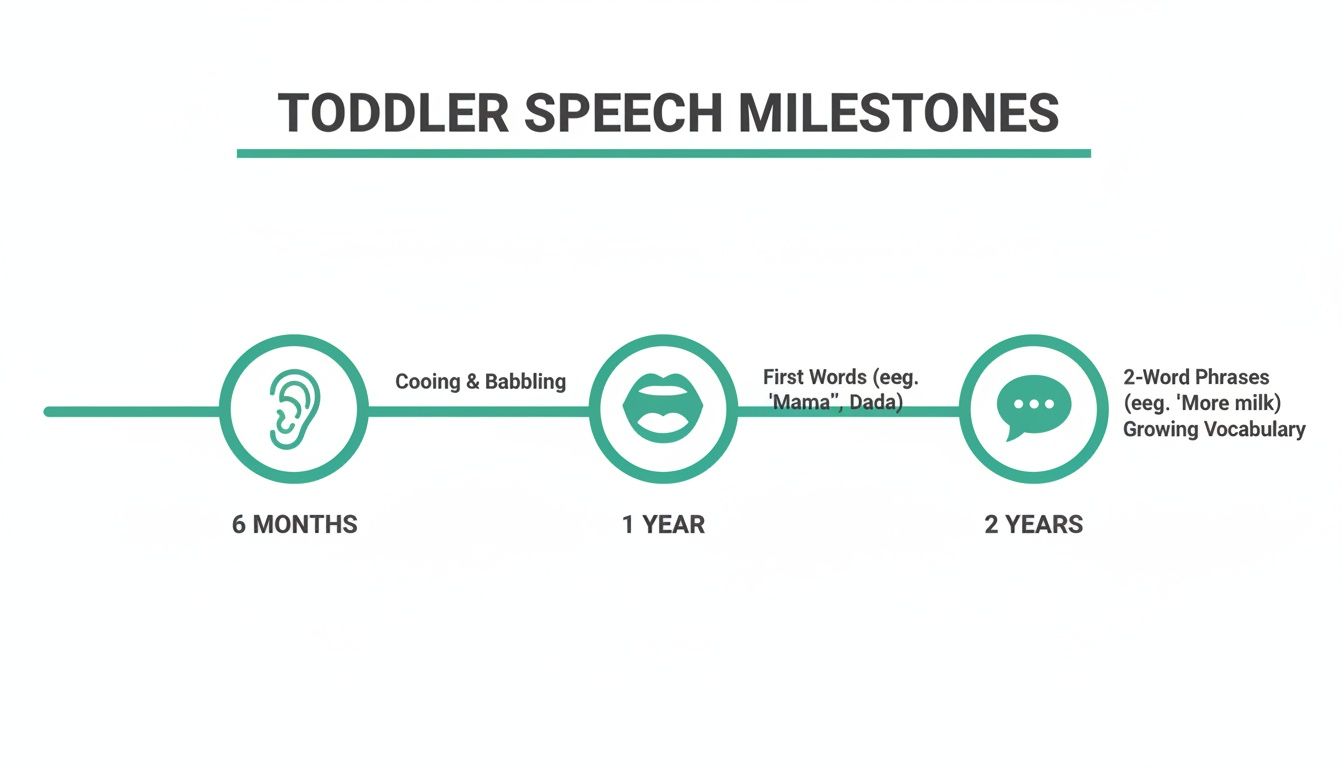
It helps frame the journey from early coos to simple phrases, offering a basic guide for what to expect.
Finding a Therapist Who Understands Your Family
Finding an SLP who respects your family's cultural and religious values is absolutely essential. You want someone who sees the beauty of a bilingual home and appreciates your family's unique dynamic. When you first connect with a clinic or therapist, don't be shy about asking questions to find the right fit:
- Do you have experience with bilingual families (e.g., Arabic/English, Urdu/English)?
- How do you involve parents in the therapy sessions?
- Can you offer teletherapy for a more flexible schedule?
Modern options like teletherapy can be a huge blessing for busy Muslim families. It lets you fit sessions into your schedule without disrupting prayer times or nap routines, making it much easier to stay consistent with the support.
The demand for these services has grown a lot, which means more resources are popping up. The US recently saw 19,000 new job openings for speech-language pathologists, which is part of a larger global investment in therapy services. This growth reflects the needs of millions of families and is leading to more accessible solutions.
For some toddlers with more significant speech delays, looking into tools like a Speech Assistant AAC can be a fantastic way to offer another method of communication. These tools can act as a bridge while spoken language is still developing, which can reduce frustration for both you and your child.
Ultimately, the right speech delay therapy is a partnership. It’s a collaboration between a skilled professional and you—the undisputed expert on your child. By taking this step, you are opening a door to new ways of connecting, giving your child the support they need to share their beautiful inner world with everyone around them, insha'Allah.
Building a Language-Rich Islamic Environment
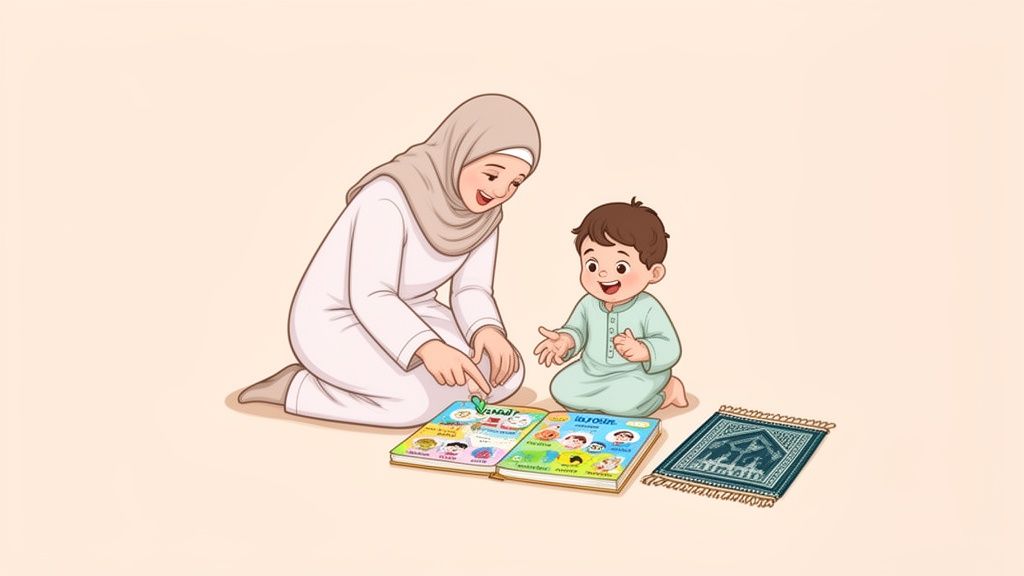
While professional therapy is incredibly helpful, the real magic happens at home. It’s in those small, everyday moments—the ones woven into the natural rhythm of your family life—where language truly begins to blossom. And the best part? You don’t need any special training or fancy toys to get started.
You can begin right now by turning your daily routines into gentle opportunities for language learning. The whole idea is to focus on connection over correction. Your goal is to create a joyful, pressure-free space that nurtures your child's confidence and vocabulary, all while deepening your precious bond.
Narrate Your Day Together
One of the easiest yet most powerful things you can do is something called self-talk. All it means is that you become a narrator for your own actions, describing what you're doing and seeing while your child is with you. It might feel a bit odd at first, but for your toddler, it's like having a personal tour guide to the world.
Think about what you’re already doing. As you prepare a snack before Maghrib, you could say, "Mama is cutting the apple. Slice, slice, slice. Now, let's put it in the bowl." This simple act floods their environment with words tied to real-life actions.
The flip side of this is parallel talk, where you narrate what your child is doing. This shows them you’re completely tuned in to their world and gives them the words to match their own experiences.
- "You're pushing the big red car. Vroom, vroom!"
- "You stacked the blocks so high, masha'Allah!"
- "Oh, you see the kitty outside the window."
This simple act of noticing and naming validates their play and helps them forge those crucial links between words and their own interests.
Weave Language into Islamic Routines
Your faith provides so many beautiful, built-in moments for language to grow. These routines are predictable and filled with love, which makes them the perfect setting for speech development.
By narrating these special moments, you are not only teaching vocabulary but also connecting language to your family’s deepest values and identity.
Look for these simple, natural opportunities:
- During Wudu: Narrate the steps simply and repetitively. "First, we wash our hands. One, two, three. Bismillah. Now, let's wash our face. Splash!"
- Before Meals: As you settle down to eat, say, "Time for lunch. Bismillah. Look at this yummy rice."
- At Bedtime: While tucking them in, you could hum a gentle, instrument-free nasheed or whisper, "Time to sleep. We say goodnight. Assalamu 'alaikum."
These small interactions, repeated daily, create strong pathways in your child's brain for both language and faith, insha'Allah.
Reading and Playing with Purpose
Cuddling up with a book is one of the best ways to introduce new words. Pick out colorful Islamic board books with simple pictures. You don't even have to read the words on the page—just pointing to the pictures and naming them is a fantastic start. "Look, a big masjid! And here is the moon."
Play is how children speak to the world. Get down on the floor with them and just follow their lead. If they’re lining up animal figures, make the animal sounds. If they’re ‘cooking’ in their play kitchen, pretend to taste the food and say, "Mmm, delicious!"
You can also use simple tools to introduce new ideas playfully. For parents looking for fresh inspiration, exploring how to use first words flash cards can provide great ideas for turning playtime into a fun vocabulary-building session. The secret is just to keep it light and joyful.
Ultimately, the most important ingredient in all of this is connection. Your warm attention and loving voice are the most powerful tools you have on this journey. By making your home a language-rich Islamic environment, you’re giving your child the greatest gift of all: the confidence to find their voice.
Using Screen Time to Support Language Goals
Let's be honest—for many Muslim parents, screen time is one of our biggest daily challenges. We're constantly worried about what our kids might see, if they're getting overstimulated, or if they're missing out on real family connection.
But what if we could reframe this? Instead of seeing screen time as a problem to be feared, what if we saw it as a potential tool to support our child's language development?
The secret is shifting from passive consumption to active, intentional viewing. Mainstream platforms are designed with algorithms that can easily send a toddler down a rabbit hole of flashy, unpredictable, and often mindless content. A curated, purpose-built service, on the other hand, puts you back in control. It ensures every minute of screen time is safe, halal, and completely in line with your family’s values.
This thoughtful approach can turn screen time from a source of stress into a valuable part of your at-home support system for speech delay therapy.
Making Technology a Deliberate Tool
Instead of just handing over a tablet to keep your little one occupied while you try to cook or pray, try thinking of it as a specific, goal-oriented activity—just like you would with reading a book or playing with blocks. This mindset shift is everything.
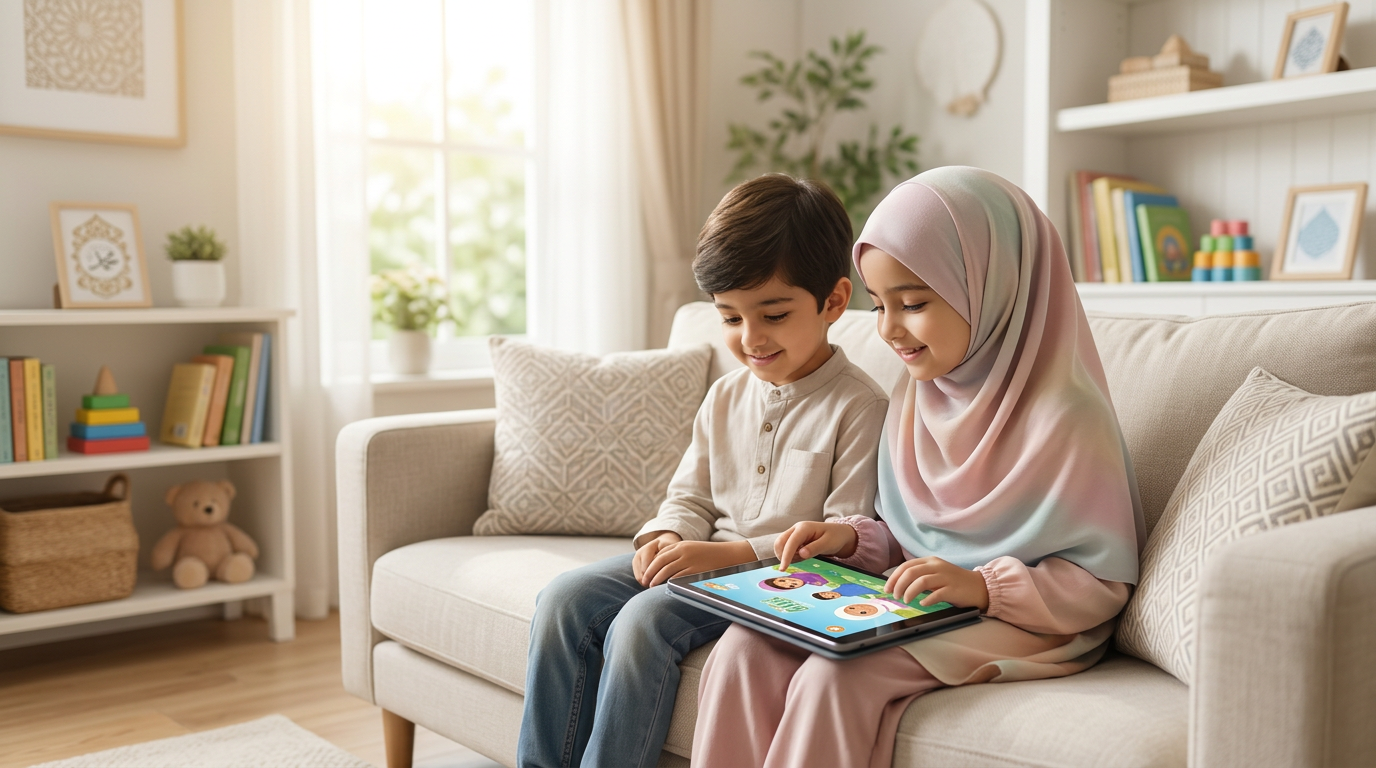
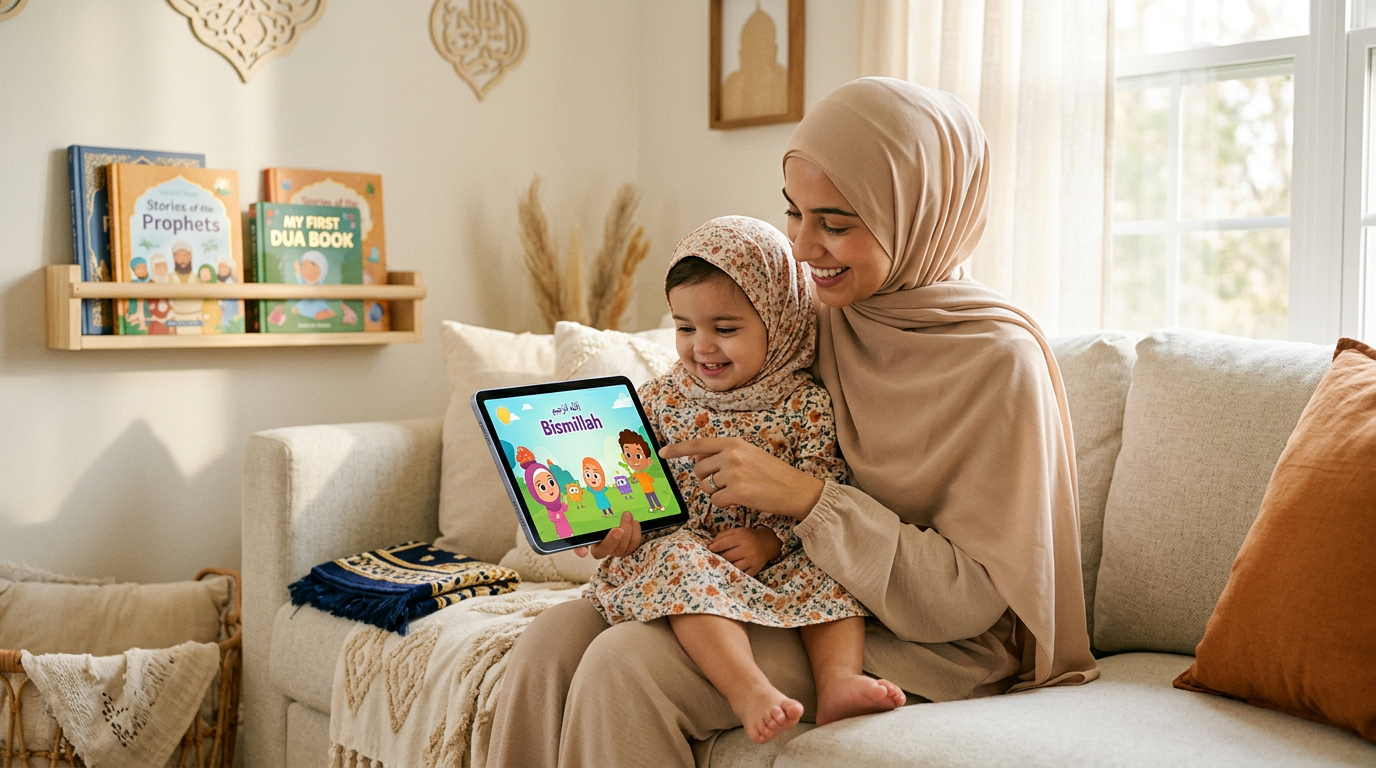
It means you're choosing content that actively reinforces language goals in a way that’s actually fun for your child. For instance, you could watch a beautifully animated story about Prophet Yunus (AS) together and then spend time talking about the "big fish." You could also sing along with an interactive Arabic alphabet song, helping your child hear and practice new sounds. Suddenly, passive watching becomes an engaging, shared experience.
The goal isn't to eliminate screens but to use them wisely. Intentional screen time is a supervised, limited, and purpose-driven activity that complements, rather than replaces, real-world interaction and play.
Choosing Screen Time Aligned with Your Family's Values
When we decide to use screen time as a tool, the type of content matters immensely. Mainstream platforms are built for broad entertainment, not necessarily for a Muslim child's developmental and spiritual needs. Purpose-built platforms offer a focused, safe alternative.
| Feature | Mainstream Platforms (e.g., YouTube Kids) | Halal Platform (e.g., Babymode) |
|---|---|---|
| Content | Algorithm-driven, can contain ads and inappropriate content slips. | Professionally curated, 100% halal, and ad-free. |
| Language Focus | General entertainment, often fast-paced and overstimulating. | Slow-paced, repetition-based, designed for language acquisition. |
| Values | Secular, commercialized themes. | Rooted in Islamic values, stories of Prophets, and duas. |
| Parental Control | Basic filters that can be unreliable. | Complete control in a closed, safe environment. |
By choosing a platform designed for Muslim toddlers, you're not just finding entertainment; you're investing in a safe space that nurtures both their deen and their development. You can find detailed guidance on finding an Islamic perspective on screen time for children aged 0-3 in our dedicated article.
Of course, using technology well also means setting healthy boundaries. Practical steps like setting up parental controls for screen time management are crucial. This empowers you to make technology a helpful tool that serves your family’s needs without ever compromising your values.
Your Questions on Speech Delay Answered
It's completely normal for your mind to be buzzing with questions as you navigate this journey. Those late-night worries and conversations with family naturally bring up a lot of specific concerns. This section is here to give you clear, reassuring answers to some of the most common questions Muslim parents have when it comes to speech delay.
Will Raising My Child Bilingual Cause a Speech Delay?
This is one of the most common worries we hear, and I can tell you with absolute confidence: no. Alhamdulillah, raising a bilingual child is one of the most beautiful gifts you can give them!
Decades of solid research have shown that learning two languages at the same time does not cause or even contribute to a speech delay. In fact, the cognitive benefits that come with being bilingual are enormous.
You might notice your toddler mixing words from both languages—maybe they’ll ask, "Can I have some pani?" This is called code-switching, and it’s a perfectly normal and frankly, very clever part of bilingual development. It’s not a sign of confusion; it’s a sign that their brain is using every single word it knows to get their message across.
Bilingual children hit their communication milestones right alongside monolingual children. Sometimes their total vocabulary is just split between the two languages. So, they might know 20 words in English and 20 in Urdu (for a total of 40), while a monolingual child knows 35 in English. The key is consistent, loving exposure to both languages in your daily life. A good speech therapist who understands and celebrates bilingualism will be a wonderful partner on this journey.
How Can I Find a Therapist Who Respects Our Islamic Values?
Finding a healthcare provider who understands your family’s context is crucial. You need to feel that trust and comfort. Therapy should feel like a supportive partnership, not a source of cultural misunderstanding.
A great first step is to ask for recommendations within your own community. Post in a local Muslim parenting group, ask friends at the masjid, or check with your local Islamic school. Word-of-mouth is often the best way to find someone who’s a great fit.
When you reach out to a potential therapist for that first chat, don’t be shy about asking direct questions. This is your chance to make sure they align with what your family needs.
You could ask something like: "Have you worked with other Muslim families before?" or "Are you familiar with supporting bilingual children who speak Arabic/Urdu?" This opens the door for a real conversation about your values and what you’re looking for.
It's perfectly fine to state your preferences, like requesting a female therapist if that makes you and your child more comfortable. You can also talk about your approach to manners, discipline, or even dietary practices (if food is used in therapy). You'll find that many therapists are incredibly open and dedicated to providing culturally sensitive care that truly helps your child.
My Family Says Boys Talk Later. Should I Be Concerned?
It can be so tough when well-meaning family members—a grandparent, an auntie, an uncle—offer advice that dismisses that nagging feeling in your heart. You’ve probably heard it: "Don't worry, boys just talk later," or "His father was the same, and he turned out fine."
While it’s true that every child develops at their own unique pace, your parental instinct is a powerful gift from Allah (SWT). If you have a persistent feeling that something might be off, it is always wise to trust that instinct.
Getting a professional opinion is never a waste of time. An early evaluation leads to one of two good outcomes:
- Peace of Mind: The specialist might confirm your child is just a "late talker" and give you some simple things to work on at home, which can ease your worries immensely.
- A Plan for Support: If a delay is identified, you get a clear, proactive plan to give your child the support they need right away. That’s the most effective path forward.
You can respond to family gently but firmly: "I really appreciate you sharing that. Just to be sure we're giving him the best support we can, we're going to get a professional opinion." Remember, you are your child's greatest advocate.
Is It Okay to Use an Educational App Before My Child Has a Delay?
Absolutely. Thinking about supportive tools proactively is a fantastic approach. Think of a high-quality educational platform not as a "fix" for a problem, but as a form of enrichment—just like reading books or singing nasheeds together.
The whole point of a platform like Babymode is to offer a safe, positive, and enriching environment right from the start. For babies and young toddlers, it provides gentle, age-appropriate exposure to language, sounds, and foundational Islamic concepts.
When you use a tool like this intentionally, for short and supervised periods, you’re building a foundation of healthy media habits. You’re also introducing vocabulary and Islamic phrases like 'Bismillah' and 'Alhamdulillah' from a very young age, making them a natural part of your child's world. This proactive approach helps you create the language-rich Islamic home that supports every area of your child’s development, insha'Allah.
Are you looking for a safe, halal, and ad-free screen time solution that can support your child's language development? Babymode is designed by Muslim parents for Muslim families just like yours. Our platform turns screen time into a valuable tool for learning, with curated stories, nasheeds, and activities that align with your values.
Join the waitlist for early access and special launch pricing at https://babymode.ai.