The Azan is such a familiar, gentle sound in the middle of a busy family day. It’s that beautiful reminder to pause, and for a moment, everything feels peaceful. The special prayer we say after this call, the dua after Azan, is a simple yet incredibly powerful way to connect with Allah and send blessings upon our Prophet Muhammad (ﷺ).
It’s one of those beautiful little rituals that can turn a fleeting moment into a deeply meaningful one for the whole family, even with a little one toddling around.
What Is the Dua After Azan

When you hear the Azan—whether it’s echoing from a nearby mosque or playing from an app on your phone—it’s an invitation to stop what you're doing. The words you recite afterward aren't just a prayer; they're a quiet conversation with Allah, a way to fill your home with a sense of tranquility and blessings.
For those of us with little ones running around, this moment is a golden opportunity. It’s a completely natural way to introduce them to the rhythm of our faith in a soft, loving, and pressure-free way.
This dua doesn't have to be a complicated lesson for your toddler. Think of it as just a few special words that bring a little calm and connection into your daily routine. By sharing this tradition, even in its simplest form, you're building a foundation of love for Allah and His Messenger (ﷺ) in their little hearts. It's a small act that strengthens the spiritual core of your family.
The Dua in Arabic, Transliteration, and English
Here is the most common and widely shared dua to recite after the Azan. We’ve broken it down to make it easy to learn and understand, with a gentle translation perfect for sharing with young children.
Arabic Text:
اللَّهُمَّ رَبَّ هَذِهِ الدَّعْوَةِ التَّامَّةِ، وَالصَّلَاةِ الْقَائِمَةِ، آتِ مُحَمِّدًا الْوَسِيلَةَ وَالْفَضِيلَةَ، وَابْعَثْهُ مَقَامًا مَحْمُودًا الَّذِي وَعَدْتَهُSimple Transliteration:
Allahumma Rabba hadhihi-d-da'watit-tammah, was-salatil-qa'imah, aati Muhammadan al-wasilata wal-fadilah, wab'ath-hu maqaman mahmudan-il-ladhi wa'adtah.Gentle English Meaning:
O Allah, Lord of this perfect call and the prayer we are about to begin, please give our Prophet Muhammad a special high place and honour, and grant him the praised station that You promised him.
This beautiful supplication is a profound way to affirm your faith and ask for immense blessings. When you recite these words, you're doing a few key things:
- Acknowledging Allah’s Greatness: You start by calling on Allah as the Lord of this "perfect call," recognizing the Azan as a complete and beautiful invitation from Him.
- Honouring the Prophet (ﷺ): You ask Allah to grant Prophet Muhammad (ﷺ) two special things: Al-Wasilah (a specific, high rank in Paradise reserved only for him) and Al-Fadilah (a general rank of excellence and favour above all creation).
- Seeking His Intercession: You end by asking Allah to raise the Prophet (ﷺ) to the Maqam Mahmood (the Praised Station), which is his unique ability to intercede for believers on the Day of Judgment.
By simply reciting this dua, you are taking part in a tradition cherished by Muslims for over 1,400 years and gently passing its light to the next generation.
Why This Dua Is a Treasure for Your Family
In the beautiful rhythm of a Muslim household, the Azan is more than just a call to prayer. It’s a gentle, loving reminder to pause. For just a moment, the world of laundry, feeding schedules, and playtime fades away, replaced by a deep sense of peace.
Reciting the dua after Azan transforms this fleeting pause into a powerful moment of connection for your entire family. It’s a simple act that truly is a treasure.
A Special Window to Allah
This practice opens a special window for communication with Allah. The time between the Azan and the Iqamah is one of those precious moments when our supplications are almost guaranteed to be heard.
More than that, Prophet Muhammad (ﷺ) taught us that reciting this dua earns his intercession on the Day of Judgment—a profound gift for just a few moments of our time.
Filling Your Home with Barakah
When you embrace this practice, you are actively inviting blessings (barakah) into your home and into your child’s life. Think of it as planting a tiny seed of faith in your toddler's heart.
Every time they hear you whisper these words, that seed gets nurtured with love, peace, and the remembrance of Allah. This shared ritual strengthens the spiritual atmosphere of your home, creating a calm and predictable transition in your day. This is especially comforting for young children, who thrive on gentle routines.
This quiet moment shared between you, your child, and Allah becomes a cornerstone of their spiritual upbringing. It’s a simple, stress-free way to nurture their innate connection to their Creator from the very beginning.
A Global Act of Faith
This beautiful practice connects your family to a global community of billions. In the daily rhythm of Muslim life worldwide, making dua immediately after the azan holds deep spiritual significance, fostering a connection to faith from an early age.
Daily prayer is a cornerstone for believers everywhere. A huge number of Muslims pray at least once a day, creating a beautiful, unified act of worship. You can learn more about the religious commitment of Muslims worldwide.
Ultimately, this dua is about so much more than words. It’s about building a legacy of faith and love, one quiet moment at a time. It’s a shared ritual that weaves tranquility and remembrance into the beautiful, chaotic tapestry of life with a toddler.
Gentle Ways to Introduce the Dua to Your Toddler
Teaching your toddler the dua after Azan isn't about rote memorization or getting every word right. At this precious age, it’s all about creating a feeling—a sense of warmth, connection, and love. The real goal is to make this moment feel like a gentle hug from you and a special whisper to Allah, not a formal lesson.
Remember, little ones learn by watching, listening, and playing. Your own calm and loving approach is the most important part. They will absorb the peaceful feeling you model far more than the specific words you say. Let this be a sweet, stress-free time you both cherish.
Start with Simple Sounds and Gestures
For a one or two-year-old, the full dua is a lot to take in. Instead of aiming for the whole thing, focus on creating simple, positive connections they can easily grasp.
- Focus on Key Words: Start by softly emphasizing the most familiar and comforting words. When you recite the dua, gently say "Allah" and "Muhammad (ﷺ)" with a loving tone. These are names they may already be starting to recognize.
- Use Gentle Hand Motions: As you say the words, you can gently bring your hands up into the dua position or place a hand softly on your chest. This simple physical cue helps your toddler connect the sound of the Azan with a specific, calm action.
This approach builds a beautiful foundation. Your child begins to understand that the sound of the Azan is followed by a quiet, special moment with you.
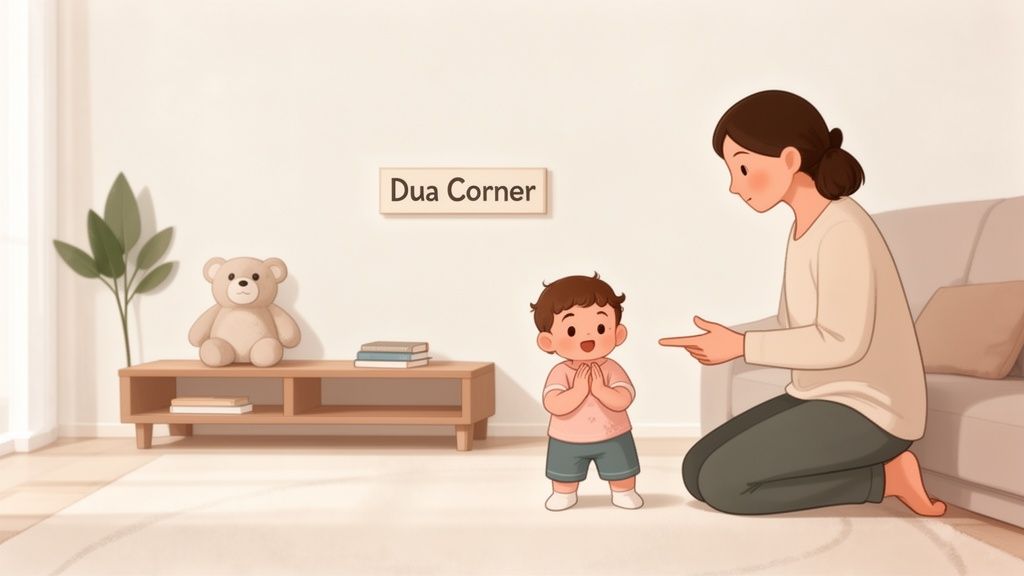
Create a Cozy Dua Corner
Toddlers thrive on routine and predictability. Setting aside a small, calm space just for prayer and dua can make these moments feel even more special and inviting.
This doesn't have to be anything elaborate. It could be as simple as a soft rug in the corner of a room with a few cushions. When the Azan sounds, you can guide your little one to this spot, sit together, and quietly recite the dua. This simple routine helps signal to their developing mind that it’s time for a peaceful activity.
The aim is to build a positive association in your child's mind: Azan means a calm, cuddly moment with Mummy or Daddy. It’s about connection over perfection, every single time.
Make It an Auditory Experience
Young children are sponges for sounds and melodies. Using gentle audio can make learning the dua a more natural and enjoyable process that happens in the background.
- Play a Gentle Recording: Find a calm, clear recording of the after-Azan dua and play it softly after the call to prayer finishes. Your child will absorb the sounds and rhythm naturally over time, without any pressure.
- Use Calming Nasheeds: Many nasheeds for children incorporate simple Islamic phrases. Playing these during quiet time can help familiarize your toddler with the beautiful sounds of remembrance in a fun way.
By weaving this practice into your daily life with gentleness and patience, you're planting seeds of faith that will, insha'Allah, grow and blossom right alongside your child. For more ideas on integrating faith into your daily routines, you might find our guide on how to teach Islam to toddlers helpful. This journey is a marathon, not a sprint, built on small, consistent moments of love.
Making the Dua Part of Your Daily Rhythm
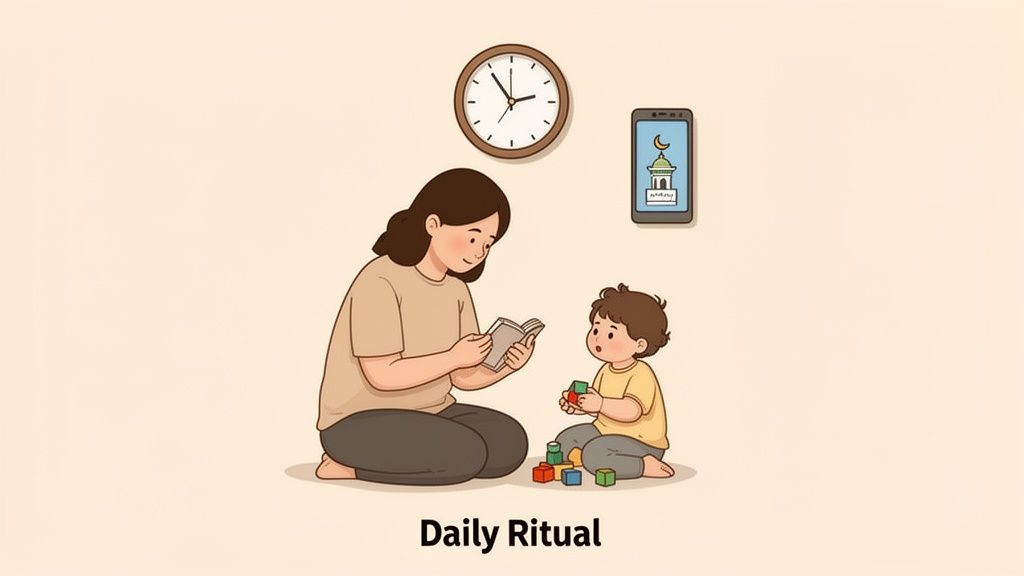
If you're a parent of a toddler, you already know that routine is everything. It's the gentle, predictable rhythm that helps your little one feel safe, secure, and loved. The beautiful thing is that introducing the dua after Azan doesn't have to be a major shift. Instead, it can become another comforting anchor in your day, as natural as a bedtime story or a morning cuddle.
The idea is to gently weave this supplication into the moments you already share. It’s about building a habit that feels organic and joyful, not like a chore. This turns the call to prayer into a brief, shared ritual of peace.
Linking the Dua to Daily Activities
Think about the natural pauses that already exist in your day. The Azan often sounds during transitions—right before a nap, after snack time, or during a quiet moment of play. By connecting the dua to these existing routines, you make it a seamless part of your family’s rhythm.
Here are a few real-life ways this might look:
* Pause and Play: When the Dhuhr Azan sounds, you could pause your block-building for just a moment. Turn to your toddler, smile, and softly whisper the dua before you both get back to it.
* Naptime Connection: Just before laying your little one down for their afternoon nap after Asr, you can recite the dua together. It can become a gentle, calming signal that it’s time to rest.
* Mealtime Blessings: If Maghrib arrives while you're getting dinner ready, the Azan can be your cue to say the dua before everyone sits down to eat.
Consistency Over Perfection
Let’s be honest: life with a toddler is beautifully chaotic. Some days, the Azan will sound right as a drink gets spilled or a tantrum begins. In those moments, remember that your intention is what matters most to Allah.
Even a brief, quiet acknowledgment is incredibly meaningful. If all you can manage is to whisper "Allahumma Rabba..." while comforting your child, that is a beautiful act in itself. This practice is about connection, not a perfect performance.
Making the dua after Azan a family habit is a wonderful way to introduce core Islamic values from the very beginning. For Muslim parents of children aged 0-3, home-based practices like these are especially important for nurturing faith, particularly in Western countries where mosque attendance might not be as frequent. You can read more about the growth of Islam and its community.
Let this simple act be a source of peace, not pressure. With time, your child will come to recognize this quiet moment as a special part of their day with you. This can also be a stepping stone to other simple supplications; for instance, you can explore another powerful prayer with our guide on the dua "Allahumma inni as'aluka".
Common Questions from Muslim Parents
Sharing the beautiful practice of the after Azan dua with a toddler naturally brings up some real-world questions. Life with little ones can be beautifully chaotic, which doesn't always line up with the peaceful ideal we have in our minds. And that's completely okay. Let's walk through some common worries with gentle, practical answers that embrace this special stage of parenting.
The goal here isn't perfection; it's all about intention and connection. Allah (SWT) sees the challenges you face and knows the sincerity in your heart.
What if my toddler has a meltdown during the Azan?
This is probably the most common concern, and the answer is simple: your child always comes first. If the Azan begins and your toddler is upset, crying, or needs you urgently, your priority is to comfort them. A calm, secure child is far more important than reciting a prayer at that exact second.
Remember, Islam is a faith built on ease and mercy. Tend to your little one, soothe their tears, and then, once things are calm again, find a quiet moment to recite the dua. Allah knows your intention was to answer the call, and He sees your compassion as a parent.
Does my pronunciation have to be perfect?
So many parents worry about this, especially if Arabic isn't their first language. While striving to pronounce the words correctly is a wonderful goal, it should never become a source of stress or stop you from making the dua altogether.
Allah looks at the sincerity in your heart, not the perfection of your tongue. Your effort to remember Him and honor the Prophet (ﷺ) is what truly matters. Recite it with love and to the best of your ability—that is more than enough.
What happens if we are busy and miss it?
Life with a child between 0-3 years old is nothing if not unpredictable. You might be driving, in the middle of a diaper change, or cleaning up a spilled snack when you hear the Azan. If the moment slips by, please don't let guilt creep in.
The beauty of this practice is its gentleness. If you miss reciting the dua right after the Azan, you can simply say it as soon as you remember and have a moment to yourself. The whole point is to build a consistent, loving habit, not to create a stressful obligation. Every single effort you make is seen and valued.
How Safe Screen Time Can Support Islamic Learning
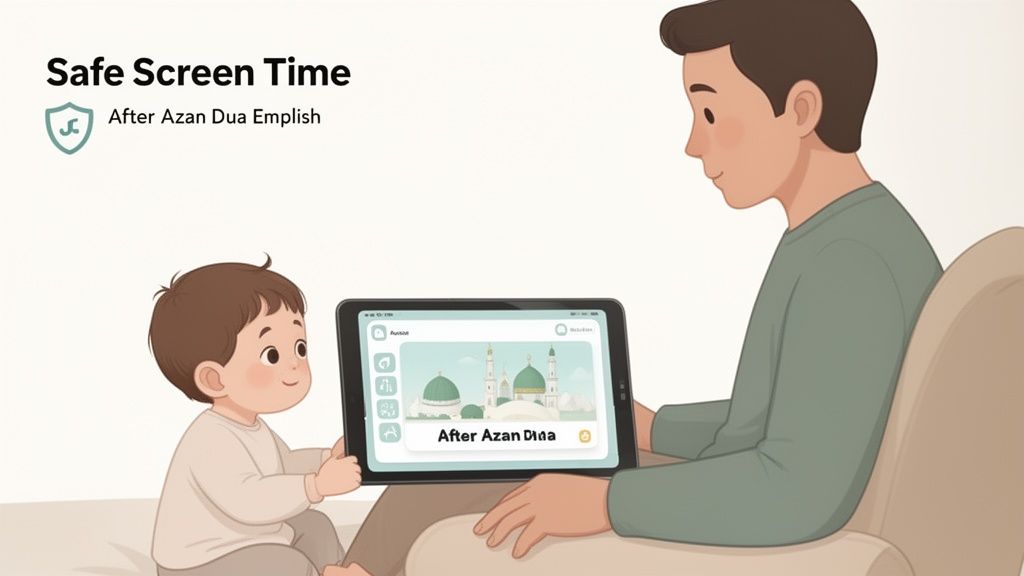
Let's be honest: in a world full of screens, it can feel like a constant battle to find content that matches our family’s values. But when chosen carefully, screen time can actually become a wonderful ally in your parenting toolkit, especially for introducing sacred practices like the after Azan dua.
The key is to find a safe digital space where Islamic values are nurtured, not drowned out. This is where curated platforms designed for Muslim families really shine, offering a peaceful alternative to mainstream apps filled with ads and unpredictable algorithms.
A Halal and Calm Digital Environment
Platforms like Babymode are built from the ground up with Muslim parents and toddlers in mind. They offer a completely ad-free, calm environment where little ones can see positive Islamic concepts brought to life in a gentle, visual way.
Instead of hyper-stimulating cartoons, they can watch a sweet animation about daily duas or listen to soothing, instrument-free nasheeds. This approach helps ensure that screen time is a complementary part of your child’s Islamic upbringing, not a distraction from it.
By choosing a safe, halal platform, you are protecting your child’s innocence while gently familiarizing them with the beautiful sounds and ideas of their faith, including the peaceful moment after the Azan.
The global Muslim population is growing, projected to exceed 25% of the world by 2025, which thankfully means we're seeing a greater demand for high-quality, faith-aligned media. For parents of young children, having access to ad-free apps that model positive behaviors—like reciting the after Azan dua—is a game-changer. It helps us thoughtfully counter the often-unpredictable nature of mainstream digital platforms.
When we use these modern tools mindfully, screen time can absolutely support our parenting goals. It can help nurture a child's natural love for their deen in a positive, age-appropriate way. For more ideas, feel free to check out our list of the best Islamic apps for kids.
Answering Your Questions About the Dua After Azan
Let's clear up some of the common questions parents have when they start sharing the dua after Azan with their little ones. Think of this as a friendly chat, from one parent to another, grounded in the beautiful, messy reality of life with a toddler.
When exactly do I recite the dua?
The best time is right after the Muezzin says the very last words of the Azan. This is that perfect, quiet moment to connect.
But we all know life with a toddler doesn't always offer perfect, quiet moments! If your little one needs you right then and there, absolutely tend to them first. Your role as a compassionate parent is its own beautiful form of worship. Recite the dua as soon as things calm down. Allah (SWT) sees your intention, and that’s what matters most.
Are there different versions of this dua?
Yes, you'll sometimes hear slightly different phrasings or see people adding other personal supplications. That's perfectly normal. The version we've shared in this guide is the most common one, directly from the teachings of Prophet Muhammad (ﷺ) and widely considered authentic.
The heart of the dua is always the same: praising Allah and asking for the Prophet (ﷺ) to be granted a special, honored station. Stick with the version you know and are comfortable with. When teaching a child, consistency is far more important than minor differences in wording.
The real goal here is to build a loving, consistent habit. Whether you use the most common version or a slight variation, it's the sincerity and peace you bring to that moment that truly connects with your child.
What if my toddler gets fussy when I’m reciting it?
Welcome to parenthood! This is not just normal; it's expected. We're aiming for gentle, positive exposure, not perfect, silent recitation from a two-year-old.
If your child is having a wiggly or fussy moment, try one of these approaches:
- Pull them into a gentle hug and whisper the dua softly in their ear.
- Let them simply watch you as you calmly raise your hands and say the words.
- Even just reciting it quietly to yourself while you soothe them is a win.
Allah (SWT) knows the nature of small children. Your patient, consistent effort is what counts. You’re modeling a beautiful, peaceful practice for them, and that's a powerful lesson in itself.
Ready to turn screen time into a positive, faith-building experience for your little one? Babymode offers a safe, ad-free world of Islamic learning designed for children aged 0-3.