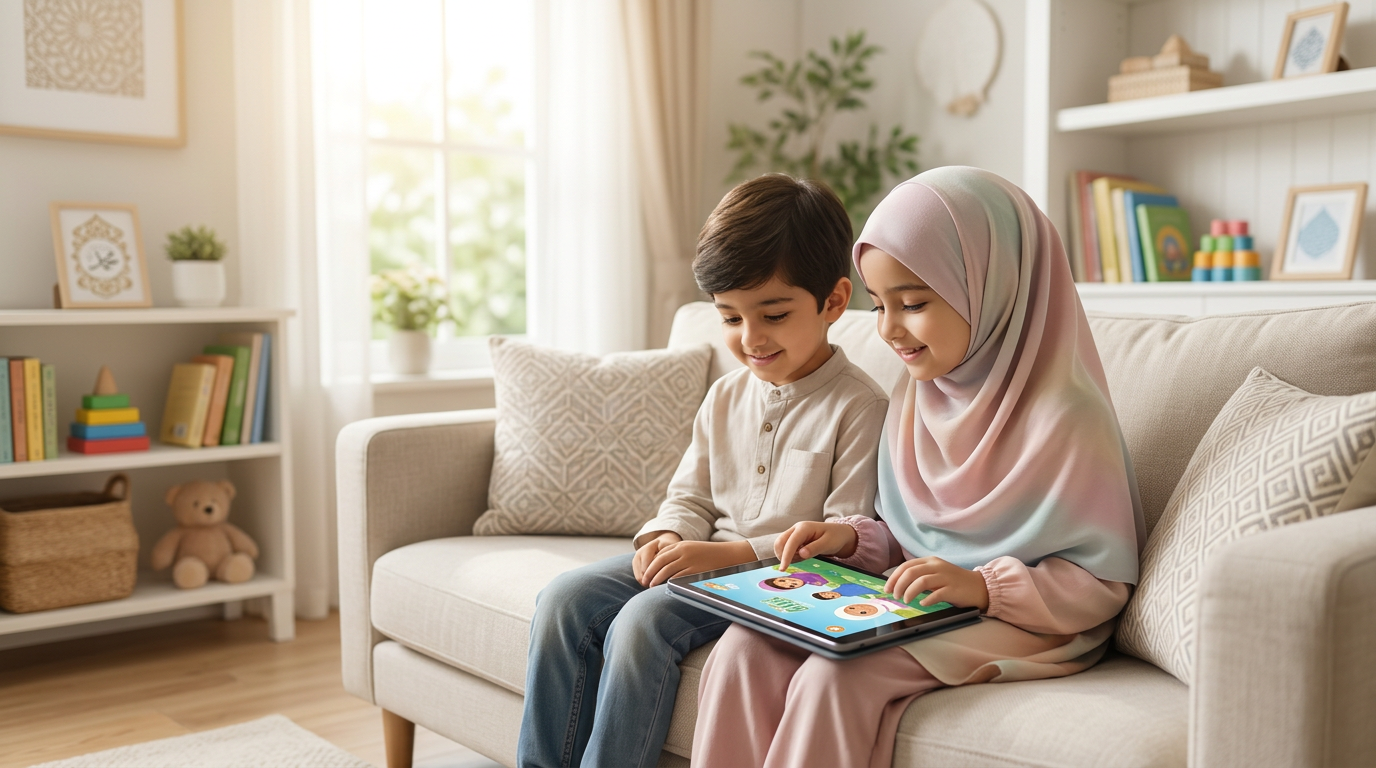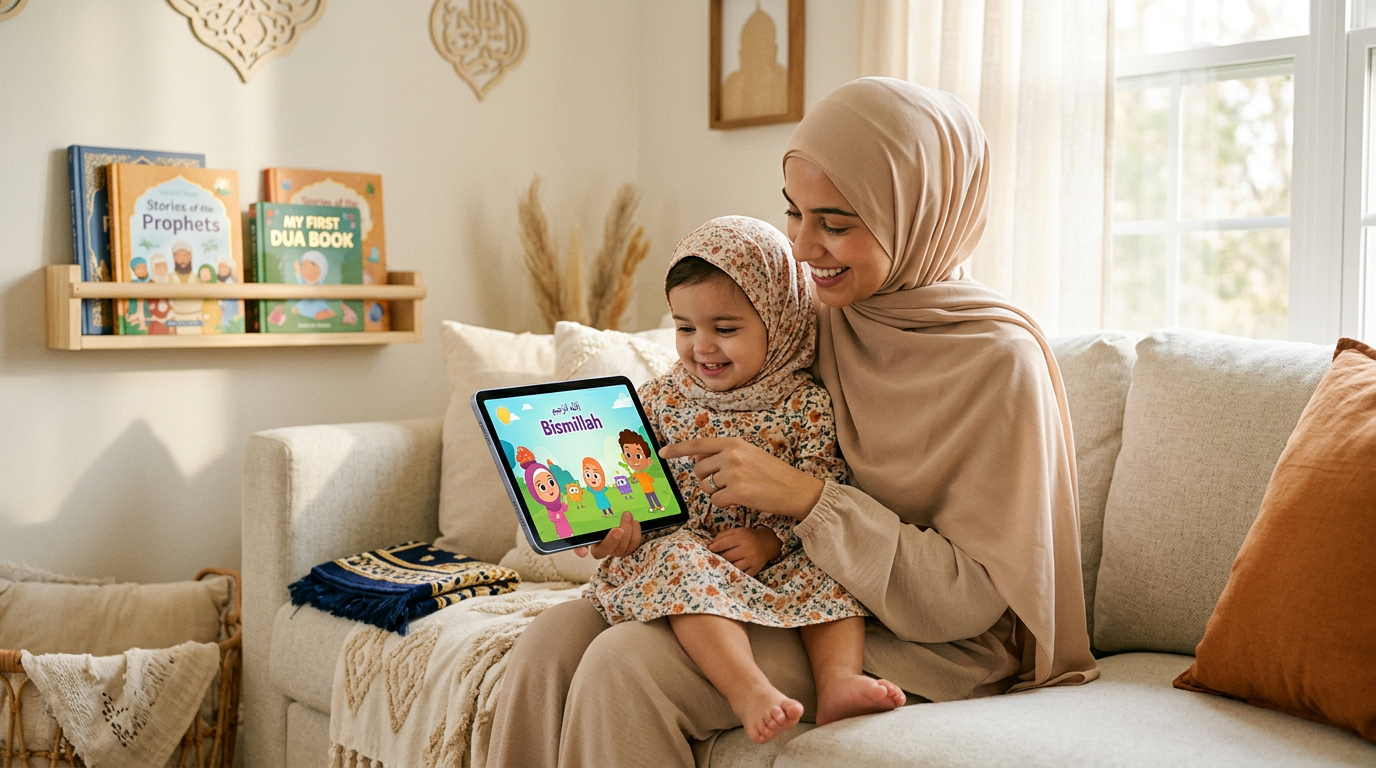
As a parent to a little one, you've likely seen classic paper flashcards—a simple picture on one side, a word on the other. Online flashcards take that same idea and bring it to life on a screen, designed specifically for a young child's curious mind. But are they right for your family's routine and values?
Understanding Digital Flashcards in a Muslim Home
Think of digital flashcards as an interactive update to the paper ones many of us grew up with. Instead of just showing your toddler a static picture of a cat, an app can show the image, say the word "cat," and even play a "meow" sound. This multi-sensory approach helps little ones connect images, sounds, and words all at once.
This interactivity is what sets them apart. While there's no substitute for hands-on learning with physical cards, digital versions offer unique advantages. For busy Muslim families juggling prayer times, meal prep, and the beautiful chaos of daily life, a quick, focused session with a good educational app can be a gentle way to introduce new ideas in a format that naturally captures a toddler's attention.
More Than Just a Toy
It's completely normal to be cautious about screen time—and it's important to be intentional. The idea isn't to replace precious one-on-one interaction, but to add another helpful resource to your parenting toolkit. Think of a well-designed flashcard app less like a passive cartoon and more like an interactive storybook you can explore together.
There's a reason these tools are so popular. Toddlers between 1 and 3 years old are in a phase of incredible brain development, and they represented 51% of the $54 billion global educational toys market in 2023. That number is only expected to grow, which shows just how much parents are looking for tools that support early learning. You can see more on this trend over at Grand View Research.
The key is intentional use. When chosen carefully, online flashcards become a way to introduce concepts—from the English and Arabic alphabets to animals mentioned in the Quran—in a way that feels like gentle, shared discovery.
Ultimately, seeing online flashcards for what they are—a tool—is the first step. You can learn more about how flashcards support early development in our article on the basics of flash cards. By finding options that are safe, ad-free, and in line with your faith, you can make sure that even a few minutes of screen time are meaningful and aligned with your family’s values.
Finding Halal and Toddler-Safe Digital Flashcards
When you're looking for online flashcards for your little one, it’s about so much more than just finding the app with the cutest animals. For Muslim families, the digital spaces our children explore are an extension of our homes. We want them to be safe, peaceful, and in line with our values, making sure every tap and swipe helps nurture their fitrah (their pure, natural disposition).
This means we have to be a bit more selective. We're looking for tools that not only teach but also protect, giving us total peace of mind when we hand over our phone or tablet for a few minutes.
The market for toddler learning is huge—we're talking billions of dollars. And toddlers make up a massive slice of that pie.
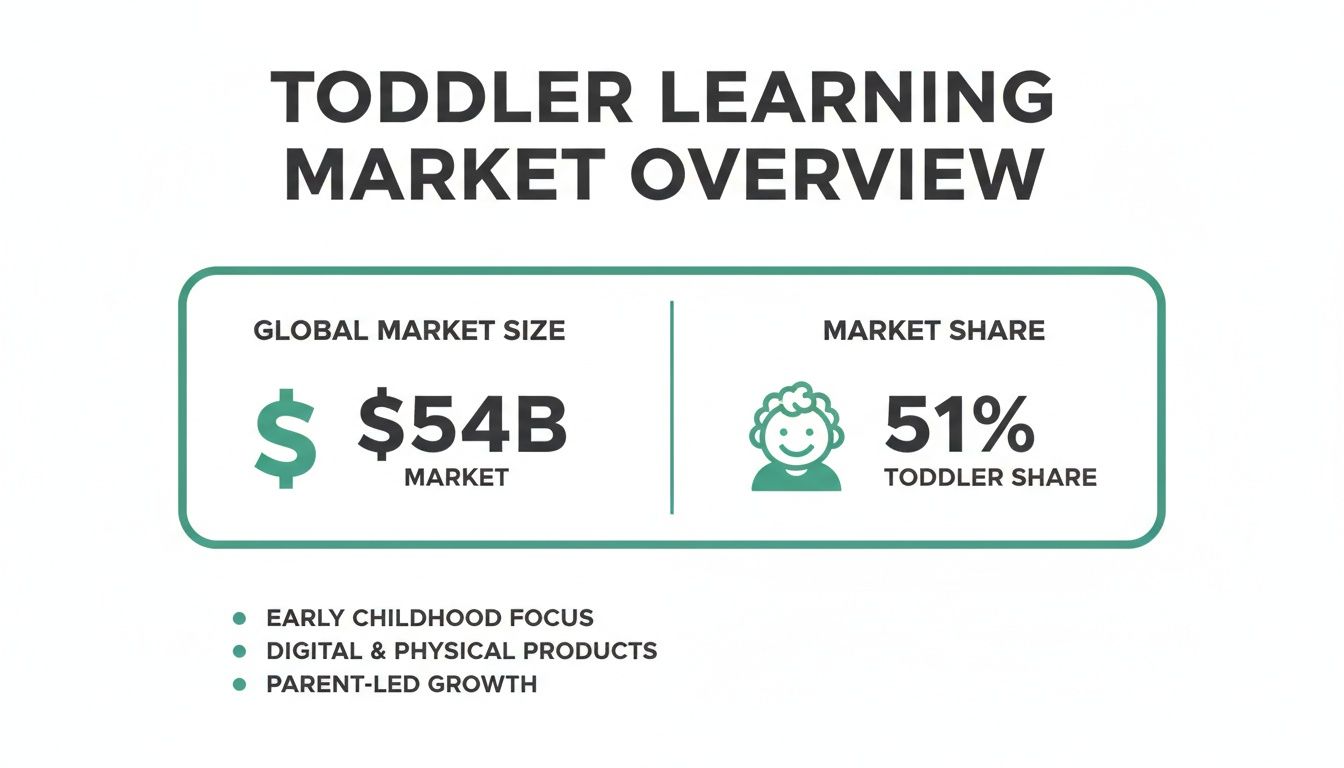
This just goes to show how many options are out there. Our job as parents is to find those few gems that were built with genuine care and safety in mind.
Your Non-Negotiable Checklist
Before you let any app into your child’s digital life, it needs to pass a basic safety check. Think of these as the absolute must-haves for any Muslim household.
Completely Ad-Free: This is my number one rule. An ad-free app means no surprise interruptions from toy commercials or, worse, inappropriate content. Your child's learning journey shouldn't be a billboard for someone else's product.
Simple, Calm Interface: A lot of kids' apps are intentionally over-the-top with flashy graphics and loud noises designed to hook them. Instead, look for clean, minimalist designs that keep the focus on learning. A calm interface leads to a calm toddler, which is something we all want.
Robust Privacy Policy: Who is seeing your child's data? A trustworthy app will have a clear, easy-to-understand privacy policy that promises they will never sell your data. Your family's privacy is not negotiable.
Getting these basics right is the first step to creating a digital "safe space" for your child to learn and grow.
Prioritizing Faith-Aligned Content
Once you've covered the safety essentials, the next step is to look at the content itself. Does it reflect the values you're teaching at home? A truly halal-aligned platform isn't just a standard app with a few Islamic images tacked on; it’s built from the ground up with a Muslim child's heart and mind as the blueprint.
The most reassuring options are those where every single piece of content—from the image of an apple to a nasheed about saying Bismillah—has been thoughtfully created and reviewed through an Islamic lens. This ensures that the learning journey supports their spiritual and moral development from the very beginning.
To help you sort through the options, here is a quick table highlighting what to prioritize.
Essential Features for a Toddler-Friendly Halal App
| Essential Feature | Why It Matters for Muslim Families | What to Look For |
|---|---|---|
| Integrated Islamic Concepts | Learning about Islam should feel as natural as learning colors and shapes. | Flashcards for the Arabic alphabet, numbers, simple duas, and stories of the prophets. |
| Positive Behavior Modeling | Digital tools should reinforce the good manners (adab) we teach at home. | Content that gently illustrates sharing, kindness, and respecting elders. |
| Bilingual & Cultural Support | Connects children to their heritage and the language of the Qur'an from day one. | Apps offering both English and another language, like Arabic, Urdu, or Malay. |
| Wholesome Representation | Ensures all visual and audio content is modest and free from problematic themes. | Look for characters in modest dress and an absence of music with instruments. |
Choosing an app with these features means you’re not just downloading an educational tool. You're inviting a partner into your home that supports the beautiful Islamic foundation you're working so hard to build for your child.
Boosting Your Toddler's Developmental Milestones
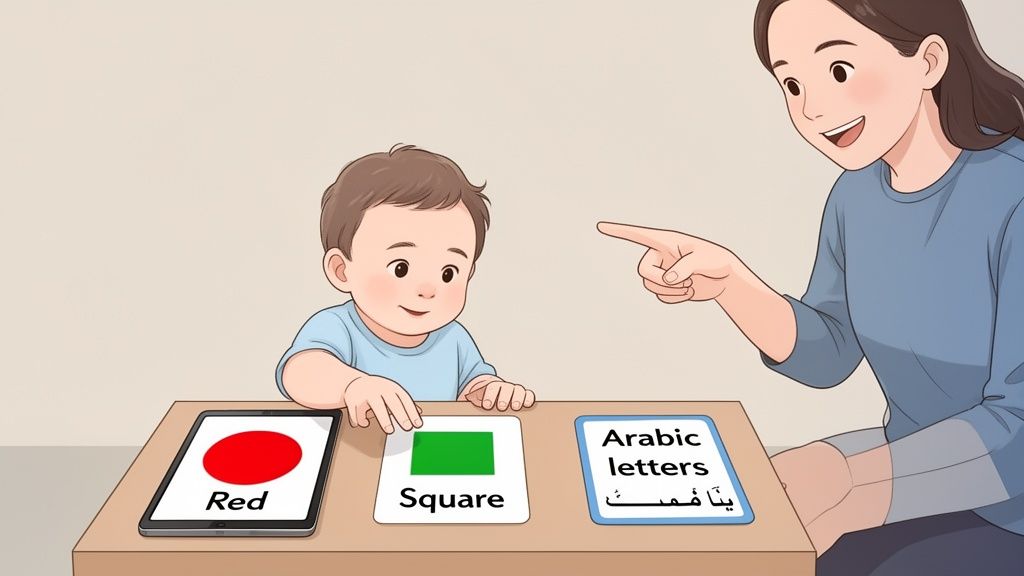
When we use them with a bit of thought and care, online flashcards can be a wonderful tool for supporting those big developmental milestones. It helps to think of them not as a substitute for real-world play, but as a shared activity—a fun few minutes you spend together exploring new words and ideas. After all, every new word is a building block for your little one's future.
These digital tools are fantastic for vocabulary development. For a toddler, seeing a picture, hearing the word spoken clearly, and maybe even hearing a related sound (like a moo for a cow) creates a powerful mental link. This multi-sensory approach is just how their little brains are wired to learn, helping them pick up new words much more quickly.
This is especially true when you start introducing bilingual concepts. Hearing the Arabic alphabet with clear, perfect pronunciation or learning simple Islamic phrases alongside their English words lays a beautiful foundation for a lifelong connection to the language of the Quran.
Nurturing Early Connections to Faith
Beyond just letters and numbers, faith-centered online flashcards can introduce Islamic ideas in a way that feels completely natural and joyful for a toddler. It’s all about planting the first, gentle seeds of faith in their hearts.
Think about these simple, sweet moments:
- Connecting to Allah's Creation: Your child sees a stunning picture of a mountain or a buzzing bee while hearing the word "Allah." This builds an early, positive connection between the Creator and the amazing world He has made.
- Introducing Core Concepts: A flashcard might show a child sharing a toy, paired with the word "kindness." This simple visual story backs up the good manners (adab) you're already teaching at home.
- Familiarizing with Islamic Words: Hearing words like "Bismillah" or "Alhamdulillah" in a calm, positive setting helps make them a familiar and comforting part of their day-to-day vocabulary.
The goal here isn't to quiz or pressure them. It's about making their first exposure to these beautiful concepts a warm, curious, and shared experience with you. This gentle way of learning ensures that their faith feels just as natural as learning about colors and shapes.
Supporting Cognitive Skills Holistically
Good online flashcards do more than just teach words; they support broader cognitive development. This goes far beyond rote memorization and helps build the foundational skills your child needs to understand and make sense of their world.
Here are a few key areas where they really help:
- Object Recognition: Linking a picture on the screen to a real-world object—like seeing an apple in the app and then pointing to one in the fruit bowl—sharpens their ability to categorize and make connections.
- Concept Development: Simple, focused flashcard sets can introduce fundamental concepts like colors, shapes, and sizes in an engaging, repeatable format that toddlers just love.
- Listening and Attention: Short, focused sessions encourage your toddler to listen closely to new sounds and words, helping build their attention span in small, manageable chunks.
By weaving these tools into your routine thoughtfully, you're giving your child’s brain another way to make those crucial connections—supporting their growth in language, faith, and understanding, one little tap at a time.
Making Flashcards a Natural Part of Your Muslim Family’s Day
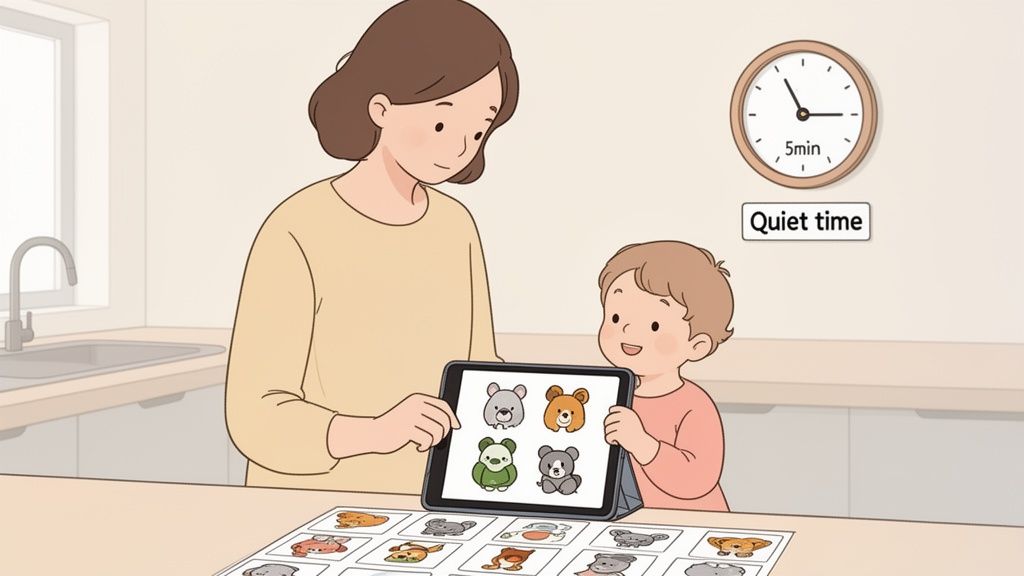
The thought of adding one more thing to your daily schedule can feel impossible, I know. Between prayer times, meals, and the wonderful whirlwind that is life with a toddler, your plate is already full. But using online flashcards for toddlers isn’t about scheduling a formal, sit-down lesson. It's about finding those small, joyful moments that already exist and sprinkling in a little learning.
Forget the idea of a long session that ends in a screen-time meltdown. Think in short, focused bursts. A few minutes here and there is far more effective for a toddler's fleeting attention span and makes learning feel like just another part of their day.
This approach lets you be intentional with screen time. You can introduce a few new words or concepts without disrupting the peaceful, faith-filled rhythm you've worked so hard to create in your home.
Finding Those Perfect Pockets of Time
Your daily routine is already packed with little gaps perfect for a quick, two-minute learning game. The secret is spotting those calm transitions or moments of waiting and turning them into something special.
Here are a few real-world examples that fit beautifully into a Muslim family's day:
* While Dinner Simmers: As the rice is cooking before Maghrib, take five minutes to sit on the kitchen floor together and look at flashcards of animals mentioned in the Quran.
* Quiet Time After Duhr: Right after prayer, when the house is still and quiet, it's a perfect pre-nap activity. Looking at simple colors or shapes can help your little one wind down.
* Waiting in the Car: Instead of just handing over your phone to keep them occupied, open up a flashcard app together while waiting to pick up an older sibling from nursery.
The goal is always connection over content. By sitting with your toddler, making the animal sounds together, and talking about Allah's beautiful creation, you transform screen time into a shared experience that strengthens your bond.
This simple shift in perspective turns online flashcards for toddlers into a tool for bonding, not just a digital babysitter.
From Screen to Real World
To really make the learning stick, you have to connect what your toddler sees on the screen to the world right in front of them. This is the magic step that helps them understand that the pictures and words represent real, tangible things.
For example, after a flashcard session on fruits, make a game of pointing out those same fruits at the grocery store or in your fruit bowl at home. If you just learned the color red, go on a "red hunt" around the house together, finding all the red things you can.
Having a predictable rhythm makes it so much easier to fit these moments in. A broader guide on a stay-at-home mom daily schedule can offer a great structural starting point. For more faith-centered ideas, our post on building a Muslim toddler routine might also be helpful.
It's clear parents are embracing these tools. The global market for educational flashcards hit $1.24 billion in 2024, and with online stores accounting for over 40% of sales, it’s a trend that's here to stay.
How to Choose the Right Online Flashcard Platform
With so many apps out there, picking the right one for your family can feel like a huge task. The secret is to look past the flashy animations and focus on what really matters: the platform's core values and thoughtful design. This approach helps you find a tool that doesn't just teach your toddler but also gives you that priceless peace of mind.
Digital flashcards are quickly becoming a staple in early education. In fact, production is expected to reach 198 million units globally in 2024. This boom really took off during the COVID-19 pandemic when parents everywhere were searching for engaging, at-home learning tools for their little ones.
Mainstream Apps Versus Faith-Built Platforms
One of the first decisions you'll make is whether to go with a mainstream educational app or one designed specifically with Muslim families in mind. Mainstream apps can be fantastic, but they’re built for a massive, general audience. That means you’ll always have to be the gatekeeper, constantly vetting the content to make sure it aligns with your family’s values.
A faith-built platform, on the other hand, is created from the ground up with a Muslim child's spiritual and developmental well-being at its heart. That alone provides a huge layer of reassurance.
When an app is designed by Muslim parents and educators, every detail—from the character illustrations to the background nasheeds—is intentionally chosen to be wholesome and appropriate. This peace of mind is invaluable, as you know the content has already been vetted through a lens of Islamic guidance.
It’s a bit like the difference between shopping at a general supermarket and going to a trusted halal butcher. You can certainly find halal options at the big store, but at the butcher, you know everything meets your standards without having to inspect every single label.
A Practical Checklist for Making Your Decision
As you start exploring different apps, keep this checklist handy. A truly well-designed platform will tick all these boxes, making your choice a whole lot simpler.
Read Reviews from Other Muslim Parents: Check out the feedback in app stores and on parenting forums. Hearing from other families is one of the best ways to get an honest take on whether an app truly delivers on its promise of being safe and Islamically sound.
Check for Offline Access: Life with a toddler is anything but predictable. An app that lets you download content is a lifesaver for long car rides, waiting rooms, or travel days. You'll always have a trusted activity ready to go, no Wi-Fi needed.
Verify Multi-Device Support: Can you use the app on your phone, your spouse's phone, and the family tablet? Flexible access across multiple devices makes it so much easier to fit learning moments into your daily routine.
Examine the Educational Approach: Does the app have a calm, educational feel, or is it hyper and overstimulating? Good instructional design best practices are crucial for ensuring the flashcards are actually teaching, not just entertaining. For more ideas on what to look for, take a look at our guide on the best Islamic apps for kids.
By being thoughtful and deliberate in your search, you can confidently choose online flashcards for toddlers that will be a positive and enriching part of your child’s early years, inshaAllah.
Answering Your Questions: A Guide for Muslim Parents
It's completely natural to have questions when you're thinking about bringing a new learning tool into your home, especially one that involves a screen. As a Muslim parent, you want to make sure everything aligns with your values and supports your child's fitrah. Let's walk through some of the most common questions we hear, one by one.
At What Age Can I Introduce Online Flashcards to My Baby?
This is a great question, and the answer is all about gentle, shared moments. For the littlest ones—babies under 18-24 months—child development experts generally recommend very limited screen time, if any at all.
When you do decide the time is right, think in moments, not minutes. A short, sweet, high-quality session where you are right there, fully engaged, is what matters most.
- For babies under 2: This might look like just a couple of minutes a day. Picture your baby on your lap, looking at a few simple flashcards of animals or familiar objects together.
- For toddlers aged 2–3: A focused session of 10–15 minutes with a high-quality, ad-free app can fit beautifully into their daily routine without being overwhelming.
The key ingredient here is co-viewing. Your presence turns passive screen watching into an active, bonding experience. You're not just handing over a device; you're exploring a new concept with your child.
How Can I Be Sure the Content Is Truly Halal and Appropriate?
Finding content you can trust is non-negotiable. The best way to get that peace of mind is to seek out platforms designed by Muslim families, for Muslim families. These services are typically built on a solid Islamic educational framework, so the content is vetted from the start.
A good first step is to check the app’s ‘About Us’ page. Who are the people behind it? Are they parents, educators, or scholars who share your values? Be wary of platforms that use algorithms to suggest the next video, as that can easily lead to questionable content. The gold standard is an app that gives you a parent dashboard, allowing you to pre-approve every category and video your child sees. That puts you firmly in control.
Will Digital Flashcards Make My Toddler Addicted to Screens?
This is a real and valid concern. Many apps, especially in the entertainment space, are intentionally designed to be addictive using things like unpredictable rewards, auto-play videos, and over-the-top sounds and visuals.
To avoid this pitfall, stick to purpose-built educational apps. Look for ones that are calm, gentle, and have a clear ending. The session should have a natural start and finish, which teaches your child that this is a structured learning activity, not an endless source of entertainment.
Setting clear boundaries right from the beginning makes all the difference. Try saying something like, "We'll look at five animal flashcards, and then we're all done." Using a timer and staying right there with your child reinforces the purpose of the activity and helps prevent those dreaded screen-time battles.
Are Online Flashcards as Effective as Physical Ones?
It’s not really a question of one being better than the other—they both have unique strengths and actually work wonderfully together. Physical cards are fantastic for hands-on, tactile learning. There’s something special about a toddler being able to touch, hold, and feel a concept in their hands.
But online flashcards bring some amazing advantages to the table. They can provide perfect audio pronunciation, which is a huge help for learning sounds correctly, especially for the Arabic alphabet. Gentle, simple animations can also capture a toddler’s attention and make abstract ideas click in a way a static image can't.
The best approach? A healthy mix of both. Use an online flashcard to introduce a new animal sound or a Quranic word with perfect pronunciation, then reinforce that learning later with a physical card or by pointing it out in a storybook. This combination creates a rich, multi-sensory learning world that nurtures your child’s development from every angle.
At Babymode, we get it because we’re Muslim parents, too. We’re building a halal, ad-free platform from the ground up to give you total peace of mind. Every piece of content is thoughtfully created to nurture your child’s fitrah, with no ads, no algorithms, and no inappropriate surprises—just gentle, faith-centered learning. Join the waitlist to be the first to know when we launch.