In a world of endless, often inappropriate, screen content, finding children learning songs that align with your family's values can feel overwhelming. As a Muslim parent of a baby or toddler, you want to nurture their development with content that is not only educational but also spiritually uplifting. This guide is for you—the parent trying to prepare a meal before Maghrib while keeping your little one engaged, the caregiver looking for a gentle bedtime routine, or the family seeking a safer alternative to algorithm-driven platforms.
We understand the challenge of balancing modern life with our deen. It’s hard to find high-quality, halal-friendly resources that genuinely support early learning without compromising our principles. That’s why we’ve created this practical resource to simplify your search and give you confidence in your choices.
Here, we've carefully curated a roundup of 10 essential categories of songs, from Quranic stories to daily duas, that are perfect for your 0–3 year old. These selections are specifically designed to support language acquisition, build good character (akhlaq), and create a joyful, halal learning environment in your home, inshaAllah. Let's explore how the right children learning songs can become a beautiful part of your family’s daily rhythm, offering peace of mind and meaningful engagement for your little one.
1. Quranic and Islamic Storytelling Songs
Quranic and Islamic storytelling songs transform foundational religious narratives into gentle, melodic experiences for infants and toddlers. These aren't just simple tunes; they are carefully crafted stories that introduce core Islamic concepts, prophetic histories, and Quranic lessons in an engaging, age-appropriate format. This approach helps build a positive, loving connection with faith from the very first months of life.
How It Works for Early Learning
For children aged 0–3, stories are best absorbed through rhythm and repetition. Storytelling songs break down complex narratives, like the story of Prophet Yusuf (AS) or the creation of Adam (AS), into simple, memorable phrases. This method supports early language acquisition by associating new vocabulary with pleasing melodies, making it one of the most effective types of children learning songs for faith-based learning.
Popular examples include character-driven series from trusted creators or the Quran Tafseer for Kids collections. These resources focus on clear, calm vocals and simple animations that capture a young child’s attention without causing overstimulation.
Parenting Insight: Using these songs as part of a daily routine creates a comforting and predictable environment. A gentle song about the Prophet's kindness during playtime or a soothing Quranic story at bedtime helps build a peaceful, faith-centric atmosphere in your home.
Practical Tips for Parents
To make these songs a meaningful part of your child’s day, consider these simple strategies:
- Weekly Repetition: Play the same story song a few times throughout the week. Repetition is key for toddlers to recognize patterns and remember key lessons.
- Visual Pairing: Accompany the song with a corresponding picture book or soft toy. This multi-sensory approach deepens comprehension and engagement.
- Create Bedtime Rituals: A calm, melodic song about a prophet's patience can be a beautiful way to wind down before sleep, associating Islamic teachings with feelings of safety and love. For a deeper dive into this topic, you can learn more about finding quality songs for kids in Arabic.
2. Alphabet and Language Learning Songs
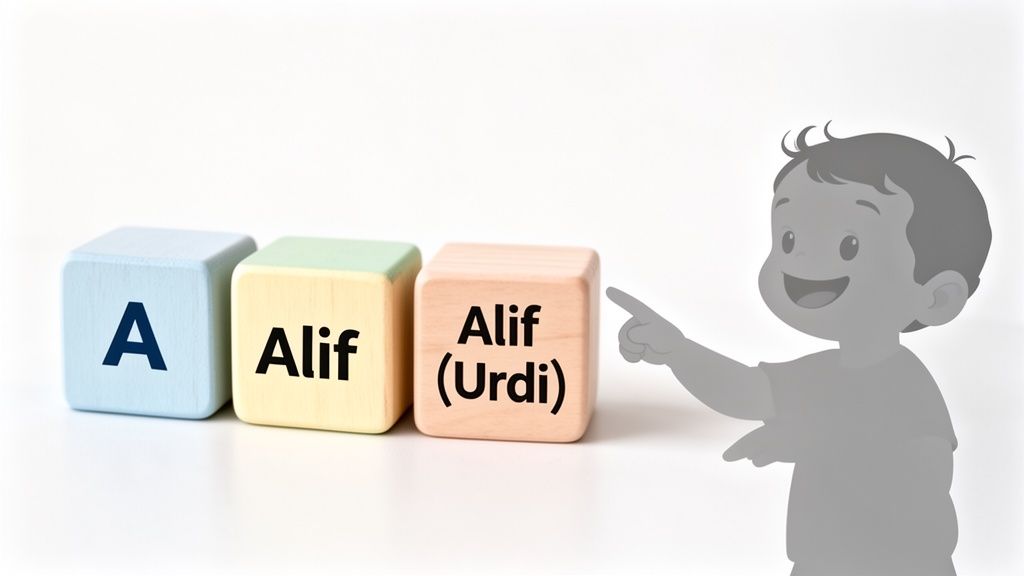
Alphabet and language learning songs are a foundational tool for introducing toddlers to the building blocks of literacy. These songs use catchy melodies and rhythmic repetition to teach letter recognition, phonetics, and basic vocabulary in multiple languages. For Muslim families, this often includes the Arabic Hijaiya alphabet, Urdu script, and the English alphabet, helping to build a rich, multilingual foundation from the earliest years.
How It Works for Early Learning
For toddlers, abstract symbols like letters become meaningful when paired with sound and rhythm. Alphabet songs turn the complex task of memorizing characters into a playful game. By associating each letter with a simple, repeated sound ("Alif is for Allah," "B is for Bismillah"), children begin to form crucial neural connections between the visual shape of a letter and its phonetic sound—a key pre-reading skill.
These types of children learning songs are particularly effective for bilingual development. Resources like Babymode's Arabic Hijaiya learning series and adapted versions of popular English songs focus on clear pronunciation and gentle visuals, making it easier for young minds to absorb and differentiate between languages. This early exposure helps normalise multilingualism within the home.
Parenting Insight: Integrating alphabet songs into playtime transforms a simple activity into a powerful learning moment. Singing an Arabic alphabet song while your child plays with wooden blocks or drawing letters in sand introduces literacy in a natural, stress-free way that feels like part of the fun, not a formal lesson.
Practical Tips for Parents
To effectively use alphabet songs for language development, consider these strategies:
- Tactile Pairing: Combine listening with touch. While an alphabet song plays, encourage your child to trace letters in a sand tray, use magnetic letters on a board, or play with alphabet-themed puzzles.
- Alternate Languages: Dedicate specific times for different languages. For example, use English alphabet songs in the morning and Arabic or Urdu songs in the afternoon to help your child compartmentalise and reduce confusion.
- Focus on Sounds: Emphasise the phonetic sound of each letter, not just its name. Sing along and clearly pronounce "ba" for ب and "buh" for B, helping your child build phonetic awareness for future reading.
3. Duas and Daily Routine Songs
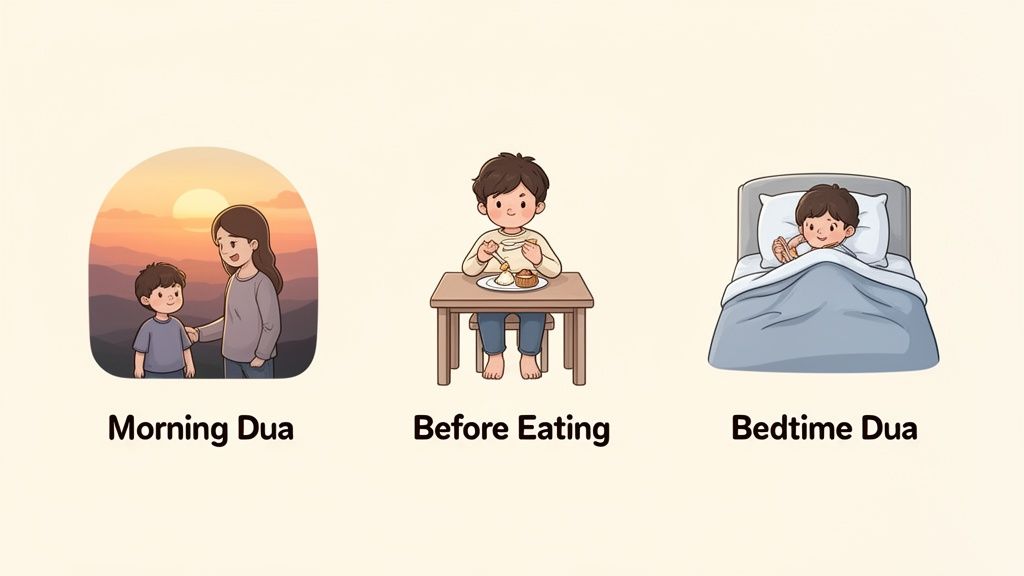
Duas and daily routine songs are designed to weave Islamic supplications and practices into the natural rhythm of a child's day. These melodies transform essential actions like waking up, eating, and preparing for sleep into moments of mindful remembrance. By setting these short, powerful duas to simple tunes, they become an effortless and joyful part of a toddler's life, laying the foundation for a lifelong connection to Allah.
How It Works for Early Learning
For infants and toddlers, learning is deeply connected to routine and context. Hearing a specific song just before mealtime or as they get into bed creates a strong neuro-association between the action and the dua. This method helps internalise Islamic etiquette (adab) naturally, without formal instruction. This makes it one of the most practical types of children learning songs for integrating faith into daily life.
Popular resources from trusted creators excel at this. They use simple, repetitive lyrics and soothing melodies that are easy for young children to recognise and eventually hum along to, familiarising them with Arabic words in a positive and gentle way.
Parenting Insight: Integrating these songs turns mundane tasks into acts of worship. When your toddler hears the "before eating" dua song as you place their plate down, it normalises the practice of beginning with Bismillah, making it an automatic and cherished habit rather than a chore.
Practical Tips for Parents
To effectively use these songs to build beautiful habits, try these strategies:
- Sing in the Moment: Play or sing the relevant dua song at the exact time the action is happening. Consistency is key to building the connection in your child’s mind.
- Model the Behavior: Let your child see you practicing the duas. When they see you put your hands up and hear the familiar tune, they will naturally want to imitate you.
- Use Visual Cues: Pair the songs with simple hand gestures. For example, a gentle "waking up" stretch with the morning dua song helps reinforce the meaning through movement. For more inspiration on connecting songs to Islamic history, discover more about the powerful story of Bilal's call to prayer.
4. Good Manners and Character-Building Songs
Good manners and character-building songs are designed to teach core Islamic values (akhlaq) such as kindness, honesty, and gratitude in a way that is fun and memorable for young children. These songs use simple narratives and catchy, repetitive phrases to model positive behaviours, helping toddlers understand abstract concepts like sharing and respecting elders. This approach lays a gentle foundation for strong moral character from an early age.
How It Works for Early Learning
For children aged 0–3, moral understanding begins with observing and imitating. These songs translate complex ethical teachings into simple, actionable scenarios. A song about saying "Bismillah" before eating or "Alhamdulillah" after a meal connects the action directly to a memorable tune, making it easier for a toddler to adopt the habit. This makes it one of the most practical types of children learning songs for daily Islamic practice.
Popular examples include character-focused series or songs adapted from traditional Islamic stories like Luqman's advice to his son. These resources use clear, positive messaging and relatable characters to demonstrate good conduct.
Parenting Insight: Character-building songs are powerful tools for proactive parenting. Instead of only correcting negative behaviour, you can use these songs to celebrate and reinforce positive actions. Singing a song about sharing when you see your child offer a toy to a sibling helps them associate good behaviour with joy and recognition.
Practical Tips for Parents
To integrate these lessons into your child's daily life, consider these strategies:
- Model the Manners: When a song teaches saying "please" or "thank you," make a point to use those words consistently throughout the day. Your actions will reinforce the song's message.
- Pause and Discuss: Briefly pause a song or video to ask simple questions like, "Was that a kind thing to do?" This encourages early critical thinking about right and wrong.
- Create Positive Routines: Use a song about cleanliness before wudu or a song about honesty during story time. Tying these themes to specific routines helps build consistent, positive habits.
5. Nature and Creation (Allah's Creations) Songs
Nature and Creation songs connect a child’s natural curiosity about the world with the Islamic concept of Allah as Al-Khaliq (The Creator). These songs celebrate the wonders of the natural world—from buzzing bees and colourful flowers to the shining moon and falling rain. By framing these observations within a faith context, they gently introduce toddlers to the idea that every element of nature is a sign of Allah’s magnificent power and wisdom.
How It Works for Early Learning
For children aged 0–3, the world is a place of constant discovery. Nature songs provide the vocabulary to name what they see, hear, and touch, such as animals, plants, and weather. Melodies that describe the seasons or the sounds of different creatures reinforce scientific concepts while simultaneously building a foundation of gratitude and awe for Allah's work.
This category of children learning songs is particularly effective because it bridges abstract faith concepts with tangible, real-world experiences. When a song about rain is followed by a walk outside to splash in puddles, the learning becomes multi-sensory and deeply memorable. Examples like Babymode's upcoming 'Allah's Creation' series or adaptations of classic nature tunes focus on this vital connection.
Parenting Insight: These songs are a beautiful tool for cultivating tadabbur (contemplation) from a young age. Singing about the stars before bed or the birds in the garden encourages your child to not just see nature, but to see the Creator behind it, fostering a lifelong sense of wonder and thankfulness.
Practical Tips for Parents
To make these songs a meaningful part of your child’s development, consider these strategies:
- Go on Nature Walks: After listening to a song about trees or animals, take a walk to your local park or even just your back garden. Point out the things you sang about to make a direct connection.
- Point and Name: During daily routines, use the vocabulary from the songs. When you see a cat, you can say, "Look, just like in our song! Allah made the kitty."
- Create a Nature Journal: For older toddlers, gather leaves, flowers, or draw pictures of what you see on your walks. Play the corresponding nature song while you do this activity together.
6. Nasheeds (Instrument-free Islamic Songs)
Nasheeds are traditional Islamic vocal performances that celebrate faith, history, and values through acapella singing, often without any instrumental accompaniment. For young listeners, these are adapted to be simple, rhythmic, and engaging, transforming spiritual concepts into an accessible musical experience. This approach provides an authentic, faith-aligned alternative to mainstream music, nurturing a child's spiritual connection from an early age.
How It Works for Early Learning
For toddlers, the human voice is a powerful learning tool. The rhythmic and melodic nature of nasheeds helps with language development, memory, and emotional regulation. By focusing solely on vocals and percussion (like hand claps or the duff), nasheeds offer a pure, uncluttered auditory experience that captures a child’s attention without overstimulation.
Popular examples from various trusted creators are designed to be catchy and repetitive, making them effective children learning songs for teaching concepts like the names of Allah, the pillars of Islam, or stories of the prophets in a joyful, memorable way.
Parenting Insight: Nasheeds create a spiritually uplifting atmosphere in the home. Playing an upbeat nasheed during morning playtime can start the day with positive energy, while a softer, more contemplative piece can help calm a fussy toddler before a nap. This helps integrate Islamic remembrance into the natural rhythm of your family’s day.
Practical Tips for Parents
To integrate nasheeds into your child's routine effectively, consider these ideas:
- Start with Rhythm: Introduce upbeat, rhythmic nasheeds first to capture your child’s interest. Clap along to the beat to make it an interactive and playful activity.
- Explore Cultural Diversity: Seek out nasheeds from different cultural traditions, such as Arab, South Asian, or African styles. This broadens your child’s appreciation for the global Muslim community.
- Quiet Time Companions: Use slower, more melodic nasheeds as a backdrop for quiet activities like drawing or looking at picture books. This helps associate a state of calm with spiritual sounds.
7. Number and Math Concept Songs
Number and math concept songs are designed to introduce toddlers to the world of numeracy in a fun, accessible way. These songs break down abstract ideas like counting, quantity, and basic patterns into catchy melodies and simple, repetitive lyrics. By associating numbers with music and rhythm, they help young children build a foundational understanding of mathematical concepts long before they start formal schooling.
How It Works for Early Learning
For toddlers, learning is a sensory experience. Math songs transform numbers from abstract symbols into tangible, audible patterns. Repetitive counting songs help solidify the sequence of numbers one through ten. This method is incredibly effective for early cognitive development, as it builds memory, pattern recognition, and early problem-solving skills, making it a crucial category of children learning songs.
These songs often use familiar objects like fingers, animals, or toys to represent numbers, making the concepts concrete. For Muslim families, this can be beautifully adapted by creating simple songs to count the five pillars of Islam or the number of daily prayers, seamlessly integrating faith with foundational learning.
Parenting Insight: Integrating counting songs into daily routines makes learning feel natural, not academic. Singing a song about counting dates while preparing a snack or counting steps on the way to the park turns everyday moments into powerful learning opportunities that feel like play.
Practical Tips for Parents
To maximize the benefits of these songs, try incorporating them into your child's daily life:
- Use Physical Objects: While singing a counting song, use your child's fingers, building blocks, or pieces of fruit to physically represent each number. This tactile connection deepens their understanding of quantity.
- Routine-Based Counting: Make counting part of your daily activities. Count spoons at mealtime, toys during cleanup, or say "one, two, three, go!" before starting a fun activity.
- Incorporate Islamic Concepts: Gently introduce songs that count up to five, linking them to the Five Pillars of Islam. For example, "One is for Shahadah, two is for Salah..." This builds both numerical and religious literacy.
8. Color and Shape Recognition Songs
Color and shape recognition songs are designed to build a child’s foundational visual discrimination skills. These tunes use simple, repetitive lyrics to introduce basic concepts like colours (red, blue, green) and shapes (circle, square, triangle), transforming a core early learning goal into a fun and memorable activity. By pairing audio cues with visual reinforcement, these songs help toddlers identify and name geometric forms and colours in their everyday environment.
How It Works for Early Learning
For toddlers, learning is a multi-sensory experience. These songs link a catchy melody with specific vocabulary, helping to create strong neural connections. When a song sings “the circle is round,” and a child sees a round object, their brain solidifies the association between the word, the sound, and the visual form. This method is incredibly effective for developing cognitive skills and early vocabulary.
Content from creators of popular English-language learning songs often focuses on bright, clear visuals and gentle repetition, which are ideal for young minds. These resources provide some of the most effective children learning songs for visual development, teaching children to observe and categorise the world around them in a playful, pressure-free way.
Parenting Insight: Integrating these songs into daily life makes learning feel natural, not like a lesson. Pointing out the "red" prayer mat while singing a colour song or finding a "square" Kufic calligraphy frame connects these concepts to their home and identity, making them more meaningful.
Practical Tips for Parents
To maximize the learning potential of these songs, try these simple, interactive ideas:
- Go on a Colour Hunt: While a colour song plays, encourage your toddler to find an object in the room that matches the colour mentioned. This turns listening into an active, physical game.
- Use Coloured Objects: Have a basket of coloured blocks or balls ready during song time. When the song mentions "blue," help your child pick up the blue block.
- Draw and Sing: Get out some crayons and paper. As the song plays, draw the shapes and colour them in together, reinforcing the concepts through creative expression.
- Sort Toys by Colour: After playtime, use a colour song to make tidying up a learning opportunity. Ask your toddler to put all the "yellow" toys in one bin and the "green" ones in another.
9. Body Parts and Physical Development Songs
Body parts and physical development songs encourage active, kinesthetic learning by teaching children to identify parts of their body and explore how they move. These interactive tunes are designed to build body awareness, improve motor control, and develop coordination. They transform learning about the human body into a fun, physical game that gets toddlers moving and laughing.
How It Works for Early Learning
For toddlers, movement is a primary language. Songs that link words like "head," "hands," or "feet" with corresponding actions create powerful mind-body connections. This active participation supports kinesthetic learning and helps children understand their physical capabilities. Such children learning songs are fundamental for developing gross motor skills, balance, and spatial awareness in a playful, structured way.
Well-known examples include adaptations of "Head, Shoulders, Knees and Toes" or movement-based episodes from trusted characters. These songs use simple, repetitive lyrics and clear actions that are easy for young children to follow, encouraging them to jump, clap, and wiggle along.
Parenting Insight: Incorporating these action songs into playtime helps toddlers burn off energy productively and builds their physical confidence. It’s a wonderful way to bond while supporting their developmental milestones, turning a simple song into a moment of shared joy and active learning.
Practical Tips for Parents
To maximize the developmental benefits of these songs, try these simple approaches:
- Active Participation: Get on the floor and do the actions with your child. Your enthusiasm is contagious and models the movements for them.
- Adapt for Routine Care: Sing a simple song about feet and toes during a nappy change or about hands and fingers during bath time to make routine tasks more engaging.
- Modify for All Stages: For a baby who isn't walking, gently guide their arms and legs to the rhythm. For an active toddler, add challenges like balancing on one foot or jumping.
- Celebrate All Efforts: Praise your child’s attempts to move and participate, regardless of how perfectly they perform the actions. The goal is joyful movement, not perfection.
10. Emotion Recognition and Social-Emotional Learning Songs
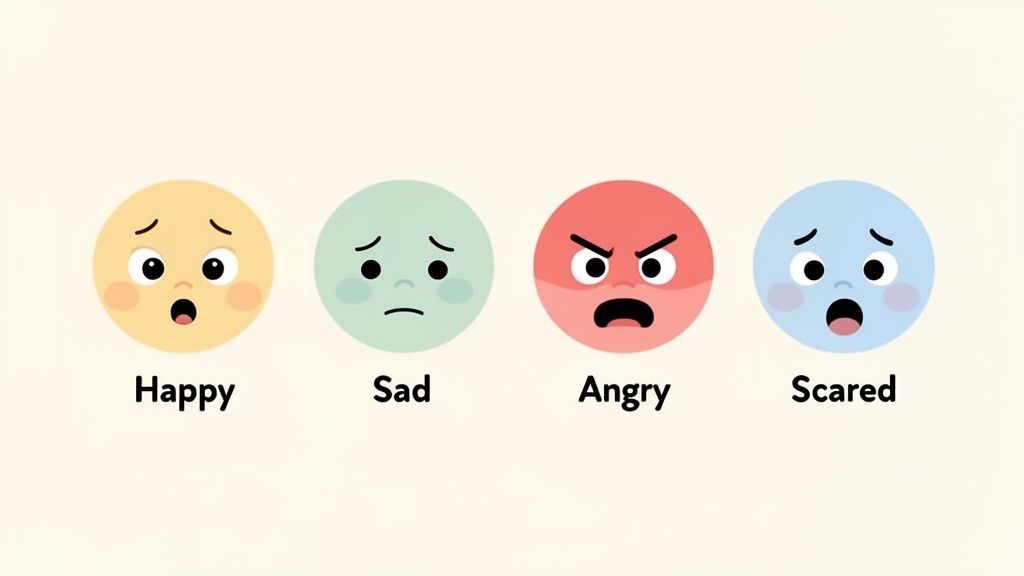
Emotion recognition and social-emotional learning songs give young children the vocabulary to understand their big feelings. These songs are designed to help toddlers identify, name, and express emotions like happiness, sadness, anger, and fear in healthy, age-appropriate ways. From an Islamic perspective, this builds the foundation for developing virtues like patience (sabr) and gratitude (shukr) by validating feelings while guiding behaviour.
How It Works for Early Learning
For toddlers, abstract concepts like emotions become understandable through simple, repetitive tunes. Songs that show a character feeling upset and then finding a calm solution help children connect a feeling to a name and a positive action. This is a crucial type of children learning songs because it supports self-regulation and empathy—key social skills.
Examples range from the social-emotional modelling in popular shows to faith-aligned content that frames these lessons within an Islamic context. These resources use gentle narratives to show that all feelings are okay, but our actions matter.
Parenting Insight: Integrating these songs into daily life helps you become your child’s emotion coach. When your toddler has a tantrum, you can gently sing a familiar line like, "It's okay to feel angry, but it's not okay to hit," connecting their real-world experience directly to the lesson from the song. This validates their feelings while gently reinforcing boundaries.
Practical Tips for Parents
To effectively use these songs for social-emotional growth, try these strategies:
- Talk About the Characters: Pause the song or video and ask simple questions like, "How is the character feeling? He looks sad." This builds emotional vocabulary and empathy.
- Create a Feelings Chart: Make a simple chart with happy, sad, and angry faces. When your child feels a certain way, point to the face and sing a line from a related song.
- Connect to Islamic Virtues: Use songs as a gentle introduction to concepts like sabr (patience) when feeling frustrated or shukr (gratitude) when feeling happy.
- Validate, Then Guide: Acknowledge your child’s emotion first ("I see you are very upset") before guiding their behaviour, just as the songs model. To build on this, you can find helpful activities in our guide to emotions worksheets for preschoolers.
10-Category Comparison of Childrens Learning Songs
| Title | 🔄 Implementation complexity | ⚡ Resource requirements | 📊 Expected outcomes | 💡 Ideal use cases | ⭐ Key advantages |
|---|---|---|---|---|---|
| Quranic and Islamic Storytelling Songs | Moderate–High: scripted narratives + scholar review | Moderate: vocal production, translators, scriptwriters | High: early Islamic identity & Quranic familiarity | Bedtime, heritage-language maintenance, diaspora families | Value-aligned engagement, bilingual exposure, narrative memory |
| Alphabet and Language Learning Songs | Moderate: phonics design + visual syncing | High: clear audio, synchronized visuals, language experts | High: letter recognition & phonetic awareness | Preschool prep, bilingual homes, literacy routines | Accelerates literacy, consistent pronunciation models |
| Duas and Daily Routine Songs | Low–Moderate: short, repeatable phrases with verification | Low–Moderate: vocal tracks, scholar QA, reminder features | High: habit formation & dua memorization | Mealtimes, waking/bedtime routines, practical ritual training | Automatic religious habits, context-based learning |
| Good Manners and Character-Building Songs | Moderate: story-based scenarios + behavior modeling | Moderate: voice actors, scenario writers, multicultural casting | Moderate–High: prosocial behavior & moral vocabulary | Behavior coaching, preschool social skills, family discussions | Teaches practical akhlaq, prompts parent-child conversations |
| Nature and Creation (Allah's Creations) Songs | Moderate: balance science accuracy with theology | Moderate: nature audio/visuals, research input | Moderate: curiosity, environmental stewardship, faith connection | Outdoor exploration, science + faith integration, calming content | Links faith to nature, encourages inquiry and outdoor play |
| Nasheeds (Instrument-free Islamic Songs) | Low–Moderate: vocal arrangements adapted for kids | Low: vocalists, production quality, cultural sourcing | Moderate: cultural appreciation & spiritual familiarity | Prayer prep, family gatherings, cultural heritage moments | Instrument-free authenticity, strong cultural connection |
| Number and Math Concept Songs | Moderate: sequencing + contextual examples | Moderate: visuals, manipulatives, curriculum alignment | High: foundational numeracy & pattern recognition | Counting practice, daily routines, early math readiness | Makes math tangible, bridges language with numeracy |
| Color and Shape Recognition Songs | Low: simple visuals with synchronized audio | Moderate: high-quality visual displays required | High (with visuals): visual discrimination & vocabulary | Art/play activities, sensory learning, early visual skills | Readiness for literacy, easy hands-on pairing |
| Body Parts and Physical Development Songs | Low: action-based design with choreography | Low–Moderate: movement design, caregiver guidance | High: motor skills, body awareness, vocabulary | Active play, gross/fine motor sessions, parent-child bonding | Encourages movement, interactive learning, physical development |
| Emotion Recognition & Social-Emotional Learning Songs | Moderate–High: sensitive scripting + SEL expertise | Moderate: child-psychology input, character-driven media | High: emotional vocabulary, coping skills, empathy | SEL curriculum, family discussions, cultural adaptation settings | Validates feelings, integrates Islamic emotional teachings |
Creating Your Family's Halal Playlist for a Peaceful Home
As we’ve explored the rich landscape of children learning songs, a powerful theme emerges. The sounds that fill our homes are not just background noise; they are the architects of our children's earliest emotional, intellectual, and spiritual worlds. For Muslim families, this isn't about finding a "halal alternative" to mainstream content. It's about proactively and joyfully choosing media that aligns with our core values, nurtures a love for Allah, and makes learning a natural part of our daily rhythm.
You now have a comprehensive toolkit of songs that cater to every aspect of your toddler’s development. We've seen how simple dua songs can transform routines like waking up or eating into moments of mindfulness and gratitude. We've discovered how character-building nasheeds can plant the seeds of kindness, honesty, and empathy in the most receptive of hearts. Each category of song we’ve discussed serves a unique purpose, weaving together to form a beautiful, faith-centric tapestry of early education.
From Information to Implementation: Building Your Daily Rhythm
The real magic happens when these songs move from a list in an article to a living, breathing part of your family’s routine. The key is to start small and be intentional. Overwhelming yourself with a hundred new songs will lead to burnout. Instead, focus on creating curated playlists that serve specific moments in your day. This practical approach transforms an abstract idea into an easy, actionable habit.
Consider these simple starting points:
* The "Morning Rise & Shine" Playlist: Begin the day with uplifting nasheeds about Allah's creation and gentle songs for waking up. This sets a positive, calm tone, replacing the potential chaos of a toddler's morning with peaceful remembrance.
* The "Active Play & Learn" Playlist: During playtime, switch to energetic alphabet, number, and colour songs. Use these tracks to guide your activities, pointing to letters on a playmat or counting blocks as the song plays. This turns passive listening into active, engaged learning.
* The "Calm Down & Wind Down" Playlist: As naptime or bedtime approaches, transition to slow, soothing nasheeds or Quranic stories. This signals to your child's body and mind that it's time to rest, making the transition to sleep smoother and creating a serene atmosphere.
* The "Mealtime Manners" Playlist: A short playlist with a Bismillah dua song and a simple song about sharing can make meal prep and eating a more structured and pleasant experience. It reinforces good adab (manners) in a way that feels fun, not forceful.
Remember, consistency is the cornerstone of building habits. A single, well-chosen song played every day before meals will have a more profound impact than a dozen different songs played sporadically. Your child thrives on predictability, and these audio cues become powerful anchors in their daily life.
The Lasting Impact of Your Choices
By carefully curating your child’s auditory environment, you are doing more than just teaching them colours and numbers. You are laying a foundational understanding of their identity as a Muslim. You are normalising the mention of Allah, the Prophet (peace be upon him), and Islamic concepts in a joyful, age-appropriate context. These children learning songs become the soundtrack to their childhood, a source of comfort, and a wellspring of positive memories they will carry with them for years to come.
In a world filled with overstimulation and content that often contradicts our values, making these conscious choices is a powerful act of love and protection. It allows you to confidently manage screen time, knowing that what your child is absorbing is not only safe but also spiritually and developmentally enriching. This proactive approach empowers you to build a peaceful, nurturing home environment where faith and fun coexist beautifully. May the melodies of learning, gratitude, and remembrance fill your home and your hearts.
Tired of endlessly searching YouTube and vetting content for your little one? Babymode is being built from the ground up to be the single, trusted source for busy Muslim parents, offering a curated, ad-free, and halal library of the very best children learning songs and shows. Sign up to our waiting list and be the first to know when you can finally press play with peace of mind.