In those quiet moments between naps and playtime, many of us are looking for simple, screen-free ways to connect with our little ones. For Muslim families, creating your own words flash cards is a wonderful solution. It’s a gentle learning tool that you control completely, making sure every word and image aligns with the values you hold dear, inshaAllah.
Why Handmade Flash Cards Are Such a Gift for Your Toddler
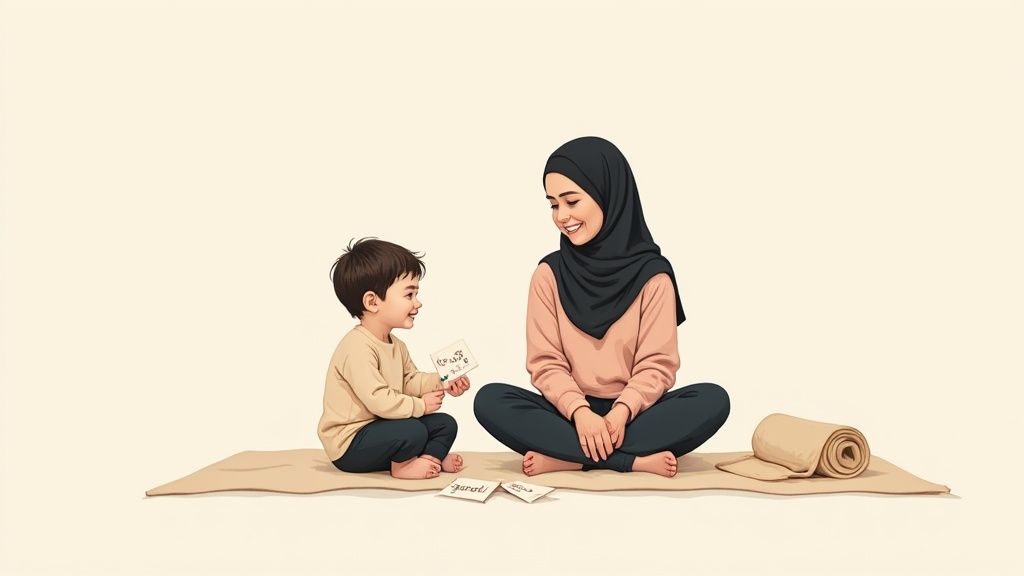
In a world overflowing with digital noise and flashy toys, there's something truly special about making things by hand. DIY flash cards are so much more than a learning game—they're a small act of love. They create a peaceful, focused activity that strengthens that precious bond between you and your child, fitting perfectly into the calm, nurturing home you're building.
When you take the time to create these cards, you're designing a learning experience that's a perfect fit for your family's faith and lifestyle. You get to choose the vocabulary that matters most, from everyday objects in your home to gentle Islamic terms.
Building a Foundation on Connection and Faith
The real magic of handmade flash cards is in their simplicity and purpose. When you craft your own set, you're not just teaching words; you're carefully curating your child’s very first library of concepts. This puts you in the driver's seat, letting you sidestep the inappropriate or overstimulating images often found in store-bought sets.
Instead of generic cartoons, you can fill the cards with words and pictures that reflect your family's identity. This hands-on approach brings some incredible benefits:
- Faith-Aligned Content: You can gently introduce words like 'Allah', 'salam', and 'dua' right from the start, making them a natural and beautiful part of their world.
- Bilingual Beginnings: It's so easy to create cards with both English and another language, like Arabic or Urdu, which helps nurture a deep connection to their heritage.
- Strengthened Bonds: The time you spend together, both making and using the cards, is pure, focused, one-on-one time that builds trust and connection.
- Meaningful Screen-Free Learning: They offer a tangible, engaging alternative to screens, helping you manage screen time without missing out on valuable learning moments.
Flash cards have become a huge part of early childhood education. In fact, the global market for them is estimated to be worth around USD 2.3–3.5 billion in 2024 and is still growing. You can check out industry reports to see just how popular they've become.
By making your own cards, you're turning a popular educational tool into a personal, meaningful part of your daily routine—perfect for those quiet moments after a nap or while waiting for dinner to cook before Maghrib. You can learn more about the fundamentals in our guide on what flash cards are and how they help learning.
Gathering Your Supplies and Choosing the Right Words
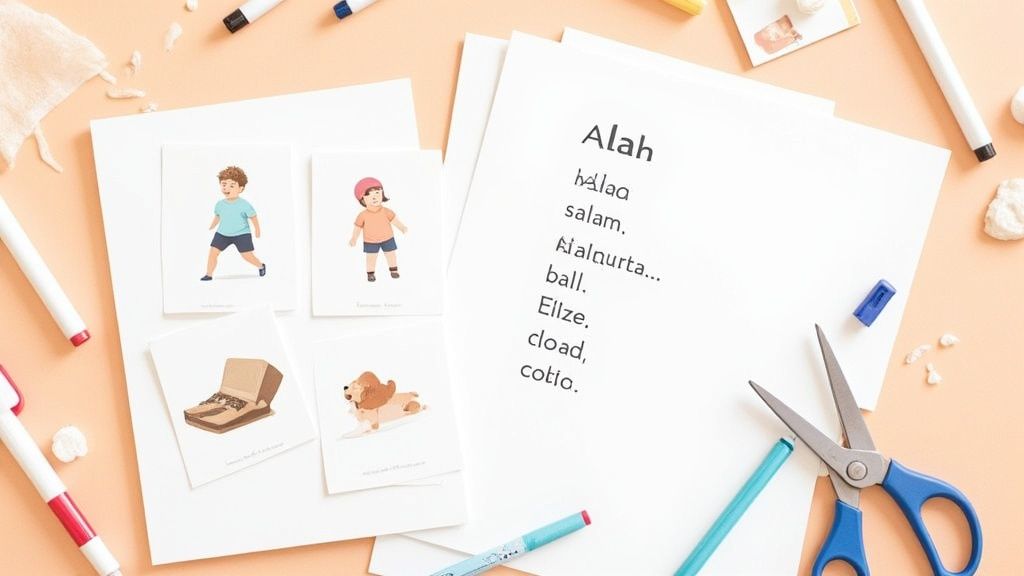
Before you can dive into creating your beautiful words flash cards, you'll need to gather your materials. Think of this as a quiet, calming activity—maybe something to do during nap time or after Isha prayer. The great news is you don’t need a whole craft store to get this done. A few simple, child-safe supplies are all it takes.
Getting everything ready beforehand, just like prepping ingredients for a special meal, makes the whole process smoother and much more enjoyable. Simple, durable materials are key to making sure your flash cards can withstand curious little hands and, let's be honest, probably a bit of drool!
Here's a practical checklist to get you started:
* Sturdy Cardstock: I recommend a thick, durable cardstock—at least 80 lb or 200 gsm. Stick to a light, neutral color like cream or off-white so the words and images really pop for your little one.
* Non-Toxic Markers: Go for bold, black, non-toxic markers. High contrast is incredibly important for developing eyes.
* Child-Safe Scissors: A good pair of scissors is a must. If you have one, a corner rounder is a fantastic extra tool to soften those sharp edges, making the cards much safer for tiny hands.
* Laminator or Clear Contact Paper: This is my secret weapon for making cards last. Laminating them makes them drool-proof, tear-resistant, and super easy to wipe clean after messy playtime.
Selecting Words That Nurture and Grow
Choosing the first words for your flash cards is where the real heart of this project lies. This is your chance to build a vocabulary that genuinely reflects your family’s world, your values, and your heritage. You're not just teaching words; you're creating a rich learning experience that is both developmentally spot-on and spiritually nurturing.
Instead of just sticking to the generic "apple, ball, cat" list, you can intentionally weave in terms that connect your child to their identity right from the start. The goal is to make these words feel just as natural and familiar as 'cup' or 'book'.
Think about the words that are truly meaningful in your daily life. It could be the name of a beloved grandparent, a favorite halal food, or a simple Islamic greeting. This personal touch is what transforms a simple learning tool into a treasured family keepsake.
Remember, the best words are the ones that are relevant to your child's immediate environment and family life. When a toddler sees a card for 'Abbu' and then looks at their father, they make a powerful connection that builds language and strengthens their sense of belonging.
Age-Appropriate First Words for Your Muslim Toddler
To get you started, I've put together a starter list of culturally and faith-relevant words. It combines everyday English with some of the gentle Arabic and Urdu terms you might already be using at home. Don't overwhelm them; just start with a few and gradually introduce more as your child shows interest.
| Category | Age 12-18 Months (Simple Nouns) | Age 18-24 Months (Expanding Vocabulary) | Age 24-36 Months (Simple Concepts & Actions) |
|---|---|---|---|
| Family & People | Mama, Baba, Ammi, Abbu | Sister, Brother, Dada, Dadi | Khala (Aunt), Ammu (Uncle), Baby |
| Faith & Values | Allah, Dua, Noor (Light) | Salam, Masjid, Adhan | Bismillah, Salah, Shukr (Thanks) |
| Food & Drink | Water, Milk, Date, Banana | Pani (Water), Apple, Rice, Bread | Eat, Drink, More, Yum |
| Household Objects | Cup, Book, Shoe, Ball | Chair, Bed, Door, Light | Open, Close, All Done, My Mat |
| Animals (Qur'anic) | Cat, Bird, Ant, Bee | Fish, Camel, Cow, Spider | Hop, Fly, Woof, Moo |
This table is just a jumping-off point. Feel free to swap words in and out based on what feels right for your family. The most important thing is to make learning joyful and meaningful.
Designing and Creating Your Toddler-Proof Flash Cards
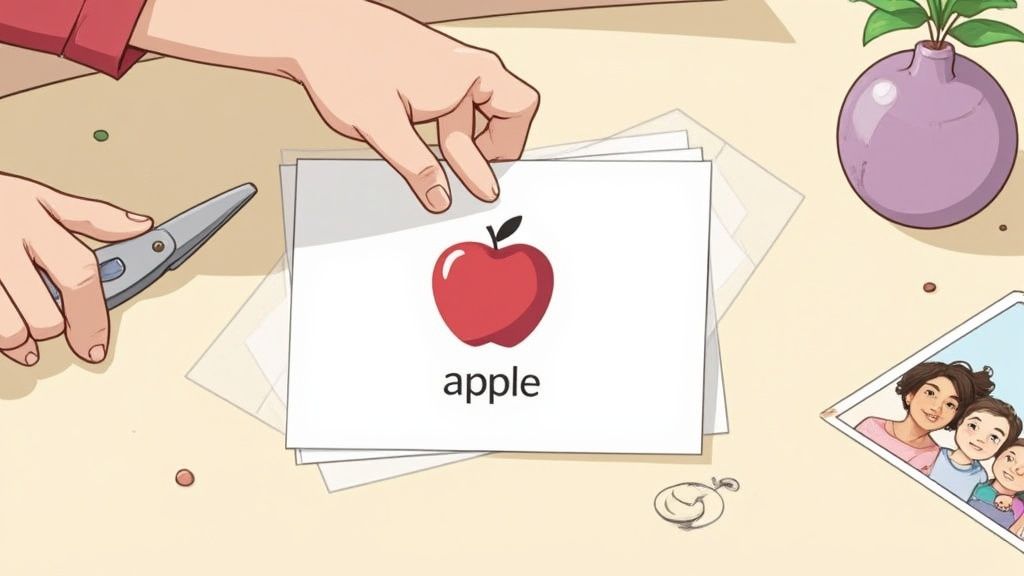
Now for the fun part—bringing your words flash cards to life! This is a lovely, quiet activity you can get lost in during naptime. Or, better yet, you could get an older sibling involved and turn it into a special project together. The whole point is to create something that’s beautiful, functional, and just the right size for your toddler's little hands.
And don't worry, you absolutely don't need to be a graphic designer. When it comes to toddlers, simple is always better. A clean, uncluttered design helps them focus without getting overwhelmed, which is exactly what we’re aiming for.
Simple Layouts for Tiny Eyes
For babies and toddlers, high contrast and clarity are everything. Their developing vision just responds so much better to simple, bold shapes and colors.
- Go with Bold, Lowercase Letters: Most of the text we see every day is in lowercase. Getting them familiar with these shapes early on builds a great foundation for reading. A thick, non-toxic black marker on some sturdy white cardstock is perfect.
- One Idea Per Card: Keep things focused. Each card should have just one word and one image. This helps your child make that direct connection between the picture and the word you're saying, avoiding any confusion.
- Use High-Contrast Images: Simple, clear photos or drawings are your best friend here. Think about it: a bright red apple against a plain white background is so much easier for a toddler’s brain to process than a busy photo of a whole fruit bowl.
If you want more ideas on using colors in learning, our guide on how to name the colors of the rainbow has some great tips.
Adding That Personal, Faith-Filled Touch
This is where your homemade cards can really shine. You get to fill them with images that are deeply meaningful to your family, creating an instant connection for your child.
Try including photos of key family members. A card with a picture of 'Dadi' (paternal grandmother) or 'Khala' (maternal aunt) next to her name is incredibly powerful. It reinforces those precious family bonds and teaches language at the same time.
You can also find simple, child-friendly illustrations of things like a masjid, a prayer mat, or dates for Ramadan. These visuals gently introduce the beautiful symbols of your faith into their vocabulary, making it a warm and familiar part of their world from day one.
A photo of your own family making dua together, placed on a card labeled 'dua,' is infinitely more meaningful than any stock image. It connects the word to a real, lived experience filled with love and security.
Making Them Last Through Toddler Life
Let’s be real—anything you give a toddler is going to be grabbed, probably bent, and most definitely chewed on. So, making your cards durable and safe is non-negotiable. Luckily, it’s easier than it sounds and turns your paper creations into long-lasting learning tools.
Here’s a simple rundown of how to make your cards truly toddler-proof:
- Print or Draw: Get your final designs onto that heavy cardstock you picked out.
- Cut Them Out: Carefully cut each card to a uniform size. I find that a small, handheld size around 4x6 inches is just right for little hands to hold onto.
- Round the Corners: This is a crucial safety step! Sharp paper corners can poke little eyes or hands. A corner rounder tool is fantastic for this, but you can also just use a pair of scissors to gently curve each corner.
- Laminate for Durability: This is the magic touch. If you have a home laminator, run each card through it. If not, clear, sticky-back plastic (often called contact paper) works just as well. This final step makes the cards drool-proof, tear-resistant, and super easy to wipe clean after sticky fingers have had a go.
Taking these extra few minutes will give you a set of high-quality words flash cards that will survive countless play sessions, inshaAllah, and become a cherished part of your daily routine.
Bringing Your Flash Cards to Life with Playful Activities
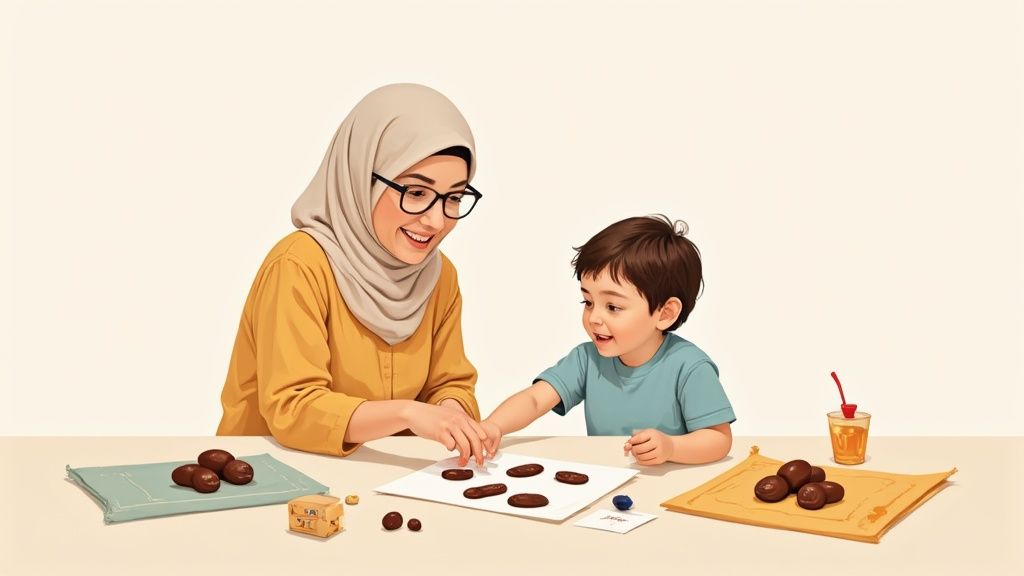
So, you’ve designed, printed, and toddler-proofed your beautiful flash cards. Now for the fun part! How do you actually use them without turning your living room into a classroom? The secret is to think of them less like a test and more like a toy—a starting point for connection and play.
A happy, relaxed toddler is a toddler who’s ready to learn. The goal here is to introduce new words in a way that feels natural, joyful, and completely pressure-free. This approach honors your child's pace and weaves learning into the beautiful rhythm of your daily routine.
Weaving Learning into Daily Rhythms
The absolute best way to use your words flash cards is to link them to what’s already happening around you. This simple act makes the words real and helps your toddler forge powerful connections between a picture on a card and their own world.
Think about the little moments that fill your day:
- During Salah Prep: As you lay down the prayer mat, you could show your toddler the 'salah' or 'masjid' card. A gentle, "Time for Salah," connects the word directly to the action.
- Meal Times: Keep the cards for 'water', 'milk', or 'date' handy. During Ramadan, finding the 'dates' card right before Iftar can become a sweet, calming ritual.
- Getting Dressed: As you’re getting ready to head out, hold up the 'shoe' or 'sock' card. Ask, "Where are your shoes?" and celebrate together when they find them.
By doing this, you're embedding learning directly into your family's life, reinforcing new words in a context that makes perfect sense to a little one.
The most powerful learning happens when a word is tied to a real-life experience or object. When your toddler matches the 'cup' card to their own sippy cup, they aren't just memorizing—they're understanding.
Simple Games for Curious Minds
Once your toddler gets familiar with the cards, you can introduce a few gentle, playful games. The key is to keep these sessions super short—just a few minutes at a time—and always end on a high note before they start to lose interest.
The "Point To..." Game
This is the perfect first game. Just lay out two or three cards on the floor and ask, "Can you point to the cat?" or "Where is the banana?" When they point to the right one (or even just touch it!), shower them with warm, encouraging praise. This simple activity is fantastic for building receptive language, which is their ability to understand words.
The Real-World Matching Hunt
This game turns your home into a little adventure. Show your toddler a card, like 'ball', and say, "Let's go find the ball!" Then, help them look around the room for the real thing. It’s a wonderful way to boost their memory, concentration, and object recognition skills.
These playful interactions do so much more than teach vocabulary. They strengthen your bond and build your child’s confidence in a loving, secure home. While physical cards offer this unique hands-on connection, learning tools are always evolving. The digital flashcard market is growing fast, with some valuing the app market at around $2.0 billion in 2024. You can explore more insights on flashcard tool market trends to see how these are being used, especially by older learners.
Balancing Physical Cards with Mindful Screen Time
Let's be real—screens are a part of modern life. Even with the best intentions, there are moments where you just need five minutes to get dinner ready before Maghrib, and a screen can feel like a lifeline. The goal isn't necessarily to eliminate screens but to use them with intention and care.
This is where your handmade words flash cards really shine. They offer a powerful, screen-free way to connect with your little one in a calm, focused learning environment. By making physical cards the cornerstone of your teaching routine, you stay firmly in the driver's seat of your child’s media consumption.
Using Cards as a Bridge to Better Screen Time
Instead of viewing physical cards and screens as rivals, think of them as partners. Your DIY cards can be a fantastic bridge to more purposeful screen time, transforming a passive activity into an active learning moment.
For instance, before showing your toddler a short, carefully chosen video about animals from the Qur'an, you could introduce the 'camel' or 'bee' flash card first. This simple act primes their brain for what's to come. They've already seen the picture and heard the word from you, their most trusted teacher.
This approach has some wonderful benefits:
- It builds context: The video now reinforces a concept you've already introduced, rather than being an overwhelming new stimulus.
- It sets a purpose: Screen time suddenly has a clear goal, making it a deliberate educational choice instead of just a distraction.
- It keeps you in control: You are the one guiding the learning journey, ensuring the content is always gentle, appropriate, and aligned with your family’s values.
By leading with your physical words flash cards, you establish a strong, tangible foundation for learning. Screen time then becomes a complementary tool you choose to use, not one that dictates your child’s attention.
The global market for flash cards is huge. In North America alone, it was worth around USD 930 million in 2024, with the Asia-Pacific region growing the fastest. This data, detailed in a flash cards market report, shows just how much parents everywhere rely on these tools, both physical and digital.
That’s why finding a healthy, faith-aligned balance is so important for today's families. For more practical advice on this, you might find our guide on Islamic screen time guidelines for your family helpful.
Common Questions from Muslim Parents
Getting started with your own words flash cards is such a rewarding project, but let's be real—questions always pop up. I've been there! So, I've gathered some of the most common concerns I hear from other Muslim parents and answered them based on my own experience raising little ones.
The whole point of this is to make early learning feel gentle and joyful, not like another task on your to-do list. Hopefully, these tips help you navigate this beautiful stage with confidence, inshaAllah.
At What Age Can I Start Using Flash Cards?
This is a great question. You can actually introduce simple, high-contrast image cards to your baby as early as 6 months old. At this stage, it's all about stimulating their developing vision, not about words.
For actual word recognition, the magic window is usually between 12 and 18 months. This is right when their own language skills are starting to take off, making it the perfect time to connect pictures with sounds.
The golden rule? Follow your child’s lead. If they’re curious and engaged, go for it. Just keep it light and playful, and never, ever force it.
How Do I Introduce Arabic or Urdu Words?
If your home is primarily English-speaking, the key is to make it simple and consistent. Just pair the English word with its Arabic or Urdu counterpart. For instance, when you show the card for ‘water,’ you can say, “Water… and in Urdu, we say pani.”
This works beautifully for faith-based words, too. Consistently say ‘Allah’, ‘Salam’, and ‘Dua’ in their proper context. When they hear these words regularly through fun, loving interactions, they’ll build a natural connection to the languages of their faith and heritage.
A gentle, dual-language approach doesn't confuse a child; it enriches their world. It shows them that both languages are a valid and cherished part of their identity.
My Toddler Just Tries to Chew the Cards!
Oh, this is a classic! And it's 100% normal for this age. Mouthing objects is a primary way toddlers explore their world. This is exactly why laminating the cards and rounding the corners is non-negotiable—it's all about safety and making them last.
Think of it as part of the process. Gently guide the card away from their mouth and redirect their focus back to the picture. “Look, a cat!” Of course, always supervise them during playtime and remember to keep the sessions short and sweet.
How Many Flash Cards Should I Show at Once?
With toddlers, less is definitely more. I recommend starting with just 3 to 5 cards in a single session. And keep that session short—a few minutes is plenty. You can do this once or twice a day, maybe during a quiet moment after a nap.
The goal here is positive exposure, not a pop quiz. To keep things from getting stale, try rotating in a new card or two every few days. If you see them getting fussy or distracted, that's your cue to wrap it up for now. No pressure!
Ready to balance hands-on learning with truly mindful screen time? Babymode offers a safe, ad-free digital space where your little one can explore Quranic stories, the Arabic alphabet, and good manners, all aligned with Islamic values. Join the waitlist for early access and special launch pricing at https://babymode.ai.